


8 Wire Mesh Fence
In industrial fluid handling and chemical processing, the structural integrity of filtration systems is as critical as the filtration accuracy itself. While high-precision layers capture microscopic contaminants, they often lack the mechanical strength to withstand high-pressure differentials or turbulent flow. This is where the 8 wire mesh fence—a coarse, high-strength mesh structure—becomes an essential component.
Whether used as a protective outer cage, a support internal core, or a debris shield for sensitive instrumentation, the 8-mesh configuration offers a specific balance of open area and mechanical rigidity. For engineers and procurement teams, understanding the technical specifications and application limits of these components is vital for ensuring the longevity of Wire Mesh Filter Cylinders & Tubes and the reliability of industrial processes.
Understanding the Technical Specifications of 8-Mesh
In the context of industrial wire cloth, the term "8-mesh" refers to the mesh count, indicating there are eight openings per linear inch in both the warp and weft directions. This configuration is categorized as a coarse mesh, typically utilized for primary filtration or structural reinforcement.
Aperture and Open Area
The aperture (the clear distance between two adjacent wires) of an 8-mesh screen depends heavily on the wire diameter selected. For instance:
* Standard Industrial Wire (0.71mm / 0.028"): Results in an aperture of approximately 2.47mm (0.097") and an open area of roughly 60%.
* Heavy Duty Wire (1.0mm / 0.039"): Results in a smaller aperture of 2.18mm (0.086") with an open area of approximately 47%.
For engineers, the open area is a critical calculation. A higher open area minimizes pressure drop across the filter but may compromise the "fence" effect—the ability of the mesh to protect inner layers from mechanical impact or to support the filter medium against collapsing under vacuum or high pressure.
Material Selection: SS304 vs. SS316L
Most industrial 8 wire mesh fence components are manufactured from stainless steel.
* Stainless Steel 304: Suitable for general industrial use, providing excellent strength and basic corrosion resistance in non-acidic environments.
* Stainless Steel 316L: The preferred choice for chemical processing, marine applications, and pharmaceutical production. The addition of molybdenum and lower carbon content provides superior resistance to pitting and crevice corrosion, especially in chloride-rich environments.
The Role of 8-Mesh in Filter Assemblies
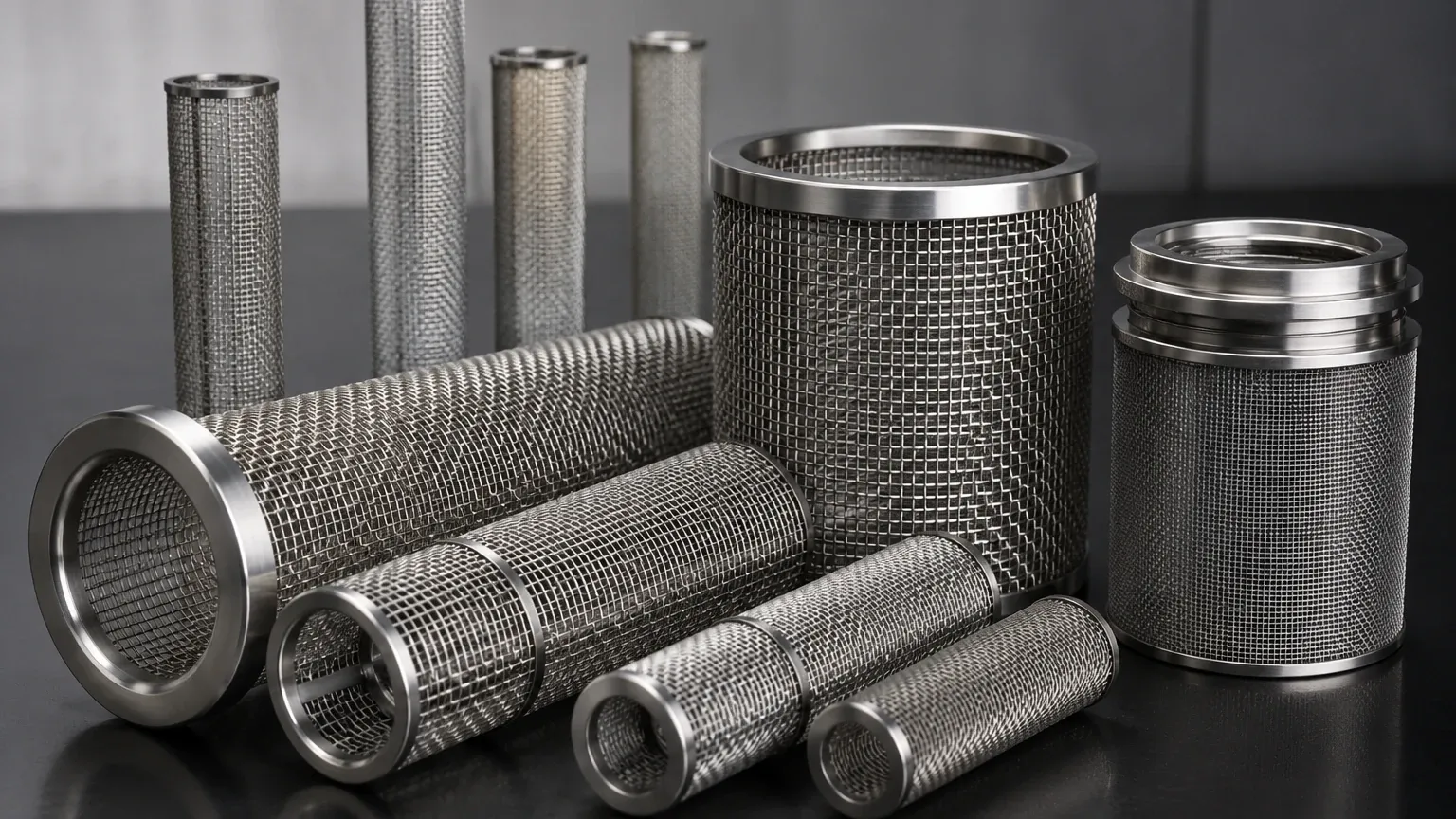
In complex filtration architectures, an 8-mesh structure rarely acts alone. Instead, it serves as the "fence" or skeleton for more complex Wire Mesh Filter Cylinders & Tubes.
Structural Support (The Skeleton)
Fine wire mesh (e.g., 200-mesh or 500-mesh) is inherently flexible and fragile. When fluid passes through at high velocities, the fine mesh can deform. By welding a layer of 8-mesh to the interior or exterior of the cylinder, manufacturers like Kaifil provide a rigid frame that maintains the cylindrical geometry under stress. This is particularly important in backwashing cycles, where flow is reversed to clear the filter; the 8-mesh prevents the fine media from bursting outward.
Pre-Filtration and Debris Shielding
In pump intake applications, an 8 wire mesh fence acts as a primary barrier. It prevents large debris—such as stones, wood chips, or large scale—from entering the system. This protects downstream pumps and finer filter stages from catastrophic mechanical damage. Because the 8-mesh is robust, it can be cleaned mechanically (e.g., with brushes or high-pressure sprays) without the risk of tearing common to finer screens.
Protection for Industrial Level Measurement
One specialized application for the 8 wire mesh fence is the protection of industrial level measurement sensors. In large storage tanks or processing vessels, level sensors (such as radar, ultrasonic, or float-based transmitters) are susceptible to interference from surface turbulence, foam, or floating debris.
Stilling Wells and Sensor Cages
Engineers often design a "stilling well" or a protective cage using 8-mesh. This structure acts as a fence around the sensor probe.
1. Turbulence Reduction: The mesh breaks up large ripples or waves on the liquid surface, providing a more stable "target" for radar and ultrasonic pulses.
2. Debris Exclusion: In float-level systems, the mesh prevents solid objects from jamming the float mechanism, ensuring continuous and accurate readings.
3. Signal Transparency: Unlike solid pipe stilling wells, an 8-mesh cage allows for instantaneous equalization of the liquid level inside and outside the cage, ensuring there is no lag in measurement during rapid filling or emptying cycles.
Selection Criteria for International Buyers
When sourcing 8-mesh components for industrial projects, procurement teams must look beyond the price per square foot. The total cost of ownership (TCO) is driven by the precision of the manufacturing and the quality of the raw materials.
Edge Treatment and Safety
In a B2B environment, the way the mesh is finished is critical. For a cylindrical "fence," the edges should be properly hemmed, bound, or welded to a solid flange. Exposed wire tips in an 8-mesh configuration are thick and sharp; they can damage gaskets, snag cleaning cloths, or cause injury to maintenance personnel. Ensure the supplier provides burr-free finishes and secure seam welds (typically TIG or plasma welding).
Dimensional Tolerances
For Wire Mesh Filter Cylinders & Tubes used in high-precision housings, the outer diameter (OD) and inner diameter (ID) tolerances are tight. An out-of-round 8-mesh cage can prevent the filter from seating correctly, leading to bypass—where unfiltered fluid escapes around the edges of the filter element.
Installation Constraints and Application Risks
Proper installation is paramount to the performance of any mesh fence or filter component. Engineers must account for the following constraints:
Flow Direction and Orientation
If the 8-mesh is intended as a support layer, it must be placed on the downstream side of the fine filter media. If it is intended as a protective fence, it is placed on the upstream side. Incorrect orientation can lead to the fine mesh pulling away from its support, resulting in premature failure.
Galvanic Corrosion
When installing a stainless steel 8-mesh fence into a carbon steel tank or piping system, the risk of galvanic corrosion must be managed. Using insulating gaskets or choosing a mesh material that is compatible with the surrounding metallurgy is essential to prevent the mesh from degrading at the contact points.
Vibration and Fatigue
In high-flow hydraulic systems, constant vibration can cause work-hardening of the wire mesh, eventually leading to brittle fractures at the weld points. Specifying a heavier wire gauge for the 8-mesh fence can dampen these vibrations and extend the service life of the entire filter assembly.
Maintenance and Replacement Cycles
Unlike disposable polymer filters, stainless steel 8-mesh components are designed for long-term reuse. However, they are not "set and forget" components.
* Inspection for Blinding: Over time, particles that are exactly the size of the 2.5mm aperture can become wedged (near-size blinding). Regular visual inspection is required to ensure the open area remains unobstructed.
* Cleaning Protocols: 8-mesh is highly resilient to ultrasonic cleaning and chemical pickling. For food and beverage applications, ensuring the mesh is free of "dead spots" where bacteria can grow is critical. This is why Kaifil emphasizes smooth weld seams and high-quality surface finishes.
* Structural Integrity Checks: During routine maintenance, the mesh should be checked for any signs of "bowing" or broken wires. A single broken wire in an 8-mesh fence can compromise the support for the internal fine-mesh layers, leading to a localized failure of the entire filtration system.
Conclusion: Making the Right Engineering Choice
The 8 wire mesh fence is a foundational component in industrial engineering, providing the necessary bridge between fine filtration performance and rugged mechanical durability. Whether it is shielding a radar level sensor from turbulence or providing the backbone for a multi-layer Wire Mesh Filter Cylinders & Tubes assembly, its selection requires careful consideration of wire gauge, material grade, and manufacturing quality.
For engineers and purchasing professionals, partnering with a manufacturer that understands these technical nuances is the best way to optimize system performance. By specifying the correct mesh parameters and ensuring high-quality construction, industrial operations can achieve higher uptime, more accurate instrumentation readings, and a lower total cost of filtration.
