


8 Mesh Wire
In the landscape of industrial filtration, selecting the correct mesh size is a critical engineering decision that impacts flow efficiency, equipment longevity, and product purity. Among the various specifications available, 8 mesh wire stands as a foundational component for coarse filtration and structural support. This guide examines the technical parameters, material considerations, and application strategies for integrating 8 mesh components into industrial processes, specifically focusing on their role in Wire Mesh Filter Cylinders & Tubes.
Understanding the Technical Specifications of 8 Mesh Wire
The term "8 mesh" refers to the number of openings per linear inch of the wire cloth. In a standard 8-mesh configuration, there are eight wires and eight openings across one inch of the material. However, the performance of the mesh is defined not just by the count, but by the relationship between wire diameter, aperture size, and open area.
Aperture and Wire Diameter
For industrial-grade stainless steel 8 mesh, a common wire diameter is approximately 0.025 inches (0.63 mm) to 0.028 inches (0.71 mm).
* Aperture (Opening Size): With a 0.025-inch wire, the aperture is approximately 0.100 inches (2.54 mm). This allows for the passage of fluids and gases while retaining particles larger than 2,540 microns.
* Open Area Percentage: The open area is a calculation of the ratio of the area of the openings to the total area of the mesh. For a standard 8 mesh wire, the open area typically ranges between 60% and 65%. A higher open area reduces initial pressure drop but may compromise the mechanical strength of the mesh under high-pressure differentials.
Engineers must balance these factors. A thicker wire increases the durability and pressure resistance of the filter but decreases the open area, which can lead to higher flow resistance and faster clogging if the particle load is high.
Material Selection: Stainless Steel Grades
Industrial filtration environments often involve exposure to corrosive chemicals, high temperatures, and abrasive particles. Consequently, the choice of material for 8 mesh wire is almost exclusively limited to stainless steel alloys.
Type 304 Stainless Steel
Type 304 is the most common material for 8 mesh wire. It provides excellent mechanical properties and good resistance to atmospheric corrosion and many organic and inorganic chemicals. It is suitable for applications in food processing, general water treatment, and standard industrial screening where extreme chemical resistance is not required.
Type 316/316L Stainless Steel
For more demanding environments, Type 316 stainless steel is preferred due to the addition of molybdenum, which enhances resistance to pitting and crevice corrosion in chloride-rich environments. Type 316L (low carbon) is specifically used when the mesh must be welded into Wire Mesh Filter Cylinders & Tubes, as it prevents carbide precipitation during the welding process, maintaining the corrosion resistance of the heat-affected zones.
High-Temperature Alloys
In specialized applications such as petrochemical refining or exhaust gas filtration, alloys like Inconel or Monel may be used for 8 mesh structures to withstand temperatures exceeding 800°C or to resist specific acidic environments that would degrade standard stainless steel.
The Role of 8 Mesh in Wire Mesh Filter Cylinders & Tubes
8 mesh wire is rarely used as a standalone fine filter. Instead, it serves two primary functions in the construction of industrial filter elements:
1. Coarse Pre-Filtration and Scalping
In systems where large debris, such as stones, metal shavings, or large organic matter, could damage sensitive downstream equipment (like pumps or fine membranes), 8 mesh cylinders act as a "scalping" screen. They remove the bulk of large contaminants, extending the service life of finer secondary filters.
2. Structural Support and Reinforcement
In multi-layer filter designs, 8 mesh wire is frequently utilized as a support layer. Fine meshes (such as 100 mesh or 325 mesh) lack the mechanical rigidity to withstand high flow velocities or pressure surges. By wrapping the fine mesh around an 8 mesh inner core or housing it within an 8 mesh outer sleeve, the filter gains the necessary structural integrity to prevent collapsing or bursting.
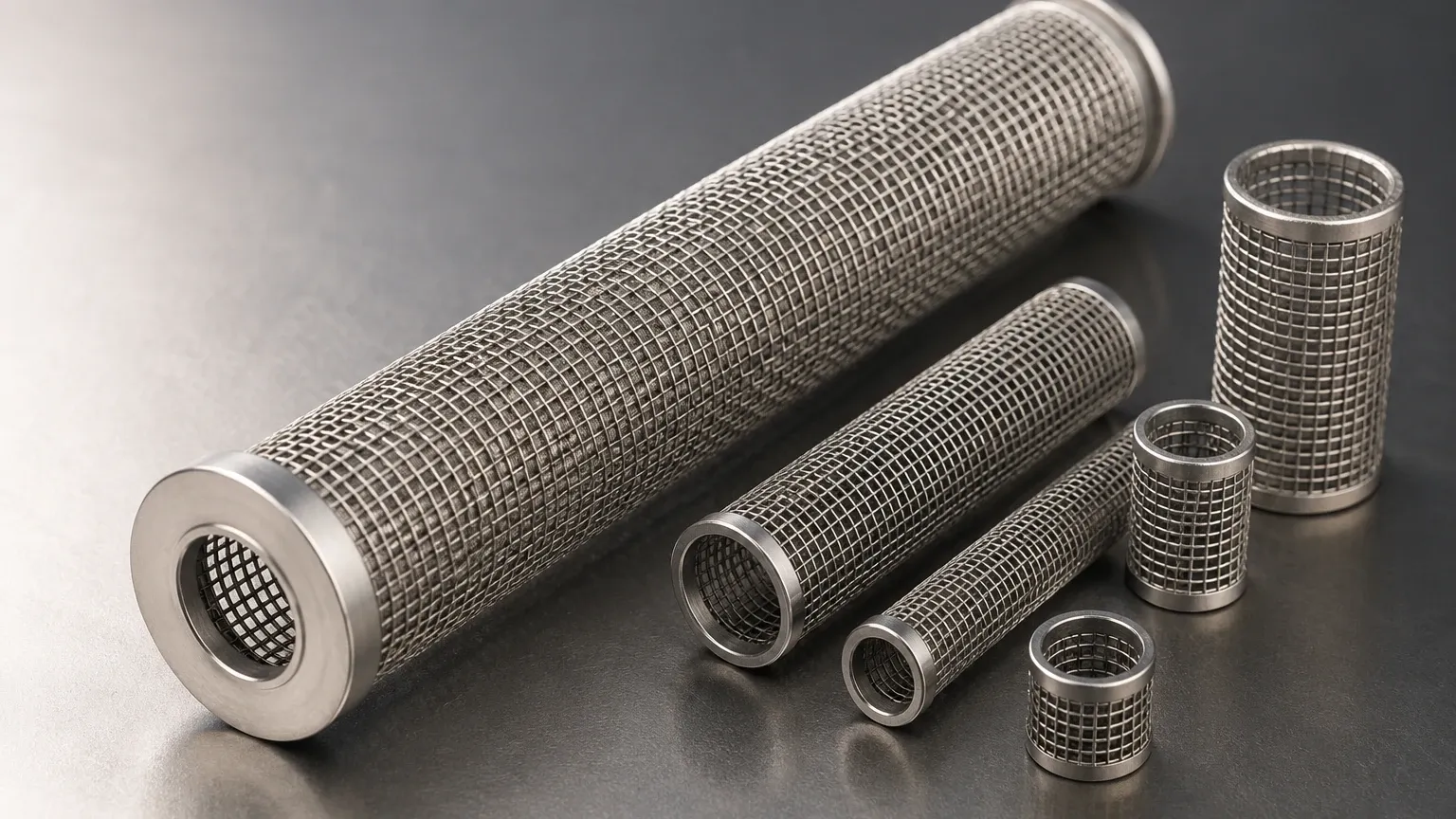
When fabricated into Wire Mesh Filter Cylinders & Tubes, the 8 mesh provides a rigid framework that maintains the cylindrical shape under vacuum or high-pressure conditions.
Engineering Considerations for System Integration
When specifying 8 mesh components for an industrial system, engineers must evaluate several performance metrics to ensure operational efficiency.
Flow Rate and Pressure Drop (ΔP)
Every filter media introduces a resistance to flow. Because 8 mesh has a relatively large aperture and high open area, the initial pressure drop is minimal. However, as particles accumulate, the "Effective Filtration Area" (EFA) decreases. Engineers should calculate the maximum allowable pressure drop before the filter requires cleaning or replacement. If the ΔP exceeds the design limit, it can lead to pump cavitation or mechanical failure of the filter element.
Velocity and Turbulence
High fluid velocities can cause wire vibration, leading to fatigue failure at the mesh intersections or weld points. In gas filtration, high velocity can also lead to "re-entrainment," where captured particles are forced through the mesh by the sheer force of the flow. For 8 mesh wire, maintaining a laminar flow profile is ideal, though its coarse nature makes it more resilient to turbulent conditions than finer weaves.
Fabrication and Seam Integrity
The method of joining the mesh to form a cylinder is critical. For 8 mesh, resistance welding or TIG (Tungsten Inert Gas) welding are standard. A "lap seam" (where edges overlap) offers higher strength, while a "butt seam" (where edges meet flush) provides a smoother profile and prevents the accumulation of stagnant fluid in the overlap, which is essential in hygienic food or pharmaceutical applications.
Installation and Maintenance Protocols
Proper installation and a proactive maintenance schedule are vital for the performance of 8 mesh filtration components.
Installation Constraints
* Gasket Compatibility: Ensure that the gaskets used at the ends of the filter cylinders are compatible with the process fluid and the operating temperature. Improper sealing can allow "bypass," where unfiltered fluid escapes around the filter element.
* Orientation: In vertical installations, ensure the flow direction (inside-to-out or outside-to-in) matches the structural design of the cylinder. 8 mesh support is usually placed on the downstream side of the pressure gradient.
Cleaning and Regeneration
One of the primary advantages of stainless steel 8 mesh is its cleanability. Depending on the contaminant, several methods can be employed:
* Backwashing: Reversing the flow of the fluid to dislodge particles trapped on the surface.
* Ultrasonic Cleaning: Using high-frequency sound waves in a cleaning solvent to remove fine particulates from the wire intersections.
* Chemical Cleaning: Using mild acids or bases to dissolve organic or mineral scaling, provided the chemical is compatible with the stainless steel grade.
Application Risks and Mitigation
While 8 mesh wire is robust, it is not immune to failure. Common risks include:
* Erosion: In high-solids applications, abrasive particles can wear down the wire diameter over time, eventually increasing the aperture size and allowing larger particles to pass.
* Stress Corrosion Cracking (SCC): In environments with high chlorides and high temperatures, stainless steel can develop micro-cracks. Regular inspection for signs of discoloration or brittle wires is necessary.
* Blinding: If the particle size distribution of the contaminant is exactly the same as the aperture size (approx. 2.5mm), particles can become wedged in the openings, a phenomenon known as "blinding" or "pegging." This significantly reduces flow and is difficult to clear via backwashing.
Buyer’s Checklist: Confirming Specifications
International buyers and procurement engineers should confirm the following technical details with the manufacturer before finalizing an order for 8 mesh components:
1. Wire Diameter: Specify the exact wire gauge required, as this dictates both the aperture and the strength of the mesh.
2. Mesh Grade: Confirm whether 304, 316, or 316L is required based on the chemical environment.
3. Tolerances: Define the allowable variance in mesh count and wire diameter (e.g., ASTM E11 standards).
4. Fabrication Details: For Wire Mesh Filter Cylinders & Tubes, specify the length, diameter, seam type, and any end-cap requirements (flanges, threaded fittings, or open ends).
5. Certification: Request material test reports (MTRs) to verify the metallurgical composition of the stainless steel.
Conclusion
8 mesh wire serves as a versatile and essential component in industrial filtration. Whether used as a primary screen for large-scale debris removal or as a structural backbone for complex multi-layer filter cartridges, its performance is a product of precise engineering and material science. By understanding the relationship between mesh geometry, material properties, and operational demands, technical professionals can optimize their filtration systems for maximum reliability and cost-effectiveness. For custom configurations and high-performance filtration components, selecting a manufacturer with deep expertise in stainless steel fabrication ensures that the final product meets the rigorous standards of modern industrial processing.
