


String Wound Filter Cartridges
In the landscape of industrial liquid process filtration, string wound filter cartridges represent one of the most established and versatile technologies for depth filtration. These components are engineered to remove suspended solids and particulate matter from a wide range of fluids, serving as a critical primary or pre-filtration stage in complex systems. For engineers and procurement specialists, understanding the technical nuances of string wound construction, material compatibility, and performance dynamics is essential for optimizing filtration efficiency and minimizing total cost of ownership.
String wound filters are categorized as depth-type Filter Cartridges, meaning they capture contaminants throughout the entire thickness of the filter media rather than just on the surface. This design allows for a high dirt-holding capacity, making them particularly effective for applications with high sediment loads or varying particle size distributions.
Understanding the Engineering Principles of String Wound Filtration
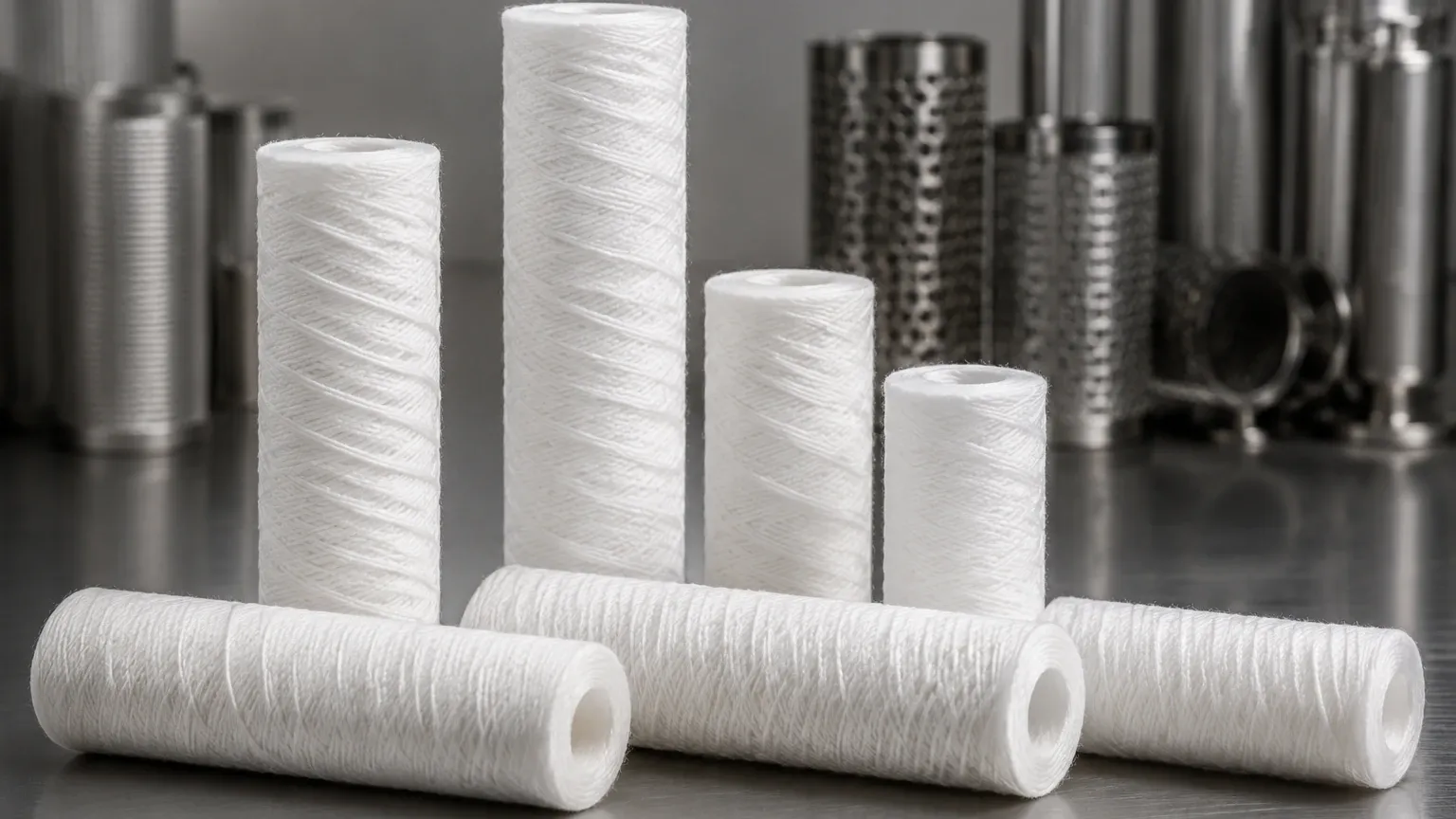
The fundamental performance of string wound filter cartridges is derived from their unique manufacturing process. These filters are produced by winding continuous yarns around a central perforated core. The winding pattern is not arbitrary; it is a precision-engineered geometry designed to create a "tortuous path" for the fluid.
Gradient Density and the Tortuous Path
As the yarn is wound, the tension and the spacing between the fibers are carefully controlled. In a well-manufactured cartridge, the density of the winding increases toward the center. This creates a gradient density structure where larger particles are trapped in the outer layers, while finer particles are captured deeper within the media. This prevents the surface from blinding prematurely, which is a common failure mode in surface-type filters.
The Role of the Diamond Pattern
The characteristic "diamond" pattern seen on the surface of these cartridges is the result of the yarn traversing back and forth across the core. The size and shape of these diamonds determine the micron rating. By adjusting the winding speed relative to the rotation of the core, manufacturers can produce cartridges with specific retention ratings, typically ranging from 0.5 microns to 150 microns. However, it is important to note that string wound filters are generally considered "nominal" rated filters, meaning they are designed to trap a high percentage of particles at their rated size, but not 100% of them.
Material Selection for Yarn and Core Components
One of the primary advantages of string wound technology is the ability to customize the material composition to suit specific chemical and thermal environments. Selecting the wrong material can lead to media migration, chemical degradation, or structural failure of the cartridge.
Yarn Media Options
1. Polypropylene (PP): This is the most common material due to its broad chemical resistance and low cost. It is suitable for water, alkalis, and many acids. It is generally rated for temperatures up to 140°F (60°C). For food and beverage applications, FDA-compliant polypropylene is used to ensure no leaching of extractables.
2. Cotton: Bleached or unbleached cotton is preferred for applications involving oils, hydrocarbons, and higher temperatures (up to 250°F or 121°C). Bleached cotton is often required for pharmaceutical or high-purity water applications to prevent the introduction of natural oils found in raw cotton.
3. Fiberglass: For extreme high-temperature applications or aggressive chemical environments (such as concentrated acids), fiberglass yarn is utilized. It can withstand temperatures up to 750°F (400°C) and is highly resistant to oxidation.
4. Polyester: Offers better heat resistance than polypropylene (up to 300°F/149°C) and is compatible with various solvents and chemicals where PP might fail.
Core Material Considerations
The core provides the structural integrity necessary to withstand the differential pressure across the filter. Common materials include:
* Polypropylene: Used for general-purpose water and chemical applications where temperature and pressure are moderate.
* Tin-Plated Steel: A cost-effective option for oils and solvents where higher structural strength is required.
* 304/316 Stainless Steel: Essential for high-temperature, high-pressure, or highly corrosive environments. Stainless steel cores are standard in pharmaceutical and heavy industrial chemical processing to prevent rust and ensure long-term durability.
Performance Characteristics and Flow Dynamics
When evaluating string wound filter cartridges for an industrial system, engineers must consider the relationship between flow rate, pressure drop, and filtration efficiency.
Differential Pressure (ΔP)
As a filter captures contaminants, the resistance to flow increases, resulting in a higher differential pressure. The "clean" pressure drop is the initial resistance offered by a new filter. A high initial ΔP usually indicates that the filter is too tight for the application or that the flow rate exceeds the cartridge's design capacity. Most industrial systems are designed to operate until a terminal ΔP is reached—typically between 15 and 30 PSI—at which point the cartridge must be replaced.
Dirt-Holding Capacity
The depth-loading nature of string wound cartridges provides a superior dirt-holding capacity compared to many pleated filters in high-solid applications. Because the particles are distributed throughout the yarn layers, the filter can maintain a steady flow for a longer duration before the pores become clogged. This longevity is a key factor in reducing maintenance downtime.
Media Migration and Shedding
A technical concern with lower-quality string wound filters is media migration, where fibers from the yarn break off and enter the filtrate. This is often caused by poor winding tension or the use of short-staple fibers. High-quality manufacturers use continuous filament yarns or specialized heat-setting processes to minimize this risk, ensuring the downstream fluid remains free of filter media.
Comparative Analysis: String Wound vs. Other Filter Cartridges
Choosing between different Filter Cartridges requires a trade-off between filtration precision, capacity, and cost.
String Wound vs. Melt-Blown
Melt-blown cartridges are also depth filters, but they are made from thermally bonded microfibers. While melt-blown filters often provide more consistent micron ratings and lower media migration, string wound filters are often preferred in applications with very high temperatures or where specific yarn materials (like fiberglass or cotton) are chemically necessary. String wound filters also tend to have a more rigid structure when wound on a metal core, allowing them to handle higher surge pressures.
String Wound vs. Pleated Filters
Pleated filters are typically surface or multi-layer media designed for high-efficiency or absolute filtration. They offer much larger surface areas, allowing for higher flow rates in a smaller footprint. However, in applications with high concentrations of deformable or gelatinous particles, pleated filters can blind quickly. String wound filters excel as pre-filters for pleated cartridges, removing the bulk of the heavy solids and extending the life of the more expensive pleated media.
Application-Specific Selection and Compatibility
The versatility of string wound filter cartridges makes them suitable for a diverse array of industrial sectors. However, each sector has unique requirements that dictate the specification of the filter.
Chemical Processing
In chemical manufacturing, compatibility is the primary concern. Engineers must verify that both the yarn and the core can withstand the pH levels and solvent characteristics of the process fluid. For example, while polypropylene is excellent for most acids, it may swell or degrade in the presence of certain aromatic hydrocarbons, necessitating a shift to cotton or polyester.
Food and Beverage
Filtration in this sector requires materials that meet stringent regulatory standards (such as FDA or EC 1935/2004). String wound filters are frequently used for the filtration of bottled water, beer, and vegetable oils. In these cases, the focus is on ensuring the media does not impart any taste, odor, or color to the product.
Oil and Gas / Petrochemical
These applications often involve high temperatures and high-viscosity fluids. String wound filters with metal cores and cotton or synthetic yarns are used to remove scale, rust, and sand from produced water, completion fluids, and lubricants. Their ability to withstand high differential pressures without collapsing is critical here.
Operational Maintenance and Replacement Indicators
Effective management of a filtration system relies on timely maintenance. Replacing a filter too early leads to unnecessary costs, while replacing it too late can cause bypass (where fluid forced by high pressure finds a path around the seals) or even cartridge collapse.
Monitoring Pressure Gauges
The most reliable method for determining replacement timing is the installation of pressure gauges before and after the filter housing. A clear SOP (Standard Operating Procedure) should define the maximum allowable ΔP. In many automated systems, differential pressure sensors trigger an alarm or automatically divert flow to a standby filter housing.
Visual Inspection and Fluid Analysis
While ΔP is the primary indicator, regular fluid analysis can help identify if a filter is performing to its micron specification. If downstream turbidity increases despite a low ΔP, it may indicate "channeling," where the fluid has carved a path through the media, or a failure of the end-cap seals.
Technical Specifications to Confirm Before Procurement
To ensure the correct Filter Cartridges are sourced, procurement and engineering teams should confirm the following technical data points with their manufacturer:
* Micron Rating: Specify whether the requirement is nominal or if a specific beta ratio is needed.
* Dimensions: Standard lengths are 9.75", 10", 20", 30", and 40". Outer diameters (OD) are typically 2.5" for standard housings and 4.5" for "Big Blue" or large-diameter housings.
* End-Cap Configuration: While many string wound filters are Double Open End (DOE), some applications require Single Open End (SOE) configurations with 222 or 226 O-rings to ensure a bypass-free seal.
* Core Material: Match the core to the chemical and thermal profile of the fluid. Ensure the core has sufficient collapse strength for the expected maximum ΔP.
* Media Treatment: Determine if the yarn needs to be washed, heat-set, or if it must be free of lubricants and anti-static agents (often required in electronics or high-purity chemical sectors).
By focusing on these technical parameters, industrial operators can leverage string wound technology to achieve reliable, cost-effective filtration. Whether used as a standalone solution for coarse sediment removal or as a protective stage for high-precision membranes, the string wound cartridge remains a foundational component in modern industrial fluid processing.
