


Architectural Woven Wire Mesh: Engineering and Selection Guide
In modern industrial and commercial design, the intersection of aesthetics and structural performance is increasingly bridged by specialized materials. Architectural woven wire mesh represents a versatile category of metal fabric that leverages the precision of industrial weaving to meet both decorative and functional requirements. While often associated with the visual appeal of building facades and interior partitions, the selection of these materials is a rigorous engineering process rooted in the same principles as high-performance industrial filtration.
For engineers and procurement professionals, understanding the technical nuances of woven wire mesh is essential for ensuring long-term durability, safety, and cost-efficiency. This guide examines the material properties, weave structures, and engineering considerations necessary for specifying architectural mesh in demanding environments.
Defining Architectural Woven Wire Mesh in Industrial Contexts
At its core, Plain, twill and dutch woven wire mesh in SS304/316L — rolls, cut mesh and framed panels. Send mesh count or micron target for a technical quote. is produced through a mechanical weaving process where longitudinal (warp) wires and transverse (shute or weft) wires are interlaced. Unlike expanded metal or perforated sheets, woven mesh maintains the structural integrity of the individual wires, providing a unique combination of flexibility and tensile strength.
In architectural applications, this material serves multiple roles. It can act as a protective barrier, a solar shading device, or a ventilation screen. Because the manufacturing process allows for precise control over the wire diameter and the spacing between wires (the aperture), engineers can specify mesh that provides exact levels of transparency, airflow, and light diffusion. This level of customization is critical when the mesh must integrate with HVAC systems or meet specific safety codes for fall protection.
Material Selection: Stainless Steel Grades and Corrosion Resistance
The longevity of architectural woven wire mesh is primarily determined by its material composition. In most industrial and commercial settings, stainless steel is the preferred medium due to its mechanical properties and resistance to environmental degradation.
Grade 304 Stainless Steel
Grade 304 is the standard "18/8" stainless steel. It offers excellent forming and welding characteristics. For interior applications or controlled outdoor environments with low pollution and no exposure to salt spray, SS304 provides a cost-effective solution. However, it is susceptible to pitting and crevice corrosion in chloride-rich environments.
Grade 316/316L Stainless Steel
For exterior facades, coastal installations, or industrial sites exposed to chemical vapors, Grade 316 is the engineering standard. The addition of molybdenum (2-3%) significantly enhances its resistance to chloride-induced corrosion. Grade 316L (the low-carbon version) is often specified for components requiring extensive welding, as it minimizes the risk of carbide precipitation which can lead to intergranular corrosion. When specifying architectural woven wire mesh for high-stakes infrastructure, the total cost of ownership is often lower with 316L due to reduced maintenance and extended service life.
Technical Specifications: Weave Patterns and Open Area
The performance of a mesh panel is defined by its weave pattern. While decorative considerations often drive the initial choice, the mechanical implications of the weave must be evaluated.
1. Plain Weave: The most common and straightforward pattern where each warp wire passes alternately over and under each shute wire. This provides the highest level of stability and is ideal for screens where uniform aperture size is required.
2. Twill Weave: Each warp wire passes alternately over and under two shute wires. This allows for a heavier wire diameter to be used for a given mesh count, resulting in a robust fabric that can withstand higher mechanical loads without sacrificing flexibility.
3. Dutch Weave: Characterized by a thicker warp wire and a finer weft wire woven closely together. While primarily used in high-pressure filtration for its superior strength and precise micron ratings, Dutch weaves are utilized in architecture for "opaque" applications where privacy or extreme solar shading is required while still allowing for some airflow.
Calculating Open Area
The "Open Area" percentage is a critical metric for engineers. It determines the amount of light and air that can pass through the mesh. A high open area (e.g., 60-70%) is suitable for ventilation covers and safety barriers where visibility is maintained. A low open area (e.g., 20-40%) is more effective for solar shading and privacy screens. Calculating this involves the formula:
`Open Area % = ((Aperture Width)^2 / (Aperture Width + Wire Diameter)^2) x 100`.
Structural Integrity and Installation Engineering
Installing architectural woven wire mesh involves more than simple fastening. Because the material is often used in large-scale facades, it must be treated as a structural element subject to various loads.
Tensile Loads and Tensioning
Woven mesh is typically installed under tension to ensure a flat, taut appearance and to prevent rattling or displacement under wind pressure. Engineers must calculate the required tensioning force based on the mesh's weight and the anticipated environmental loads. This requires robust mounting hardware, such as spring-loaded tension bolts or heavy-duty tube frames, to distribute the load evenly across the warp wires.
Wind Loads and Vibration
Large mesh panels act as sails. Even with a high open area, the cumulative force of high-velocity winds can be substantial. Furthermore, the wind passing through the mesh can induce vortex shedding, leading to vibration and potential fatigue at the attachment points. Specifying the correct wire gauge and mesh density is essential to mitigate these risks. In many cases, intermediate support bars are necessary to reduce the span and control the deflection of the mesh.
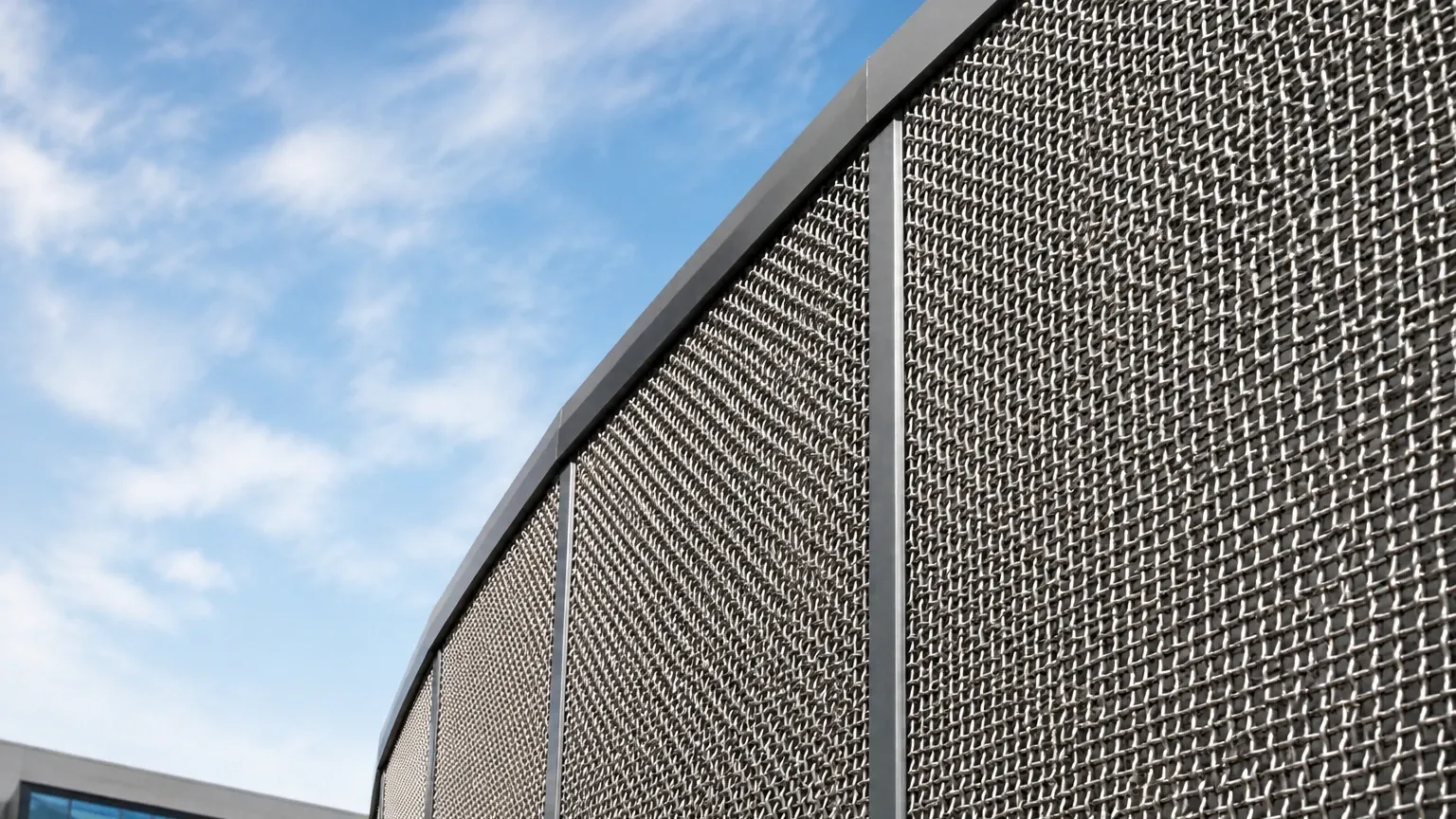
Functional Performance: Solar Shading and Ventilation
One of the primary technical reasons for selecting architectural woven wire mesh is its impact on a building’s thermal performance.
Solar Heat Gain Coefficient (SHGC)
By acting as an external shading device, woven mesh can significantly reduce the Solar Heat Gain Coefficient of a building's envelope. The mesh intercepts solar radiation before it reaches the glazing, reflecting and absorbing a portion of the energy. Unlike solid louvers, the mesh maintains a degree of transparency, allowing occupants to see out while reducing the load on the building's HVAC system. This contributes to energy efficiency and can assist in achieving LEED or other green building certifications.
Natural Ventilation
In parking structures, equipment enclosures, and industrial warehouses, natural ventilation is a safety requirement to prevent the buildup of exhaust fumes or heat. Woven wire mesh provides a secure perimeter that does not impede airflow. Engineers must balance the mesh aperture size to ensure it is small enough to prevent unauthorized entry or pest ingress but large enough to meet the required air exchange rates.
Common Risks and Mitigation in Mesh Selection
When procuring architectural woven wire mesh, several risks can impact the project's success if not addressed during the specification phase:
* Galvanic Corrosion: If stainless steel mesh is mounted using carbon steel fasteners or aluminum frames in a moist environment, galvanic corrosion will occur, leading to rapid failure of the connection points. Always specify compatible fasteners, preferably of the same stainless steel grade as the mesh.
* Aesthetic Inconsistency: In large-scale projects, mesh should be sourced from the same production batch. Variations in wire drawing or loom tension can lead to slight differences in the reflection of light, which become visible when panels are installed side-by-side.
* Maintenance Access: While stainless steel is low-maintenance, it is not "no-maintenance." In urban environments, soot and pollutants can accumulate in the intersections of the weave. The installation design should allow for periodic cleaning, typically using low-pressure water or specialized neutral detergents, to prevent staining.
Procurement Guide: Specifying Mesh for Custom Projects
To receive an accurate technical quote and ensure the material meets the application's demands, purchasing teams should provide the following data points to the manufacturer:
1. Material Grade: (e.g., SS304, SS316L).
2. Mesh Count: The number of wires per inch in both directions.
3. Wire Diameter: Specified in millimeters or inches. Note that the diameter affects both the weight and the open area.
4. Overall Dimensions: The size of the individual panels or rolls required.
5. Edge Treatment: Should the mesh be supplied with raw edges, hemmed, or pre-installed in a frame?
6. Load Requirements: Any specific wind load or impact resistance standards the mesh must meet.
As a manufacturer specializing in custom stainless steel filtration and metal components, Kaifil applies industrial-grade precision to every mesh product. Whether the requirement is for a high-micron filter cartridge or a large-scale architectural panel, the focus remains on material purity, weave accuracy, and structural reliability.
Conclusion
Architectural woven wire mesh is a sophisticated engineering material that offers a unique blend of form and function. By moving beyond aesthetic considerations and focusing on material science, weave geometry, and structural loads, engineers can leverage this material to enhance building performance and safety. Selecting the right grade of stainless steel and the appropriate weave pattern ensures that the installation remains a durable asset for the duration of the structure's lifecycle. For those in the procurement and engineering sectors, partnering with a manufacturer that understands the technical rigors of industrial filtration ensures that the architectural mesh supplied meets the highest standards of precision and quality.
