


Filter Cartridge 10
In industrial filtration, the designation of a "filter cartridge 10" typically serves as a dual-purpose specification, referring either to a 10-inch nominal length or a 10-micron filtration rating. These parameters are foundational in the design of process piping and fluid purification systems. For engineers and procurement specialists, selecting the correct Filter Cartridges requires a deep understanding of how these dimensions and ratings interact with flow dynamics, material compatibility, and structural integrity.
Standardization around the 10-inch format allows for modularity in filtration housings, while the 10-micron threshold often serves as a critical point for pre-filtration or fine particulate removal in chemical, food and beverage, and hydraulic applications. This guide examines the engineering considerations necessary to optimize the performance of a filter cartridge 10 within industrial environments.
The Technical Significance of the Filter Cartridge 10 Specification
When discussing a filter cartridge 10, the first step is to distinguish between its physical dimensions and its filtration efficiency. In most industrial contexts, "10" refers to the nominal length. However, because different housing manufacturers utilize slightly different seating depths, a "10-inch" cartridge may actually measure 9.75 inches, 10 inches, or 10.125 inches.
Dimensional Compatibility
Ensuring the cartridge fits the existing housing is paramount. A mismatch of even a few millimeters can lead to bypass—where unfiltered fluid escapes around the edges of the cartridge—rendering the entire filtration process ineffective. Engineers must verify the overall length (OAL) and the outer diameter (OD), which is typically standard at 2.5 inches or 2.75 inches for slim-line housings, or 4.5 inches for "Big Blue" or high-flow configurations.
Micron Rating: Nominal vs. Absolute
If the "10" refers to the micron rating, it is vital to determine if the rating is nominal or absolute. A nominal 10-micron filter cartridge 10 might only capture 60% to 80% of particles at that size, whereas an absolute-rated cartridge (often defined by a Beta ratio of 5000 or higher) will capture 99.9% of particles. In precision industries like pharmaceutical manufacturing or high-pressure hydraulics, relying on nominal ratings can lead to downstream component failure or product contamination.
Material Engineering: Stainless Steel vs. Synthetic Media
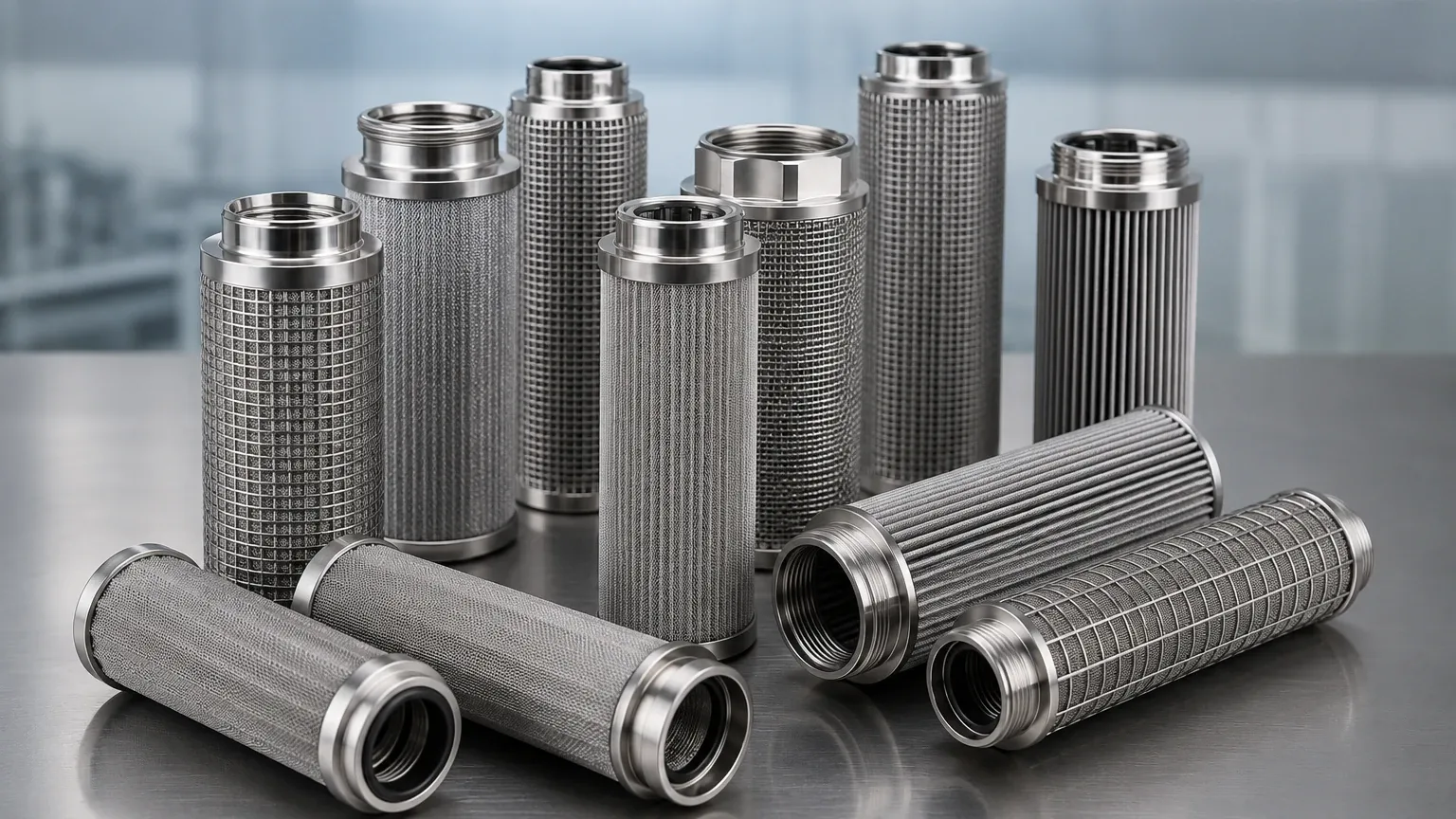
While many commercial applications utilize polypropylene or pleated paper, industrial-grade filtration often demands the durability of metal. Kaifil specializes in stainless steel solutions that offer significant advantages in demanding environments.
Stainless Steel Wire Mesh
For a filter cartridge 10 used in high-temperature or corrosive settings, 304 or 316L stainless steel wire mesh is the preferred medium. Unlike synthetic fibers, stainless steel does not shed particles into the fluid stream (media migration) and can withstand extreme pressure differentials without collapsing.
* Plain Weave: Offers a straightforward pore structure for general filtration.
* Dutch Weave: Provides higher mechanical strength and finer filtration by using a higher density of weft wires.
* Sintered Mesh: For the most rigorous applications, multiple layers of wire mesh are diffusion-bonded (sintered) to create a monolithic structure that maintains its pore size even under intense vibration or back-pressure.
Chemical and Thermal Resistance
Synthetic cartridges often fail when exposed to solvents, strong acids, or temperatures exceeding 60°C (140°F). A stainless steel filter cartridge 10 can operate effectively at temperatures up to 300°C and across a wide pH range. This makes them indispensable in chemical processing plants where caustic fluids would degrade polymer-based filters.
Structural Design and End-Cap Configurations
The performance of a filter cartridge 10 is not solely dependent on the media; the structural assembly and the method of sealing within the housing are equally critical.
End-Cap Styles
There are several standard end-cap configurations that engineers must specify based on their housing requirements:
1. Double Open End (DOE): The cartridge is open at both ends and relies on gaskets (often EPDM, Viton, or PTFE) and housing compression to create a seal.
2. Single Open End (SOE): One end is sealed, while the other features a specific adapter. Common industrial adapters include:
* Code 7 (226 O-rings with a locking fin): Provides a secure, bayonet-style lock for high-vibration environments.
* Code 3 (222 O-rings with a flat top): A standard double O-ring seal for reliable leak prevention.
* Code 8 (222 O-rings with a fin): Combines the 222 seal with a centering fin for easier installation in multi-round housings.
Core Strength
In high-viscosity applications or systems prone to pressure spikes, the internal core of the filter cartridge 10 must be robust. A perforated stainless steel core provides the necessary support to prevent the media from collapsing inward under a high differential pressure ($\Delta P$).
Evaluating Performance: Flow Rate and Pressure Drop
One of the most common mistakes in filter selection is undersizing the cartridge for the required flow rate. Every filter cartridge 10 introduces a degree of resistance to the fluid flow, known as the clean pressure drop.
Calculating Differential Pressure
As the filter captures contaminants, the pores become restricted, and the differential pressure increases. Engineers must calculate the "terminal $\Delta P$"—the point at which the filter is considered fouled and must be cleaned or replaced. For stainless steel Filter Cartridges, the structural limit is much higher than for plastic, but operating at excessively high $\Delta P$ can still force contaminants through the media or damage the pump.
Surface Area Optimization
To maximize the life of a filter cartridge 10, the surface area should be as large as possible. Pleated metal mesh cartridges offer significantly more surface area than cylindrical (wrap) designs. This increased area results in a lower initial pressure drop and a higher dirt-holding capacity, which extends the interval between maintenance cycles.
Maintenance and Reusability in Industrial Cycles
A primary driver for selecting a stainless steel filter cartridge 10 over disposable options is the total cost of ownership (TCO). While the initial investment for a metal cartridge is higher, its ability to be cleaned and reused provides long-term economic and environmental benefits.
Cleaning Methodologies
Depending on the nature of the contaminant, stainless steel cartridges can be cleaned using several methods:
* Backwashing: Reversing the flow of fluid to dislodge particles from the surface of the mesh.
* Ultrasonic Cleaning: Using high-frequency sound waves in a solvent bath to remove fine particulates from deep within the mesh layers.
* Chemical Cleaning: Using acids or alkalis to dissolve organic or mineral buildup, followed by a thorough rinse.
* Burn-off/Pyrolysis: For heavy polymer or resin buildup, controlled heating can vaporize the contaminants without damaging the stainless steel structure.
Replacement Cycles
Even with cleaning, a filter cartridge 10 will eventually reach the end of its service life. This usually occurs when the mesh becomes work-hardened from repeated pressure cycles or when contaminants become permanently embedded (irreversible fouling). Regular inspection for mesh integrity and seal wear is essential to prevent bypass.
Procurement Checklist for Custom Filter Cartridges
When ordering a filter cartridge 10 for a specific industrial application, providing precise technical data to the manufacturer ensures the product will perform as expected. Before contacting a supplier like Kaifil, confirm the following parameters:
1. Fluid Characteristics: What is the viscosity, temperature, and chemical composition of the fluid?
2. Contaminant Profile: What is the nature of the solids being removed? Are they hard, deformable, or gelatinous?
3. Target Micron Rating: Is an absolute or nominal 10-micron rating required?
4. Flow Requirements: What is the maximum and operating flow rate (GPM or LPM)?
5. Housing Dimensions: Confirm the exact OAL and OD, as well as the end-cap code or gasket material.
6. Operating Pressure: What is the normal operating pressure and the maximum allowable differential pressure?
By addressing these technical details, engineers can secure a filtration solution that minimizes downtime and protects expensive downstream equipment. Whether for a standard water treatment system or a specialized chemical reactor, the right filter cartridge 10 is a balance of material science, mechanical design, and fluid dynamics.
