


Filter Cartridge 30 Inch
In industrial filtration systems, the selection of filter dimensions is as critical as the choice of media. The filter cartridge 30 inch format has emerged as a standard for medium-to-high flow applications where balancing housing footprint with filtration surface area is paramount. For engineers and procurement specialists, moving to a 30-inch specification often represents a strategic shift toward optimizing process efficiency and reducing the frequency of maintenance intervals.
As a manufacturer specializing in high-performance stainless steel Filter Cartridges, Kaifil provides precision-engineered solutions designed to withstand the rigors of chemical processing, steam filtration, and high-pressure hydraulic systems. Understanding the technical nuances of the 30-inch form factor—ranging from mechanical structural integrity to hydraulic performance—is essential for ensuring long-term operational reliability.
The Strategic Advantage of the 30-Inch Form Factor
The 30-inch length is a modular standard in the filtration industry. While 10-inch and 20-inch cartridges are common for pilot plants or low-flow bypass lines, the 30-inch variant is the workhorse of industrial-scale production.
Surface Area and Flow Capacity
By utilizing a 30-inch cartridge, operators effectively triple the surface area available for filtration compared to a standard 10-inch unit. This increase in surface area allows for a higher flow rate through a single housing or, conversely, a significantly lower flux (flow per unit area) at a constant flow rate. Lower flux is often desirable as it reduces the velocity of particles hitting the filter media, which can improve capture efficiency and extend the life of the cartridge by slowing the rate of pressure drop (Delta P) increase.
Reducing Footprint and Hardware Costs
From a plant design perspective, using 30-inch cartridges allows for smaller filter housings. For example, a flow requirement that might necessitate a 12-round housing using 10-inch cartridges could potentially be handled by a 4-round housing using 30-inch cartridges. This reduces the physical footprint of the filtration skid and lowers the initial capital expenditure on pressure vessels and associated piping.
Material Considerations: The Case for Stainless Steel
While 30-inch cartridges are available in various polymers, industrial applications involving high temperatures, aggressive chemicals, or high differential pressures require the durability of metal. Kaifil specializes in stainless steel constructions, typically utilizing 304, 316, or 316L grades.
Corrosion Resistance and Chemical Compatibility
Stainless steel 316L is the preferred material for the pharmaceutical and chemical industries due to its superior resistance to pitting and crevice corrosion. In applications involving deionized water, solvents, or acidic solutions, a filter cartridge 30 inch made of 316L ensures that the structural integrity of the filter is not compromised, preventing media migration and downstream contamination.
Thermal Stability
Polymer-based filters (such as polypropylene or PES) often have a maximum operating temperature of 60°C to 80°C. In contrast, stainless steel cartridges can operate effectively at temperatures exceeding 300°C, depending on the seal material used. This makes them indispensable for steam filtration, hot oil processing, and polymer melt applications.
Mechanical Design and End-Cap Configurations
A 30-inch cartridge must maintain its axial alignment and structural rigidity under pressure. This is achieved through a robust inner support core and, in many designs, an outer protective cage. The interface between the cartridge and the housing is governed by the end-cap configuration, which is vital for preventing bypass.
Common Interface Standards
* DOE (Double Open End): These cartridges are open at both ends and rely on gaskets and housing tie-rods to create a seal. While cost-effective, they are generally less secure than SOE designs in high-purity applications.
* Code 7 (222 O-Ring/Fin): Featuring two 222 O-rings and a locking tab (fin), this is a common high-security interface for the food, beverage, and pharmaceutical industries. It ensures a positive seal and prevents the cartridge from unseating during back-pressure surges.
* Code 3 (222 O-Ring/Flat): Similar to Code 7 but with a flat top, often used in shorter housings or specific OEM configurations.
* Code 8 (226 O-Ring/Fin): This configuration utilizes a larger 226 O-ring and a bayonet-style locking mechanism, providing the highest level of mechanical security for critical processes.
When specifying a filter cartridge 30 inch, engineers must confirm the housing's internal dimensions to ensure the end-cap style and total length (including fins or springs) are compatible.
Hydraulic Performance and Pressure Drop
The performance of a filter is often measured by its clean pressure drop and its dirt-holding capacity. In a 30-inch cartridge, the fluid dynamics are more complex than in shorter units.
Pressure Drop (Delta P) Management
As fluid travels along the 30-inch length of the cartridge, there is a potential for a pressure gradient to develop. High-quality industrial filters are designed with perforated inner cores that ensure uniform flow distribution across the entire 30 inches of media. If the flow is not uniform, certain sections of the media will blind (clog) faster than others, leading to premature filter failure.
Viscosity Considerations
For high-viscosity fluids, such as resins or heavy oils, the 30-inch length provides the necessary surface area to keep the initial pressure drop within acceptable limits. Engineers must calculate the expected Delta P based on the fluid's viscosity, the micron rating of the mesh, and the total flow rate to ensure the system pump can handle the resistance as the filter loads with contaminants.
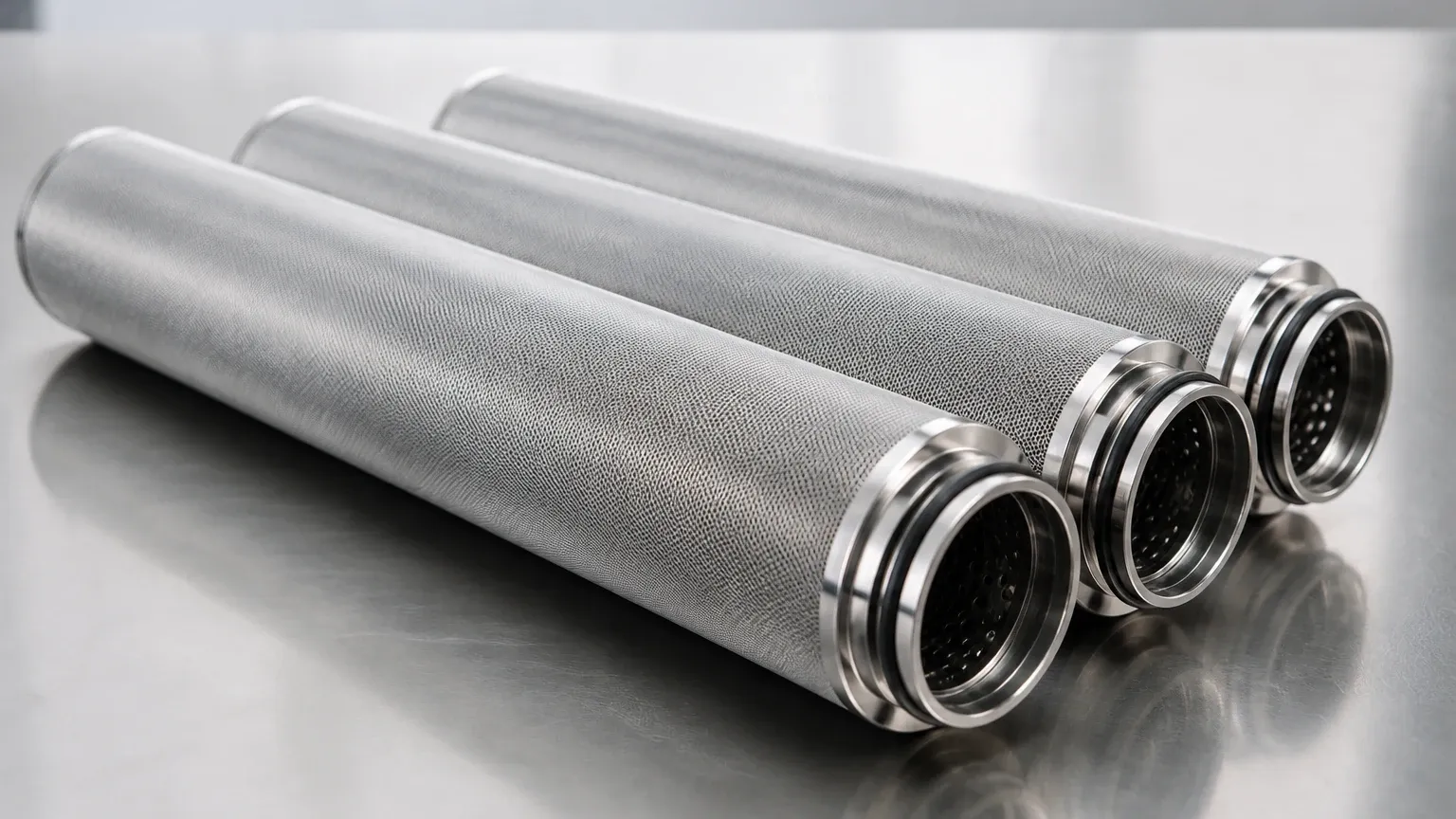
Filtration Media: Mesh vs. Sintered Metal
Kaifil offers various media types within the 30-inch form factor to suit different precision requirements.
1. Woven Wire Mesh: Ideal for surface filtration and easy cleaning. It provides a precise pore size and is excellent for removing hard, angular particles.
2. Sintered Metal Fiber: A depth-filtration media that offers high porosity (up to 80%) and exceptional dirt-holding capacity. It is preferred for applications requiring fine filtration (down to 1 micron) with low pressure drop.
3. Sintered Multi-layer Mesh: Combines multiple layers of woven mesh through a heat-treating process to create a robust, rigid media that can withstand extreme mechanical stress and backwashing.
Industry-Specific Applications
The versatility of the 30-inch stainless steel filter makes it a staple across several demanding sectors:
* Food and Beverage: Used for the filtration of syrups, edible oils, and carbonated beverages. The ability to undergo SIP (Sterilization-in-Place) makes stainless steel 30-inch cartridges ideal for maintaining aseptic conditions.
* Chemical and Petrochemical: These cartridges handle aggressive solvents, catalysts recovery, and high-temperature gas filtration where polymer filters would melt or degrade.
* Water Treatment: In high-flow pre-filtration for Reverse Osmosis (RO) systems, 30-inch cartridges provide the necessary protection for expensive membranes while minimizing the number of filter changes required.
* Hydraulics and Lubrication: Used in large-scale industrial machinery to remove wear particles from lubricating oils, ensuring the longevity of bearings and gears.
Maintenance, Cleaning, and Total Cost of Ownership
One of the primary advantages of choosing a stainless steel filter cartridge 30 inch from Kaifil is the ability to clean and reuse the element. Unlike disposable plastic cartridges that contribute to waste and require frequent purchasing, stainless steel elements represent a long-term investment.
Cleaning Methodologies
Depending on the contaminant, these cartridges can be cleaned using several methods:
* Backwashing: Reversing the flow of clean fluid through the cartridge to dislodge surface particles.
* Ultrasonic Cleaning: Using high-frequency sound waves in a solvent bath to remove deeply embedded particles from sintered media.
* Chemical Cleaning: Using surfactants, acids, or caustics to dissolve organic or inorganic fouling.
* Burn-off/Calcination: For polymer or carbonaceous contaminants, the cartridge can be heated in a controlled oven to vaporize the debris without damaging the stainless steel structure.
Evaluating TCO
While the initial cost of a stainless steel 30-inch cartridge is higher than a disposable equivalent, the Total Cost of Ownership (TCO) is often lower. When factoring in the costs of replacement filters, labor for change-outs, disposal fees for contaminated plastic, and potential downtime, the reusable metal solution becomes the more economical choice for many industrial facilities.
Customization and Engineering Support
Every industrial process has unique variables. Standard off-the-shelf filters may not always meet the specific needs of a complex system. Kaifil provides extensive OEM and customization services for 30-inch filter components. This includes custom micron ratings, specialized end-cap machining to fit legacy housings, and reinforced structures for high-pressure pulsations.
Before finalizing a purchase, engineering teams should confirm the following data points with the manufacturer:
* Fluid Properties: Chemical composition, temperature, and viscosity.
* Contaminant Profile: Particle size distribution and concentration.
* Operational Parameters: Maximum flow rate and maximum allowable pressure drop.
* Housing Compatibility: Exact length measurements and seal types.
By addressing these factors, organizations can ensure they select a 30-inch filter cartridge that provides the optimal balance of filtration efficiency, durability, and cost-effectiveness. Whether for a new installation or an upgrade to an existing system, the 30-inch stainless steel cartridge remains a cornerstone of reliable industrial filtration.
