


Filter Cartridge 90
In industrial filtration, precision and reliability are the primary drivers of operational efficiency. The specification of a filter cartridge 90—whether referring to a 90-micron filtration rating, a 90mm length, or a specific 90-series housing compatibility—represents a critical component in protecting downstream equipment and ensuring product purity. For engineers and procurement specialists, selecting the correct Filter Cartridges requires a deep understanding of material science, fluid dynamics, and the specific mechanical stresses of the application environment.
Industrial filtration is rarely a one-size-fits-all solution. A filter cartridge 90 must be evaluated based on its ability to withstand pressure differentials, resist chemical corrosion, and maintain structural integrity under thermal cycling. As a manufacturer specializing in stainless steel filtration solutions, Kaifil emphasizes that the "90" designation serves as a baseline for engineering discussions that eventually lead to optimized system performance.
Understanding Technical Specifications for Filter Cartridge 90
When identifying a filter cartridge 90, technical professionals typically focus on two primary interpretations: the micron rating and the physical dimensions. Both factors are essential for ensuring the component fits the existing infrastructure and meets the required filtration efficiency.
Micron Rating and Filtration Efficiency
A 90-micron filter cartridge is often utilized in the pre-filtration stage or for coarse filtration in high-flow systems. At 90 microns, the filter is designed to capture larger particulates such as sand, scale, and metal shavings. This level of filtration is vital for protecting sensitive components like high-pressure pumps, nozzles, and finer secondary filters. In industrial settings, the efficiency of a filter cartridge 90 is measured by its ability to maintain a consistent pore size under load, a feat best achieved through sintered metal or high-grade wire mesh constructions.
Dimensional Standards
In some specialized equipment, "90" refers to the physical length or diameter (e.g., 90mm). Compact industrial systems often require these smaller, high-density cartridges to provide maximum surface area within a limited footprint. Engineering teams must confirm the end-cap configuration—such as Double Open End (DOE), Code 7 (226), or Code 3 (222)—to ensure a leak-proof seal within the housing. A mismatch in dimensions, even by a few millimeters, can lead to fluid bypass, rendering the entire filtration process ineffective.
Material Selection and Engineering for Industrial Environments
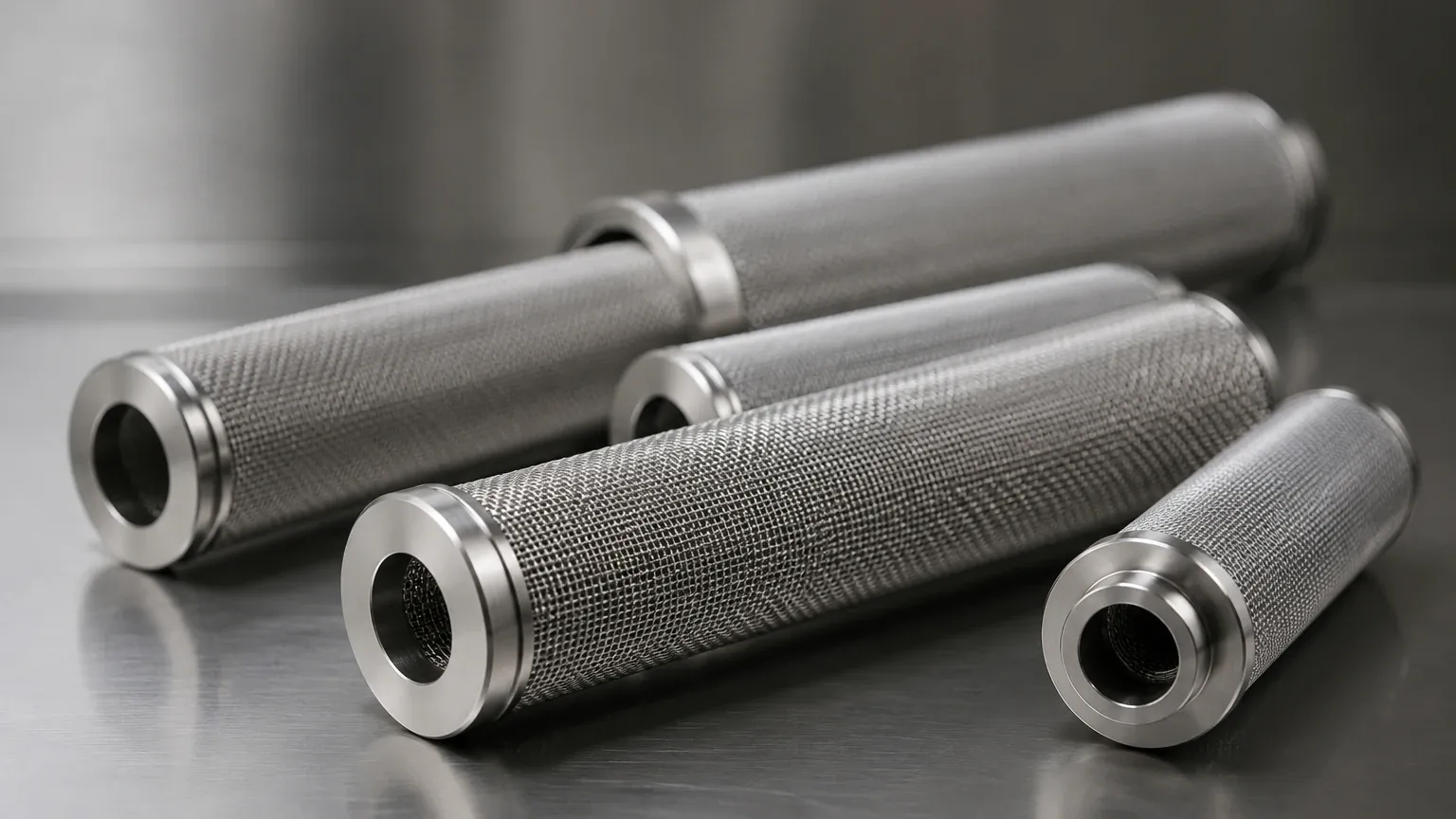
The performance of a filter cartridge 90 is heavily dictated by its material composition. While polymer-based filters are common in light-duty applications, heavy industrial processes demand the durability of stainless steel. Kaifil utilizes advanced alloys to meet these rigorous requirements.
Stainless Steel 304 vs. 316L
For most industrial applications, Stainless Steel 304 provides excellent strength and basic corrosion resistance. However, in environments involving chlorides, high acidity, or pharmaceutical-grade requirements, 316L stainless steel is the industry standard. The "L" denotes low carbon content, which enhances weldability and prevents intergranular corrosion. A stainless steel filter cartridge 90 manufactured from 316L can operate in temperatures exceeding 300°C and withstand significant pressure drops that would collapse a standard polypropylene cartridge.
Structural Reinforcement
In high-viscosity or high-pressure applications, the filter media requires internal or external support. Perforated metal cores and outer shrouds are often integrated into the design of a filter cartridge 90 to prevent media migration and deformation. This structural reinforcement ensures that the 90-micron gaps remain consistent even when the filter becomes loaded with contaminants.
Performance Metrics and Efficiency Standards
Evaluating a filter cartridge 90 goes beyond its nominal rating. Engineers must look at the "Beta Ratio" and the pressure drop curves to understand how the filter will behave in a real-world circuit.
Beta Ratio and Absolute Filtration
A nominal 90-micron rating suggests the filter will stop a majority of particles of that size. However, for critical applications, an "absolute" rating is preferred. An absolute filter cartridge 90 ensures that 99.9% of particles at the specified micron level are captured. This is particularly important in hydraulic systems where even a small percentage of oversized particles can cause catastrophic valve failure.
Clean Pressure Drop (ΔP)
Every filter introduces a degree of resistance to the flow. The initial pressure drop of a clean filter cartridge 90 must be calculated to ensure the pump system can maintain the required flow rate. Stainless steel wire mesh filters generally offer a lower pressure drop compared to depth filters because they provide a more direct flow path through the surface media. This efficiency translates to lower energy consumption for the pumping system over the life of the filter.
Application Scenarios for 90-Micron and 90mm Filtration Components
The versatility of the filter cartridge 90 makes it a staple across various sectors. Its role varies depending on the fluid being processed and the desired outcome of the filtration stage.
* Chemical Processing: In the production of resins, paints, and aggressive chemicals, a 90-micron stainless steel cartridge acts as a primary strainer. It removes undissolved solids and agglomerates that could interfere with the chemical reaction or clog downstream dispensing equipment.
* Food and Beverage: During the initial stages of juice extraction or syrup processing, a filter cartridge 90 is used to remove pulp and large organic debris. The use of food-grade stainless steel ensures that the filter does not leach contaminants into the product and can be sanitized using steam or caustic chemicals.
* Hydraulic and Lubrication Systems: In heavy machinery, 90-micron filters are often placed in the return line to capture wear particles before the oil is recirculated into the reservoir. This extends the life of the oil and the finer pressure-line filters.
* Water Treatment: For industrial cooling towers and well water systems, these cartridges serve as effective sediment filters, protecting heat exchangers from scale buildup and abrasion.
Customization and OEM Considerations for Industrial Procurement
Standard off-the-shelf solutions do not always meet the nuances of complex industrial machinery. This is where customization becomes a strategic advantage. When sourcing a filter cartridge 90, procurement teams should consider the following customization options:
1. Media Type: Depending on the particulate load, one might choose between plain square weave mesh, twilled weave, or sintered metal fiber felt. Sintered media offers higher dirt-holding capacity, while plain weave is easier to clean.
2. End Cap Configurations: Custom end caps can be engineered to fit proprietary housings, including specialized gaskets made of Viton, EPDM, or PTFE to ensure chemical compatibility.
3. Pleated vs. Cylindrical: A pleated filter cartridge 90 significantly increases the effective filtration area compared to a smooth cylindrical design. This allows for higher flow rates and longer intervals between cleanings without increasing the physical footprint of the filter housing.
Kaifil works closely with OEM partners to develop these tailored solutions, ensuring that every filter cartridge 90 is optimized for the specific flow velocity and contaminant profile of the application.
Maintenance, Cleaning, and Total Cost of Ownership (TCO)
One of the primary advantages of a stainless steel filter cartridge 90 over disposable alternatives is its cleanability. While the initial investment in a metal cartridge is higher, the total cost of ownership is often significantly lower due to the elimination of frequent replacement costs and disposal fees.
Cleaning Methodologies
Stainless steel cartridges can be restored to near-original performance through several methods:
* Backwashing: Reversing the flow of fluid to dislodge particles from the surface of the mesh.
* Ultrasonic Cleaning: Using high-frequency sound waves in a cleaning solvent to remove fine particles embedded deep within the mesh pores.
* Chemical Cleaning: Using acids or alkalis to dissolve organic or mineral deposits, provided the filter material is compatible with the cleaning agent.
* Burn-off/Pyrolysis: For filters used in plastic extrusion or heavy oil processing, controlled heating can be used to carbonize and remove organic binders.
Determining Replacement Cycles
Despite their durability, even a stainless steel filter cartridge 90 has a finite lifespan. Engineers should monitor the pressure differential across the filter. Once the "terminal pressure drop" is reached, the filter must be cleaned. If the pressure drop remains high even after cleaning, it indicates that the media has become permanently fouled or blinded, and a replacement is necessary. Regular inspection for mechanical wear or mesh displacement is also recommended to prevent bypass.
Conclusion: Selecting the Right Filter Cartridge 90
Selecting a filter cartridge 90 is a technical decision that impacts the longevity of an entire industrial system. By focusing on high-quality materials like stainless steel and considering factors such as absolute vs. nominal ratings, structural integrity, and cleanability, engineers can ensure reliable performance in the most demanding environments.
For those seeking specialized advice or custom-engineered components, reviewing the technical specifications of various Filter Cartridges is the first step toward optimizing your filtration process. Whether your application requires a standard 90-micron mesh or a custom 90mm precision component, prioritizing engineering excellence will result in reduced downtime and superior product quality.
