


Sintered Metal Sheet
In industrial filtration and fluid dynamics, the selection of media is a critical engineering decision that dictates the efficiency, longevity, and safety of a process. Among the various options available, the sintered metal sheet stands out as a high-performance solution for environments characterized by extreme temperatures, high pressures, and corrosive chemical interactions. Unlike traditional woven or non-woven media, a sintered metal sheet is a rigid, porous structure created through a specialized metallurgical process that bonds metal particles or wire mesh layers without the use of binders or adhesives.
For engineers and procurement professionals, understanding the technical nuances of these components is essential for optimizing system performance. This guide explores the engineering principles, performance metrics, and selection criteria for sintered metal sheets in industrial applications.
Understanding the Sintering Process and Material Composition
The production of a sintered metal sheet involves diffusion bonding. This process begins with either metal powders or multiple layers of stainless steel wire mesh. These materials are placed into a furnace and heated to a temperature just below their melting point while under controlled atmospheric conditions and, often, mechanical pressure. At this temperature, the atoms in the metal particles diffuse across the boundaries of the particles, fusing them together into a solid, integrated structure.
Material Selection
The choice of alloy is the first step in engineering a sintered metal sheet. The most common materials include:
* 316L Stainless Steel: The industry standard for general filtration due to its excellent corrosion resistance and mechanical strength. The "L" denotes low carbon content, which minimizes carbide precipitation during welding and sintering, enhancing the sheet's durability.
* 304L Stainless Steel: Used in less aggressive environments where cost-effectiveness is a priority but stainless properties are still required.
* Nickel and Monel Alloys: Selected for specific chemical compatibility, particularly in environments involving hydrofluoric acid or caustic solutions.
* Hastelloy: Reserved for extreme chemical resistance requirements, such as high-temperature acidic processes.
By controlling the particle size of the powder or the wire diameter and weave of the mesh, manufacturers like Kaifil can precisely engineer the porosity and mechanical characteristics of the final Main Page product.
Performance Characteristics in Demanding Environments
A sintered metal sheet offers several distinct advantages over polymer-based or simple woven metal filters. These characteristics are derived from its rigid, monolithic structure.
Thermal and Mechanical Stability
One of the most significant benefits is the ability to operate at temperatures exceeding 450°C (842°F) in oxidizing environments and even higher in reducing atmospheres. Because the structure is fused at the molecular level, it does not suffer from media migration or pore deformation under high differential pressures. This structural integrity ensures that the filtration efficiency remains constant throughout the service life of the component.
Corrosion and Chemical Resistance
Industrial processes in the chemical and pharmaceutical sectors often involve fluids that would degrade synthetic media. Sintered metal sheets, particularly those made from 316L stainless steel, provide a robust barrier against a wide range of solvents, acids, and bases. This resistance is critical for maintaining the purity of the filtrate and preventing downstream contamination.
Fixed Pore Structure
In many filtration applications, "unloading" is a major concern. This occurs when a filter's pores expand under pressure, allowing previously trapped contaminants to pass through. The sintering process creates a tortuous path with fixed pore geometry. This ensures that once a particle is captured, it remains trapped regardless of pressure fluctuations within the system.
Technical Evaluation: Micron Ratings and Permeability
When evaluating a sintered metal sheet for a specific application, engineers must look beyond simple dimensions. The performance of the sheet is defined by its micron rating and its permeability.
Absolute vs. Nominal Micron Ratings
It is vital to distinguish between these two metrics. A nominal rating refers to the ability of the filter to retain a certain percentage (usually 60% to 90%) of particles of a specific size. However, for critical applications, an absolute rating is required. This indicates the diameter of the largest spherical particle that can pass through the media under specified test conditions. Sintered metal sheets can be engineered to provide absolute filtration ratings from as low as 0.5 microns up to 200 microns or more.
Pressure Drop and Flow Rate
Permeability is a measure of how easily a fluid can pass through the porous media. A high-quality sintered metal sheet must balance filtration efficiency with a manageable pressure drop. If the pores are too small or the sheet is too thick, the energy required to move fluid through the system increases, leading to higher operational costs. Engineers use Darcy’s Law to calculate the expected pressure drop across the media based on fluid viscosity, flow velocity, and the sheet's permeability coefficient.
Sintered Metal Sheet vs. Traditional Filter Media
Comparing sintered metal to other media types highlights why it is often the preferred choice for high-stakes industrial applications.
| Feature | Sintered Metal Sheet | Woven Wire Mesh (Non-Sintered) | Polymer/Synthetic Media |
| :— | :— | :— | :— |
| Structural Integrity | Excellent (Rigid) | Moderate (Flexible) | Low (Deformable) |
| Temperature Limit | Very High (>450°C) | High | Low (<150°C) |
| Pore Migration | None | Possible under pressure | Common |
| Cleanability | Excellent (Backwashable) | Moderate | Limited/Disposable |
| Initial Cost | Higher | Moderate | Low |
| Total Cost of Ownership | Low (Long lifespan) | Moderate | High (Frequent replacement) |
While the initial investment in a sintered metal sheet is higher, the total cost of ownership is often lower due to its durability and the ability to clean and reuse the media multiple times.
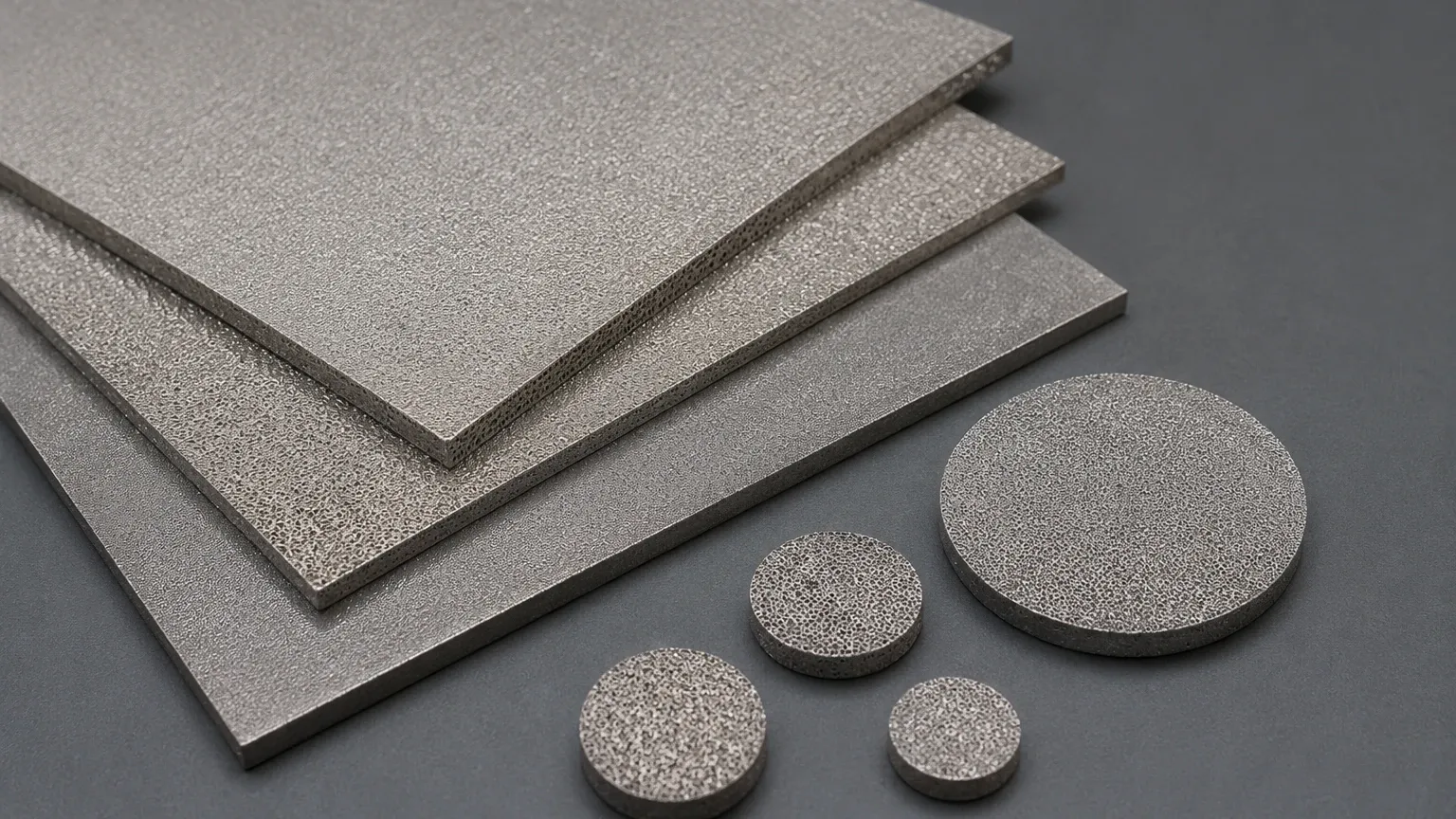
Design Customization and OEM Considerations
Industrial filtration is rarely a one-size-fits-all field. Sintered metal sheets are highly customizable to meet the specific geometric and functional requirements of a system.
Form Factors and Secondary Processing
Sintered sheets can be manufactured in various thicknesses, typically ranging from 0.5mm to 5mm. Beyond flat sheets, these materials can be further processed into:
* Sintered Discs: Used in laboratory equipment and small-scale chemical processing.
* Pleated Cartridges: By pleating the sintered sheet, the effective filtration area is significantly increased within the same footprint, allowing for higher flow rates and longer service intervals.
* Conical and Cylindrical Shapes: Often used in strainers and suction filters.
Custom Porosity Gradients
Advanced manufacturing allows for the creation of multi-layered sintered sheets. For example, a fine filtration layer can be sintered to a coarser support layer. This "asymmetric" structure provides the necessary filtration accuracy while maintaining the mechanical strength required to withstand high-pressure differentials.
Maintenance, Cleaning, and Lifecycle Management
The ability to regenerate a sintered metal sheet is one of its most valuable industrial properties. Unlike disposable filters that contribute to waste streams and require frequent downtime for replacement, sintered sheets can be cleaned using several methods:
1. Backpulsing/Backwashing: Reversing the flow of fluid through the media to dislodge accumulated particles from the surface.
2. Ultrasonic Cleaning: Using high-frequency sound waves in a cleaning solvent to remove fine particles trapped deep within the pore structure.
3. Chemical Cleaning: Using specific solvents or acids to dissolve contaminants without damaging the stainless steel structure.
4. Thermal Burn-off: In applications involving organic contaminants, the sheet can be heated to oxidize and remove the buildup.
Proper maintenance extends the lifecycle of the filter, ensuring that the initial investment continues to provide value over years of operation.
Critical Factors to Confirm Before Procurement
Before finalizing a specification for a sintered metal sheet, engineering and purchasing teams should confirm several operational parameters to ensure the media is fit for purpose.
Fluid Characteristics
Identify the viscosity, density, and chemical composition of the fluid. Is the fluid corrosive? Does it contain abrasive particles? These factors dictate the alloy selection and the required mechanical strength of the sheet.
Operating Conditions
Confirm the maximum operating temperature and pressure. Additionally, consider the potential for pressure spikes or thermal shock, which can affect the fatigue life of the metal structure.
Contaminant Profile
What is the nature of the solids being removed? Understanding the particle size distribution, concentration, and morphology (e.g., hard vs. gelatinous) is essential for selecting the correct micron rating and predicting the cleaning frequency.
Interface and Installation
How will the sheet be integrated into the existing housing? Sintered metal sheets can be welded, machined, or fitted with gaskets. It is crucial to ensure that the sealing mechanism is as robust as the filter media itself to prevent bypass—where unfiltered fluid escapes around the edges of the filter.
Conclusion
The sintered metal sheet represents a pinnacle of industrial filtration technology, offering a combination of precision, durability, and versatility that other media cannot match. By leveraging the principles of diffusion bonding and advanced metallurgy, these components provide reliable performance in the most demanding environments across the chemical, pharmaceutical, and food and beverage industries.
When selecting a filtration partner, it is important to work with manufacturers who understand these technical boundaries. Kaifil provides the engineering expertise and manufacturing precision necessary to develop customized filtration solutions that meet exact application requirements. Whether you are designing a new system or optimizing an existing process, the integration of high-quality sintered metal media is a proven strategy for achieving efficient, long-term filtration performance.
