


Sintered Metal Filter Market
The global sintered metal filter market is currently undergoing a significant transformation, driven by the increasing demand for high-performance filtration solutions in demanding industrial environments. As industries such as chemical processing, pharmaceutical manufacturing, and aerospace move toward more extreme operating conditions—including higher temperatures, corrosive atmospheres, and greater pressure differentials—the limitations of traditional polymer and fiberglass filters have become evident. Sintered metal media, known for its structural integrity and thermal stability, has emerged as the preferred choice for critical process applications.
For engineers and procurement professionals, understanding the nuances of the sintered metal filter market is essential for optimizing system performance and ensuring long-term reliability. This market is not merely about the procurement of components; it involves the integration of material science, precision engineering, and application-specific design to achieve desired filtration outcomes.
Understanding the Dynamics of the Sintered Metal Filter Market
The growth of the sintered metal filter market is fundamentally linked to the industrial shift toward sustainability and process efficiency. Unlike disposable filter elements, sintered metal components are cleanable and reusable, aligning with global initiatives to reduce industrial waste. This shift is particularly visible in sectors where the cost of downtime and the environmental impact of disposal are high.
Technological advancements in powder metallurgy and diffusion bonding have allowed manufacturers to produce filters with highly controlled porosity and pore size distribution. This precision is a primary driver in the market, as it enables the filtration of sub-micron particles even in high-viscosity fluids. Furthermore, the expansion of the green hydrogen sector has created a new frontier for the sintered metal filter market, where these components are used in electrolyzers and fuel cells to manage gas-liquid separation and provide structural support for membranes.
Technical Engineering Considerations for Sintered Media
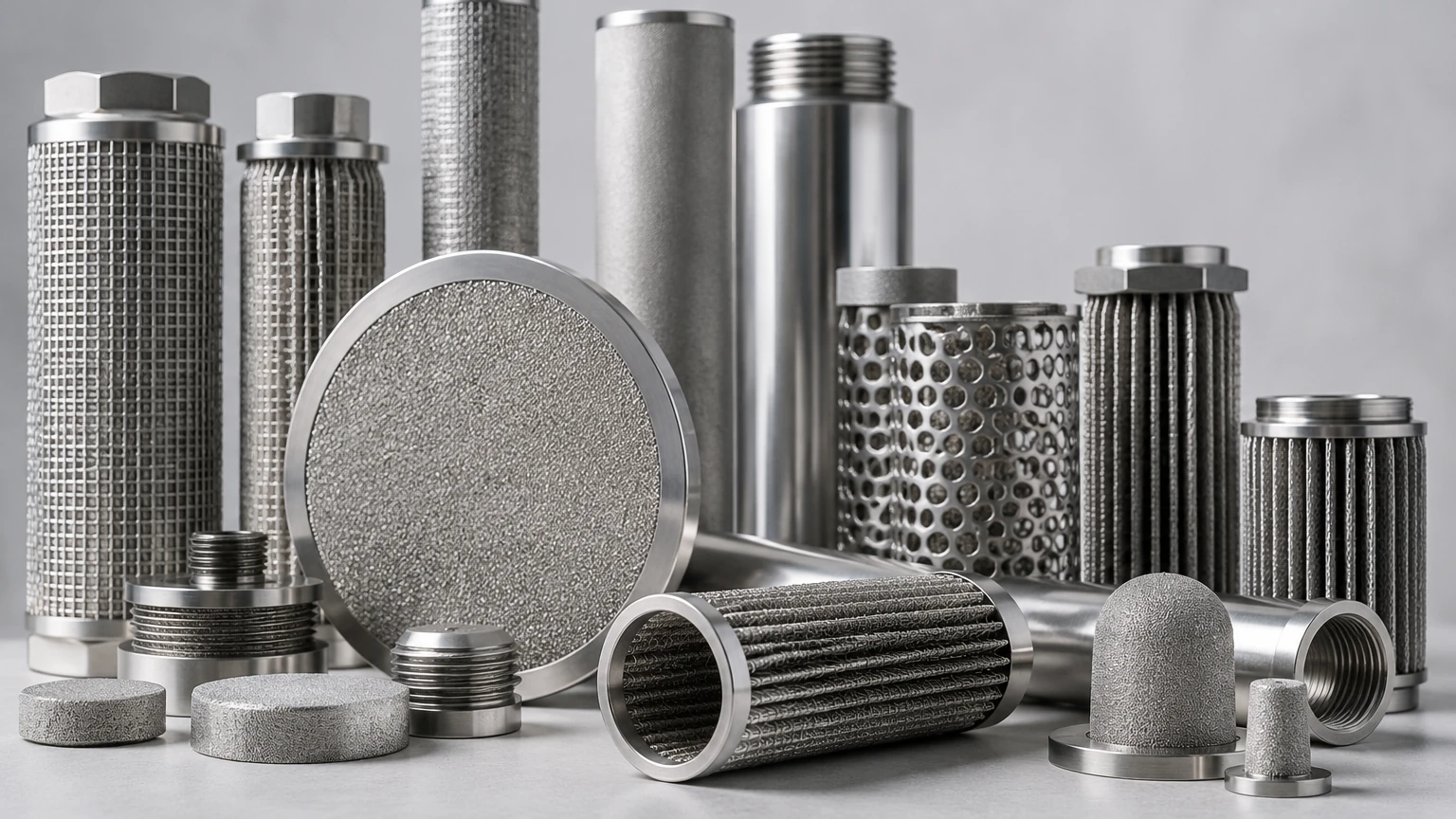
When navigating the sintered metal filter market, engineering teams must look beyond simple dimensions and focus on the technical properties that define performance. Sintered metal filters are typically manufactured by bonding metal powders or multiple layers of wire mesh through a thermal process known as sintering. This process occurs at temperatures just below the melting point of the metal, causing the particles or wires to fuse at their contact points.
Porosity and Permeability
Porosity refers to the percentage of void space within the filter media, while permeability measures the ability of the media to allow fluid flow under a given pressure drop. In the sintered metal filter market, achieving the right balance between these two is critical. High porosity reduces pressure drop and energy consumption but can compromise the mechanical strength of the filter. Engineers must specify the required flow rate and maximum allowable pressure drop to ensure the filter media is engineered correctly.
Micron Ratings: Absolute vs. Nominal
A common point of confusion in the market is the distinction between nominal and absolute micron ratings. A nominal rating is an electronic estimate of the particle size that the filter can capture, often based on weight percentage. In contrast, an absolute rating refers to the diameter of the largest spherical particle that can pass through the filter under specific test conditions. For critical applications in the pharmaceutical or semiconductor industries, absolute-rated sintered filters are mandatory to ensure process consistency.
Material Science in Industrial Filtration
Material selection is a cornerstone of the sintered metal filter market. The choice of alloy determines the filter's resistance to corrosion, oxidation, and mechanical stress. While several specialized alloys exist, the majority of industrial applications rely on stainless steel due to its versatility and cost-effectiveness.
* 316L Stainless Steel: This is the industry standard for the sintered metal filter market. The "L" stands for low carbon, which improves weldability and resistance to intergranular corrosion. 316L offers excellent resistance to many organic and inorganic acids, making it suitable for chemical processing and food production.
* 304 Stainless Steel: Often used in less aggressive environments, 304 provides good mechanical strength and basic corrosion resistance at a lower price point than 316L.
* Specialty Alloys: In environments involving high concentrations of chlorides or extreme temperatures (above 500°C), materials like Inconel, Monel, or Hastelloy may be specified. These alloys are increasingly common in the sintered metal filter market for specialized petrochemical and aerospace applications.
Application-Specific Demand Drivers
The sintered metal filter market serves a diverse range of industries, each with unique technical requirements. Understanding these drivers helps in selecting the right filtration partner.
Chemical and Petrochemical Processing
In these industries, filters are exposed to aggressive solvents and high-pressure catalysts. Sintered metal filters are used for catalyst recovery, where the ability to withstand back-pulsing (reverse flow cleaning) is essential. The mechanical strength of sintered media prevents the filter from collapsing under the high differential pressures common in these systems.
Food and Beverage Production
Cleanability and hygiene are the primary concerns here. Sintered stainless steel filters are ideal because they do not shed fibers into the product stream—a common risk with polymer filters. They can also withstand Steam-in-Place (SIP) and Clean-in-Place (CIP) sterilization cycles, which are standard in the industry. For a detailed look at how these solutions are implemented in professional environments, you can review product options and application support on our Main Page.
Pharmaceutical and Biotechnology
Precision is paramount in pharmaceutical applications. Sintered metal filters are used for gas sparging, carbon removal, and sterile filtration of steam. The market for these applications demands high levels of documentation and compliance with standards such as FDA and USP Class VI, ensuring that the filter materials do not leach contaminants into the drug products.
Selection Criteria: Evaluating Performance and Reliability
For purchasing teams, selecting a supplier in the sintered metal filter market requires a rigorous evaluation of technical capabilities. Relying on price alone often leads to higher total costs due to premature failure or inadequate filtration efficiency. Key evaluation criteria include:
1. Manufacturing Standards: Does the supplier use high-purity metal powders? Is the sintering process controlled in a vacuum or inert atmosphere to prevent oxidation?
2. Testing and Validation: Can the manufacturer provide bubble point test data, permeability curves, and material certifications (MTRs)?
3. Structural Integrity: For high-pressure applications, the filter must be able to withstand significant differential pressure without deforming. This requires expertise in both the sintering process and the subsequent welding/assembly of the filter housing.
4. Customization Capabilities: Many industrial systems require non-standard dimensions or unique end-fitting configurations. A supplier's ability to provide custom OEM solutions is a major differentiator in the sintered metal filter market.
Total Cost of Ownership and Maintenance
One of the most compelling arguments for investing in the sintered metal filter market is the favorable Total Cost of Ownership (TCO). While the initial purchase price of a sintered metal cartridge is higher than that of a disposable pleated paper or melt-blown filter, the long-term savings are significant.
Cleaning and Regeneration
Sintered metal filters can be cleaned using several methods, depending on the nature of the contaminant:
* Back-pulsing/Back-washing: Using a reverse flow of fluid or gas to dislodge particles from the surface of the filter.
* Ultrasonic Cleaning: Using high-frequency sound waves in a cleaning solution to remove fine particles trapped deep within the pores.
* Chemical Cleaning: Using acids, alkalis, or solvents to dissolve specific contaminants without damaging the metal structure.
* Thermal Cleaning (Burn-off): Using high temperatures to oxidize organic contaminants.
By regenerating the filter media, plants can extend the service life of a single element to several years, drastically reducing the cost per gallon filtered and minimizing the labor associated with frequent filter changes.
The Role of Customization in Modern Filtration Systems
In the current sintered metal filter market, a "one size fits all" approach is rarely successful. Every industrial process has unique variables, including fluid chemistry, flow dynamics, and space constraints. Customization allows for the optimization of the filter's surface area, which directly impacts the cleaning frequency and the overall footprint of the filtration system.
Customization often involves the design of specialized wire mesh laminates. By combining different layers of mesh—such as a fine filtration layer supported by coarser drainage and reinforcement layers—manufacturers can create a composite media that offers both high filtration accuracy and extreme mechanical robustness. This level of engineering is where the value of a professional manufacturer like Kaifil becomes apparent, providing tailored solutions that address specific operational challenges.
Future Trends in the Sintered Metal Filter Market
Looking ahead, the sintered metal filter market is expected to grow as industries prioritize decarbonization and resource efficiency. The development of even finer metal powders will allow for the creation of filters with higher dirt-holding capacities and lower resistance. Additionally, the integration of 3D printing (additive manufacturing) with traditional sintering techniques is beginning to allow for the creation of complex internal geometries that were previously impossible to manufacture. These innovations will further expand the applications for sintered metal media, solidifying its place as a critical technology in the global industrial landscape.
For engineers tasked with maintaining system integrity, the sintered metal filter market offers a robust toolkit of solutions. By focusing on material science, precise micron ratings, and the benefits of cleanable media, organizations can achieve superior filtration performance while supporting their sustainability goals. Whether dealing with high-temperature gas filtration or the delicate requirements of food-grade processing, the right sintered metal solution provides the reliability that modern industry demands.
