


Filtros De Aire Industriales
In modern industrial environments, the management of air quality and gas purity is a fundamental requirement for operational efficiency, equipment longevity, and product integrity. The implementation of high-quality filtros de aire industriales (industrial air filters) goes beyond simple dust collection; it involves complex engineering to handle high temperatures, corrosive gases, and high-pressure differentials. For engineers and procurement professionals, selecting the right filtration media is a critical decision that impacts both the initial capital expenditure and the long-term operational costs of a facility.
Industrial filtration systems are designed to remove particulate matter, aerosols, and contaminants from air streams in sectors ranging from chemical processing to food production. Unlike commercial HVAC filters, industrial-grade components must withstand rigorous cleaning cycles and maintain structural integrity under mechanical stress. This article explores the technical considerations, material science, and application-specific requirements for industrial air filtration solutions.
The Role of High-Performance Industrial Air Filtration
Industrial air filtration serves three primary purposes: protecting sensitive downstream equipment, ensuring the purity of the end product, and managing environmental emissions. In many processes, air is used as a medium for transport, cooling, or chemical reaction. Any contamination within this air stream can lead to catastrophic equipment failure or batch rejection.
For instance, in pneumatic conveying systems, the air must be free of moisture and solid particles to prevent the clogging of valves and the abrasion of piping. Similarly, in gas turbine applications, even microscopic particles can cause significant erosion on high-speed blades. High-performance filtros de aire industriales provide the necessary barrier to ensure that only clean, processed air enters these critical systems.
From a technical perspective, filtration is achieved through several mechanisms, including inertial impaction, interception, and diffusion. The choice of filter media determines which mechanism is dominant. While polymer-based filters are common in light-duty applications, heavy industrial processes often require the robustness of metal mesh or sintered metal components to handle the mechanical and thermal loads involved.
Engineering Specifications for Filtros de Aire Industriales
When evaluating filtration components, engineers must look past generic marketing claims and focus on specific technical metrics. The performance of an industrial air filter is defined by its efficiency, pressure drop, and holding capacity.
Filtration Efficiency and Micron Rating
Efficiency is typically expressed by the micron rating, which indicates the size of particles the filter can reliably capture. It is important to distinguish between nominal and absolute ratings. A nominal rating refers to the filter's ability to retain a percentage of particles of a given size, while an absolute rating indicates the diameter of the largest spherical particle that will pass through the filter under specified test conditions. For critical industrial processes, absolute-rated stainless steel mesh is often preferred for its predictable performance.
Pressure Drop (Differential Pressure)
Pressure drop, or $\Delta P$, is the difference in total pressure between the upstream and downstream sides of the filter. A high initial pressure drop indicates that the filter media is too restrictive for the required flow rate, which forces the system's fans or compressors to work harder, increasing energy consumption. Selecting filtros de aire industriales with an optimized pleat geometry can increase the effective surface area, thereby reducing the initial pressure drop and extending the service life between cleanings.
Flow Rate and Face Velocity
The volume of air passing through the filter per unit of time (CFM or $m^3/h$) must be balanced against the face velocity. If the velocity is too high, particles may be forced through the media or cause premature clogging. Engineering a solution requires calculating the optimal surface area to maintain a laminar flow profile across the filtration interface.
Material Advantages: Stainless Steel vs. Traditional Media
One of the most significant decisions in specifying industrial air filters is the choice of material. While fiberglass and synthetic fibers are cost-effective for one-time use, they often fail in demanding industrial environments. Stainless steel, particularly grades 304 and 316L, has become the industry standard for high-performance applications.
Temperature and Chemical Resistance
Many industrial processes involve exhaust gases or process air at temperatures exceeding 200°C. Synthetic filters will melt or degrade under these conditions. Stainless steel filtros de aire industriales can operate at temperatures up to 500°C (or higher with specialized alloys), making them indispensable for kiln exhausts, steam filtration, and high-temperature chemical reactors. Furthermore, 316L stainless steel offers superior resistance to corrosion from acidic or alkaline vapors, which would quickly disintegrate standard filter media.
Structural Integrity
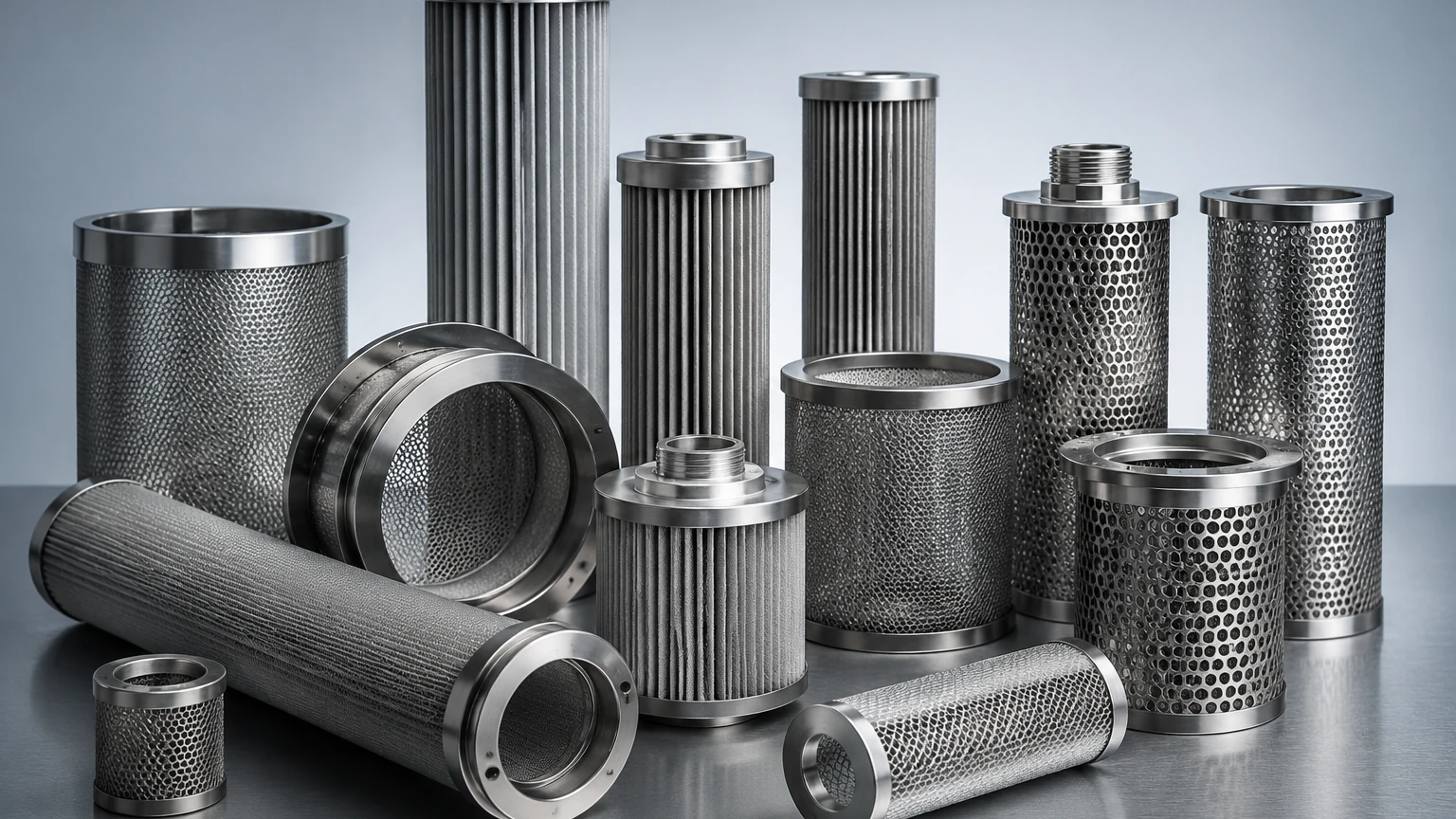
Industrial systems often experience pressure surges or mechanical vibrations. Metal mesh filters are structurally self-supporting or can be reinforced with internal cores and outer cages. This prevents media migration—a common failure in fiber filters where the filter material itself sheds particles into the clean air stream.
Reusability and Sustainability
Unlike disposable filters that contribute to industrial waste, stainless steel filter cartridges are cleanable and reusable. Methods such as ultrasonic cleaning, backwashing, or chemical cleaning can restore the filter to near-original pressure drop levels. This recyclability significantly reduces the total cost of ownership over the life of the equipment. For more information on durable filtration components, you can visit the Main Page of professional manufacturers to review technical specifications.
Application-Specific Filtration Strategies
Different industries present unique challenges that dictate the design of filtros de aire industriales. Understanding these nuances is key to selecting a successful filtration strategy.
Chemical and Petrochemical Processing
In these environments, air filters are often exposed to volatile organic compounds (VOCs) and corrosive gases. The filtration system must not only capture particulates but also resist chemical attack. Sintered metal fiber felt is frequently used here because it combines high porosity with excellent chemical resistance, allowing for high flow rates in compact housings.
Food and Beverage Production
Hygiene is the primary concern in food-grade air filtration. Air used for drying, packaging, or aeration must be sterile. Stainless steel wire mesh filters are ideal because they can be easily sterilized using SIP (Steam-In-Place) or CIP (Clean-In-Place) protocols. The non-shedding nature of metal media ensures that no contaminants are introduced into the food product.
Pharmaceutical Manufacturing
Pharmaceutical processes require extremely high filtration efficiency to prevent cross-contamination between batches. Precision-engineered metal filter cartridges provide the consistent pore size distribution necessary to meet stringent regulatory standards. These filters are often used as pre-filters for HEPA systems to extend the life of more expensive terminal filters.
Technical Evaluation and Selection Criteria
To ensure the selected filtros de aire industriales meet the application requirements, engineers should conduct a thorough technical evaluation. This process involves confirming several key parameters with the manufacturer:
1. Pore Size Distribution: Beyond a single micron rating, understanding the distribution of pore sizes helps predict how the filter will behave as it begins to load with dust.
2. Compatibility Testing: Ensure that the gaskets and seals (O-rings) used in the filter housing are compatible with the process gas and operating temperature. Common materials include Viton, EPDM, and PTFE.
3. Mechanical Strength: Determine the maximum allowable differential pressure ($DP_{max}$) before the filter element risks structural collapse.
4. Cleaning Protocols: Confirm that the filter media can withstand the intended cleaning method (e.g., high-pressure water, solvents, or thermal burnout).
By addressing these factors during the procurement phase, technical teams can avoid unexpected downtime and reduce the frequency of unplanned maintenance interventions.
Customization and OEM Solutions in Air Filtration
Standard off-the-shelf filters often fall short in specialized industrial machinery. This is where customized OEM (Original Equipment Manufacturer) solutions become valuable. Customization allows for the optimization of the filter’s dimensions, end-cap configurations, and media layers to fit specific housing constraints or performance targets.
For example, a manufacturer might require a custom-pleated stainless steel cartridge that fits into a legacy housing but offers 30% more surface area to handle an increased production capacity. Working with a manufacturer that understands both the metallurgy and the fluid dynamics of filtration is essential for developing these bespoke filtros de aire industriales. Custom solutions also allow for the integration of specialized features like magnetic inserts for capturing metallic fines or multi-stage media for gradient density filtration.
Optimization of Lifecycle and Maintenance Costs
The total cost of ownership (TCO) for industrial air filtration includes the purchase price, energy costs related to pressure drop, maintenance labor, and disposal costs. While stainless steel filters have a higher initial price point than disposable alternatives, their TCO is often significantly lower due to their long service life and cleanability.
To optimize the lifecycle of filtros de aire industriales, facilities should implement a condition-based maintenance program. By monitoring the differential pressure across the filter bank, maintenance teams can clean the elements only when necessary, rather than on a fixed schedule. This prevents unnecessary wear on the media and ensures the system always operates within its most energy-efficient range.
In conclusion, industrial air filtration is a complex discipline that requires a balance of material science and mechanical engineering. Whether the goal is to protect a high-speed compressor or ensure the sterility of a pharmaceutical cleanroom, the selection of high-quality stainless steel filtration components is a proven strategy for achieving reliable, long-term performance. For those seeking to explore advanced filtration options or custom designs, visiting the Main Page of an experienced manufacturer provides access to the technical expertise needed to solve the most challenging filtration problems.
