


304 Stainless Steel Mesh Filter
In the landscape of industrial filtration, the 304 stainless steel mesh filter stands as one of the most versatile and widely utilized components. Engineering teams across diverse sectors—ranging from chemical processing to food production—rely on this material for its balanced combination of mechanical strength, corrosion resistance, and cost-effectiveness. As a specialized manufacturer, Kaifil provides precision-engineered filtration solutions that leverage the specific metallurgical properties of AISI 304 to meet demanding operational requirements.
Selecting the appropriate filtration media requires a deep understanding of material science, fluid dynamics, and the specific environmental stressors of the application. This guide examines the technical specifications, performance metrics, and engineering considerations essential for integrating a 304 stainless steel mesh filter into industrial systems.
Technical Properties of AISI 304 in Filtration
The performance of a 304 stainless steel mesh filter is fundamentally rooted in its chemical composition. AISI 304 is an austenitic stainless steel containing approximately 18% chromium and 8% nickel. This "18/8" structure provides the material with its characteristic resistance to oxidation and corrosion in a variety of environments.
Corrosion Resistance
In most atmospheric conditions and many organic and inorganic chemical environments, 304 stainless steel remains passive. It forms a self-healing chromium oxide layer that prevents deep-pitting and surface degradation. While 316 stainless steel is often preferred for high-chloride or marine environments, 304 is the industry standard for general industrial water treatment, hydraulic oils, and food-grade applications where extreme acidity or salinity is not present.
Temperature Stability
Industrial processes often involve thermal fluctuations. A 304 stainless steel mesh filter can maintain its structural integrity at temperatures up to 870°C (1600°F) for intermittent service and approximately 925°C (1700°F) for continuous service. However, for filtration applications, engineers must also consider the thermal expansion of the mesh relative to the filter housing to prevent bypass or mechanical failure of the seals.
Mechanical Strength and Fabricability
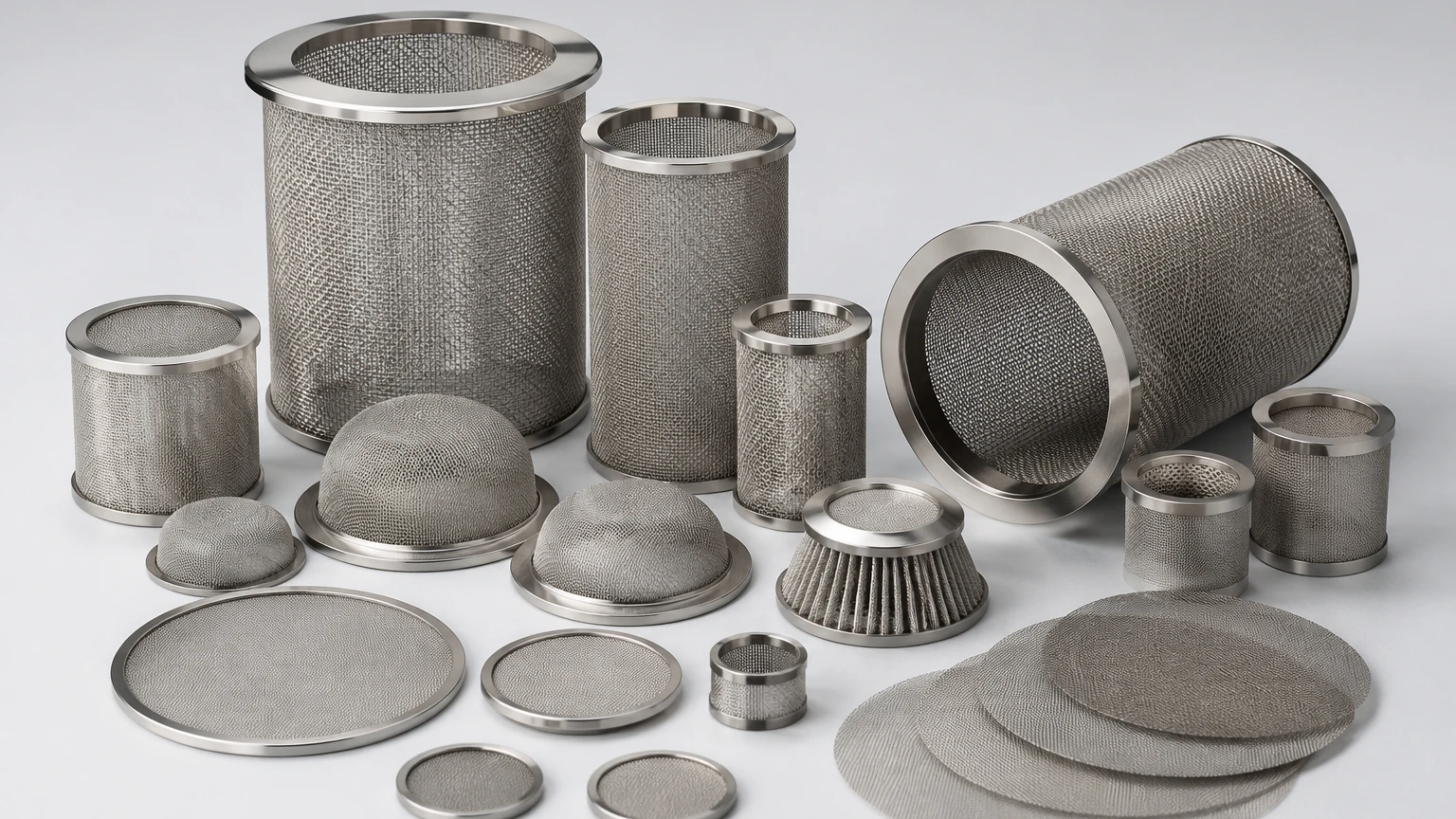
The high tensile strength of 304 wire allows for the production of very fine meshes that can withstand significant differential pressures without deforming. This ductility also makes it an ideal candidate for customized fabrication, including pleating, welding into cylindrical cartridges, or forming into complex conical shapes.
Weave Patterns and Their Impact on Filtration
The geometry of the weave determines the pore size, flow rate, and particle retention capabilities of the 304 stainless steel mesh filter. Understanding these patterns is critical for matching the filter to the specific contaminant profile of a fluid stream.
Plain Weave
This is the most common weave, where each warp wire crosses alternately over and under each shute wire. It provides a simple, square opening and is typically used for coarse to medium filtration. It offers the highest open area percentage, which translates to lower initial pressure drops.
Twill Weave
In a twill weave, each shute wire passes alternately over and under two warp wires. This allows for the use of heavier wire diameters in a given mesh count, resulting in a stronger mesh. Twill weaves are often employed when the filter must handle higher mechanical loads or when a finer mesh is required than what plain weave can achieve with a specific wire thickness.
Dutch Weave (Plain and Twill)
Dutch weaves utilize different diameters for warp and shute wires. The shute wires are driven closely together, creating a dense, wedge-shaped opening rather than a square one.
- Plain Dutch Weave: Offers high strength and is excellent for high-pressure filtration.
- Twill Dutch Weave: Allows for the finest filtration levels (down to 5-10 microns) by overlapping multiple wires, creating a tortuous path for particles.
Engineering Metrics for Filter Selection
When specifying a 304 stainless steel mesh filter, engineers must evaluate several key metrics to ensure the component meets the system's performance goals. For detailed technical specifications and support, engineers often Review product options and application support to align mesh characteristics with operational needs.
Micron Rating: Nominal vs. Absolute
- Nominal Rating: Indicates the ability of the mesh to retain a majority of particles of a specific size (e.g., 90% of 20-micron particles). This is often used for square meshes.
- Absolute Rating: Refers to the diameter of the largest hard spherical particle that will pass through the filter under specified test conditions. For critical applications, such as protecting high-pressure nozzles or sensitive valves, absolute ratings are mandatory.
Open Area and Flow Velocity
The percentage of open area determines the flow capacity of the filter. A higher open area reduces the velocity of the fluid as it passes through the mesh, which decreases the likelihood of particle "breakthrough" and minimizes the pressure drop across the element. Engineers must balance the need for fine filtration (which usually reduces open area) with the required flow rate of the system.
Differential Pressure (ΔP)
The pressure drop across a clean 304 stainless steel mesh filter is a function of fluid viscosity, flow velocity, and mesh geometry. It is vital to calculate the "terminal pressure drop"—the point at which the filter is considered blinded and must be cleaned or replaced—to prevent system cavitation or structural collapse of the filter element.
Customization and Structural Design
Standard mesh sheets are rarely used in isolation within industrial systems. Instead, they are fabricated into complex components designed for specific flow paths. Kaifil specializes in these customized configurations to ensure the 304 stainless steel mesh filter performs reliably under stress.
Multi-Layer Sintered Mesh
For applications involving high pressures or backwashing, a single layer of mesh may lack sufficient rigidity. Sintering involves bonding multiple layers of 304 mesh together using heat and pressure without the use of binders. This creates a monolithic structure that combines a fine filtration layer with heavy-duty support layers, significantly increasing the mechanical strength and lifespan of the filter.
Pleated Cartridge Construction
Pleating the mesh increases the effective filtration surface area within the same footprint. This design choice is ideal for systems with high contaminant loads, as it extends the time between cleaning cycles and reduces the frequency of maintenance-related downtime.
Reinforced Support Cores
In high-viscosity or high-pressure hydraulic applications, the mesh is often wrapped around a perforated stainless steel core. This core provides the necessary hoop strength to prevent the mesh from collapsing inward under the force of the fluid flow.
Industrial Applications and Compliance
The 304 stainless steel mesh filter is a staple in industries where durability and hygiene are paramount.
Food and Beverage Processing
In the food industry, 304 stainless steel is favored for its ease of cleaning and resistance to food acids. It is used in the filtration of syrups, beverages, and oils. Because it is a non-leaching material, it ensures that the end product remains free from metallic contamination, meeting stringent safety standards.
Chemical and Petrochemical
While 316 is used for more aggressive acids, 304 is highly effective for filtering polymers, resins, and various industrial solvents. Its ability to withstand high temperatures makes it suitable for hot gas filtration and catalyst recovery processes.
Hydraulic and Lubrication Systems
Precision machinery requires clean oil to prevent component wear. 304 mesh filters are used as suction strainers or high-pressure inline filters to remove metallic shavings, silica, and other particulates that could damage pumps and actuators.
Maintenance, Cleaning, and Total Cost of Ownership
One of the primary advantages of a 304 stainless steel mesh filter over disposable polymer or paper filters is its cleanability. This characteristic significantly reduces the total cost of ownership (TCO) by eliminating the recurring cost of replacement elements and reducing waste disposal volumes.
Cleaning Methodologies
- Ultrasonic Cleaning: Uses high-frequency sound waves to create cavitation bubbles that dislodge microscopic particles from deep within the mesh weave.
- Backwashing: Reversing the flow of the fluid to push contaminants out of the mesh. This is often automated in continuous process systems.
- Chemical Cleaning: Utilizing compatible solvents or mild acids to dissolve organic or mineral scale buildup without damaging the 304 substrate.
Determining Replacement Cycles
Despite their durability, 304 mesh filters are not infinite. Over many cleaning cycles, the wire may experience work hardening or stress corrosion cracking, particularly if subjected to high-frequency vibrations. Regular inspection for "blinded" areas (pores that cannot be cleaned) and mechanical tears is essential for maintaining system integrity.
Procurement Checklist for Engineers
Before finalizing a specification for a 304 stainless steel mesh filter, technical professionals should confirm the following data points with their manufacturer:
1. Fluid Compatibility: Confirm that the pH and chemical composition of the fluid will not cause localized pitting of the 304 alloy.
2. Operating Pressure: Define both the normal operating pressure and the maximum surge pressure the filter must withstand.
3. Particle Profile: Identify the size, shape, and concentration of the contaminants to select the optimal weave and micron rating.
4. Seal Requirements: Ensure that the gaskets or O-rings used in the filter housing (e.g., Viton, EPDM, or PTFE) are compatible with the process fluid and temperature.
5. Flow Rate Requirements: Calculate the required surface area to maintain an acceptable pressure drop at maximum flow.
By addressing these technical variables, engineering teams can ensure that their choice of a 304 stainless steel mesh filter provides reliable, long-term performance in even the most demanding industrial environments. For further technical guidance on custom filtration components, visiting the Main Page provides access to specialized engineering resources and product capabilities.
