


Koalescer
In industrial process engineering, the separation of immiscible liquids or the removal of liquid aerosols from gas streams is a critical requirement for maintaining equipment integrity and product purity. A koalescer (often referred to in English as a coalescer) is a specialized filtration and separation device designed to merge small droplets of a dispersed phase into larger droplets, which can then be easily separated from the continuous phase based on density differences.
For engineers and procurement specialists, understanding the technical nuances of koalescer design—particularly the role of stainless steel wire mesh and precision metal components—is essential for optimizing system performance. Whether the application involves removing water from aviation fuel, separating oil from wastewater, or protecting downstream compressors from liquid carryover, the efficiency of the koalescer directly impacts operational costs and system reliability.
The Fundamental Principles of Coalescence
Coalescence is a multi-stage physical process. Unlike standard particulate filtration, which relies on mechanical sieving to trap solids, a koalescer focuses on the phase behavior of liquids and gases. The process generally follows three distinct stages:
1. Droplet Capture: As the contaminated fluid passes through the coalescing media, the small droplets of the dispersed phase (such as water in oil) come into contact with the fibers or wires of the media. This is achieved through mechanisms like inertial impaction, brownian motion, or direct interception.
2. Wetting and Attachment: The effectiveness of the capture depends heavily on the surface properties of the media. In a well-designed koalescer, the media is selected to be "preferentially wetted" by the dispersed phase. For instance, if water is being removed from oil, the media should be hydrophilic. As droplets attach to the surface, they spread out and form a film.
3. Droplet Growth and Release: As more droplets are captured, they merge (coalesce) with the existing liquid film. Once the combined mass of the droplet becomes large enough that the drag force of the flowing fluid or the force of gravity exceeds the surface tension holding it to the media, the enlarged droplet is released. These larger droplets then settle out of the stream due to the density differential between the two phases.
Technical Considerations in Koalescer Media Selection
The choice of media is the most critical factor in the design of a koalescer. While synthetic fibers like fiberglass or polyester are common, industrial applications involving high temperatures, high pressures, or chemically aggressive fluids often require stainless steel wire mesh or sintered metal components.
Stainless Steel Wire Mesh
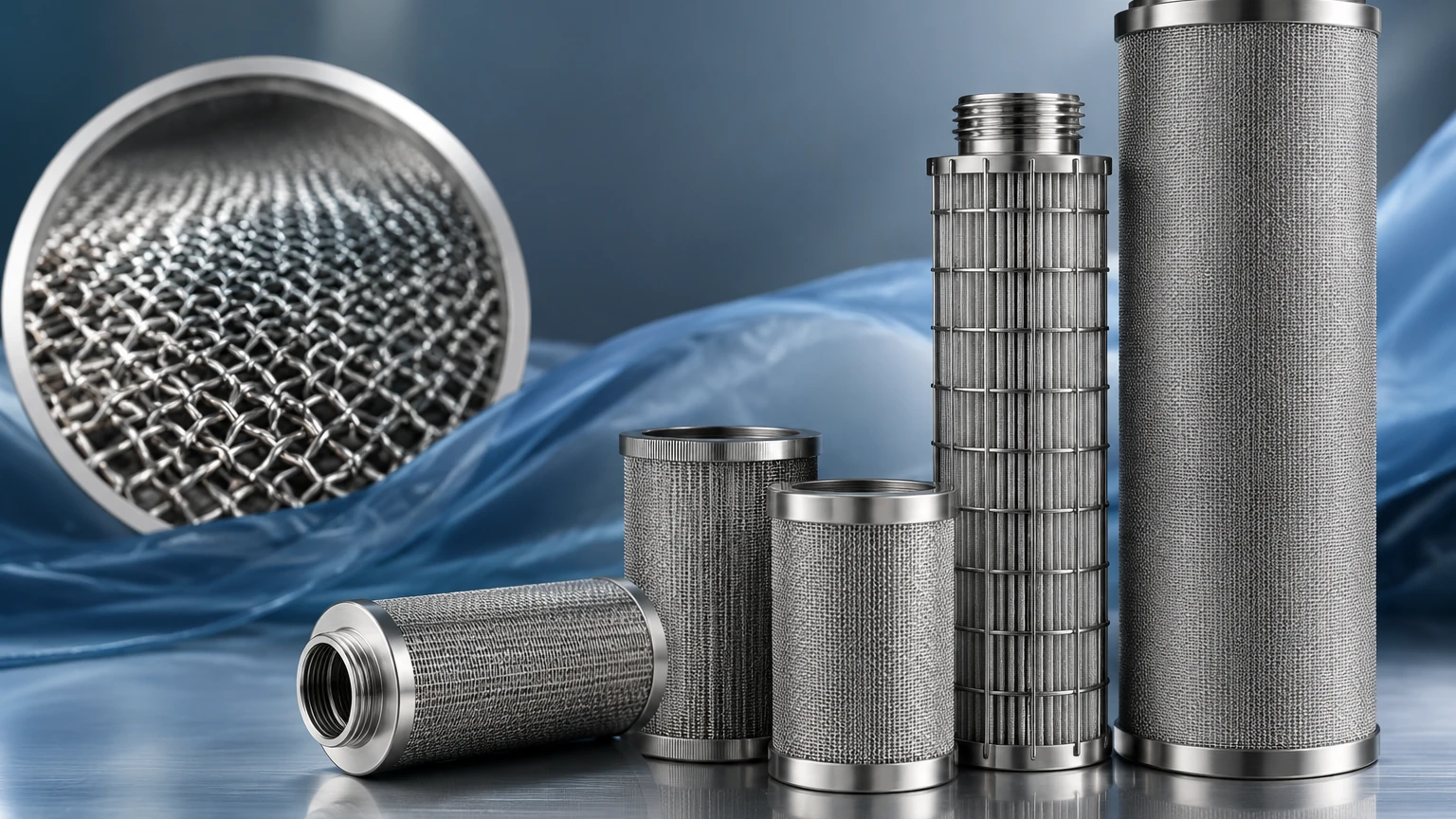
Stainless steel mesh provides a rigid, durable structure that can withstand significant differential pressures without deforming. In many high-performance koalescer units, multiple layers of varying mesh counts are used to create a gradient. The initial layers might provide pre-filtration for solids, while the inner layers feature a specific weave density designed to maximize the surface area for droplet impingement.
Surface Tension and Interfacial Tension
Engineers must consider the interfacial tension (IFT) between the two liquids. Low IFT (typically below 20 dynes/cm) makes coalescence significantly more difficult because the droplets are more stable and less likely to merge. In such cases, specialized surface treatments or extremely fine stainless steel fibers may be required to facilitate the merging process.
Compatibility and Corrosion Resistance
In chemical processing and offshore oil and gas applications, the koalescer must resist corrosion. Stainless steel grades like 304 and 316L are standard, but for environments involving high chloride concentrations or acidic conditions, high-nickel alloys may be integrated into the filter structure. This ensures a long service life and prevents metallic contamination of the process stream.
Liquid-Liquid vs. Gas-Liquid Coalescence
While the underlying physics of merging droplets remains similar, the engineering approach differs between liquid-liquid and gas-liquid separation.
Liquid-Liquid Separation
This is most commonly seen in oil-water separation. The koalescer element is usually oriented horizontally or vertically within a pressure vessel. Because the density difference between two liquids is often small, the velocity through the media must be carefully controlled to prevent the newly formed large droplets from being shattered by turbulence.
Gas-Liquid Separation
In gas streams, the goal is to remove liquid aerosols (mist). These units are often called "mist eliminators." The gas flows through a knitted wire mesh pad or a cartridge-style koalescer. Gravity plays a larger role here; as droplets grow on the mesh, they eventually become heavy enough to fall against the gas flow (in vertical vessels) or drain into a sump (in horizontal vessels). High-efficiency gas koalescers can remove droplets down to 0.3 microns with 99.9% efficiency.
Engineering Design Parameters for Industrial Applications
When specifying a koalescer for an industrial system, several engineering parameters must be evaluated to ensure the unit does not become a bottleneck or a point of failure.
* Flux Rate (Velocity): The velocity of the fluid through the media is paramount. If the velocity is too high, the residence time is insufficient for droplets to capture and merge. Conversely, if it is too low, the vessel becomes unnecessarily large and expensive.
* Pressure Drop (ΔP): A clean koalescer should have a low initial pressure drop. As the media captures fine solids (which often coexist with the dispersed liquid phase), the ΔP will rise. Monitoring this is essential for determining the maintenance cycle.
* Viscosity: Higher viscosity of the continuous phase (e.g., heavy hydraulic oil) slows down the rate at which droplets can move toward each other and the media, requiring a larger surface area or a slower flow rate.
* Vessel Internal Design: The koalescer element is only one part of the solution. The vessel must include quiet zones, baffles, or settling chambers to allow the enlarged droplets to separate from the main flow without being re-entrained.
Common Risks and Operational Challenges
Despite their efficiency, koalescer systems are susceptible to specific operational risks that can degrade performance:
1. Surfactant Poisoning: Surfactants (surface-active agents) reduce the interfacial tension of the liquids. If surfactants are present, they can coat the coalescing media, preventing the dispersed phase from wetting the surface. This effectively "blinds" the koalescer, causing it to pass the dispersed phase through without separation.
2. Solid Contamination: Koalescers are not primary particulate filters. If the process fluid contains high levels of solids, the fine pores of the coalescing media will clog rapidly. It is standard engineering practice to install a high-quality pre-filter upstream of the koalescer to protect the more expensive coalescing elements.
3. Flow Surges: Sudden increases in flow rate can create high-velocity spikes that shear apart the droplets currently forming on the media, leading to a "breakthrough" where the outlet fluid is contaminated.
The Role of Customization in Filtration Performance
Off-the-shelf filtration solutions rarely meet the precise needs of complex industrial processes. Customization in the manufacturing of the internal components—such as the support cores, end caps, and the specific layering of the stainless steel mesh—allows for a tailored approach to specific fluid dynamics.
For instance, in hydraulic systems, the koalescer must handle high-pressure pulses while maintaining a compact footprint. In pharmaceutical applications, the focus shifts to material traceability and the ability to withstand rigorous cleaning protocols (CIP/SIP). By working with a manufacturer that understands the nuances of metal fabrication and filtration science, engineers can ensure that the koalescer housing and elements are optimized for the specific chemical and physical properties of their process.
Maintenance and Total Cost of Ownership
While the initial purchase price of a stainless steel koalescer element may be higher than that of a disposable synthetic version, the total cost of ownership (TCO) is often lower in demanding environments. Stainless steel components offer:
* Cleanability: Many metal-based koalescer elements can be cleaned using ultrasonic baths or chemical solvents, extending their lifespan significantly compared to one-time-use cartridges.
* Durability: Resistance to pressure spikes and mechanical shock reduces the risk of bypass or catastrophic failure.
* Predictability: Consistent manufacturing tolerances in wire mesh ensure that the filtration rating remains stable over the life of the product.
Before finalizing a procurement decision, technical teams should confirm the compatibility of the media with all potential process chemicals, the expected solids loading, and the required effluent purity levels.
To explore high-performance stainless steel filtration components and customized solutions for your industrial separation needs, you can Review product options and application support on the Kaifil website. Accessing professional engineering guidance during the design phase ensures that the selected filtration technology aligns with the long-term operational goals of the facility.
