


Stainless Steel Filter Basket
In the landscape of industrial fluid management, the stainless steel filter basket serves as a critical component for protecting downstream equipment and ensuring product purity. Unlike disposable filtration media, these robust components are engineered for durability, high-pressure tolerance, and repeated cleaning cycles. For engineers and procurement specialists in sectors such as chemical processing, food and beverage, and water treatment, selecting the correct basket design is not merely a matter of dimensions, but a complex calculation involving material science, fluid dynamics, and operational efficiency.
As a specialized manufacturer, Kaifil focuses on providing precision-engineered filtration solutions that address the specific challenges of demanding industrial environments. Understanding the technical nuances of a stainless steel filter basket is essential for optimizing system performance and reducing the total cost of ownership.
The Engineering Fundamentals of Filter Baskets
A stainless steel filter basket is typically housed within a strainer or a filter vessel. Its primary function is to remove solid contaminants from a liquid or gas stream. While the concept is straightforward, the engineering behind a high-performance basket involves several layers of design.
Material Selection: 304 vs. 316L Stainless Steel
The choice of alloy is the first and most critical decision in the specification process.
* Type 304 Stainless Steel: This is the standard grade for general industrial use. It offers excellent strength and good corrosion resistance for water treatment and most food-grade applications. However, it is susceptible to pitting in high-chloride environments.
* Type 316L Stainless Steel: For applications involving chemicals, pharmaceuticals, or marine environments, 316L is the preferred choice. The addition of molybdenum enhances its resistance to corrosion and pitting, while the "L" (low carbon) designation ensures better weldability and prevents intergranular corrosion in the heat-affected zones of the basket's structure.
In specialized cases, exotic alloys may be used, but for the vast majority of industrial filtration needs, 316L provides the optimal balance of performance and cost-effectiveness.
Structural Design and Construction Types
Industrial filter baskets are rarely made of a single layer of material. They are usually composite structures designed to balance filtration accuracy with mechanical strength.
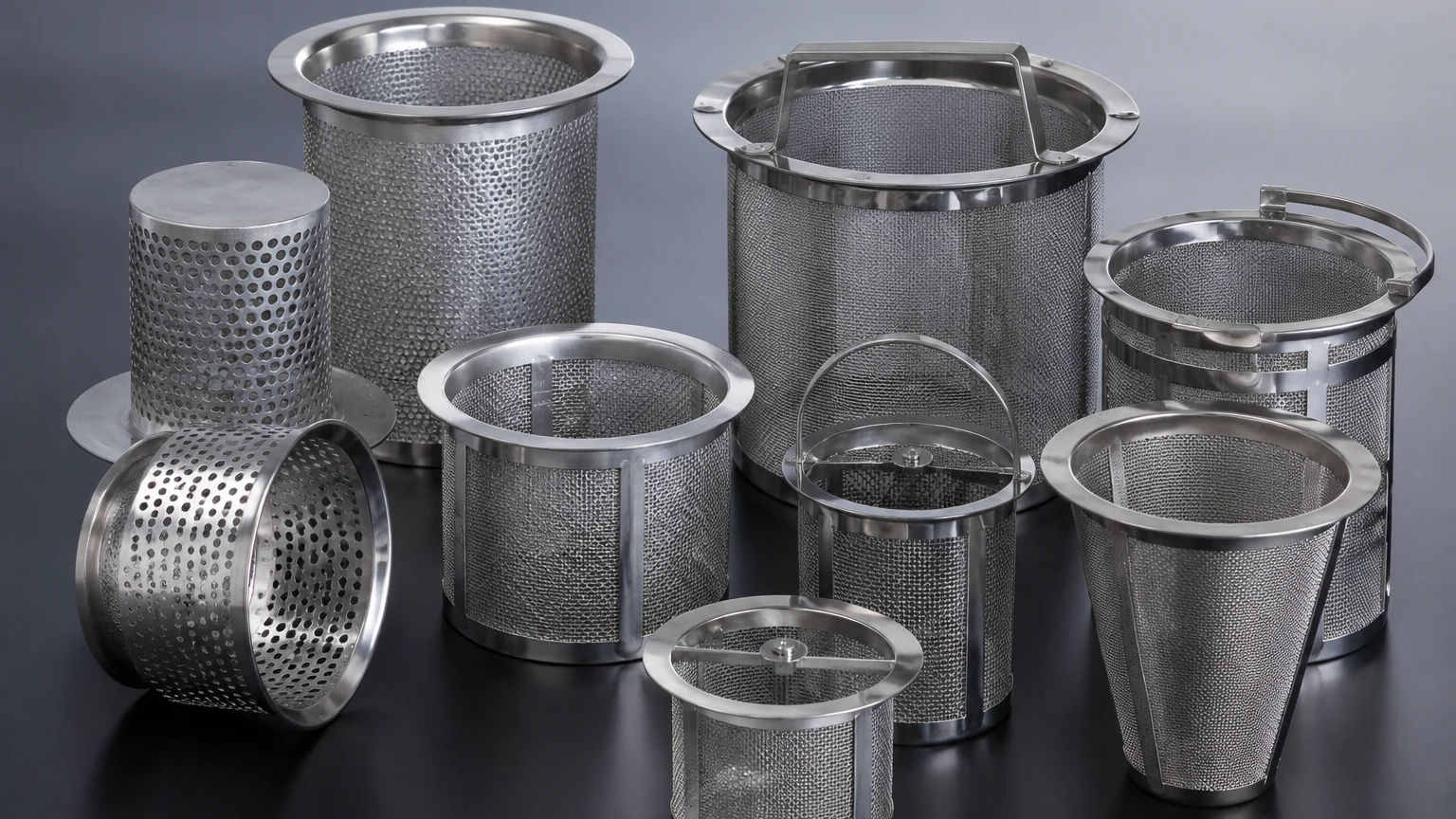
Perforated Metal Support
The outermost layer of a filter basket is typically a perforated metal sheet. This provides the structural "skeleton" that allows the basket to withstand high differential pressures without collapsing. The hole size and pattern (staggered or straight) are calculated to maximize the open area while maintaining the integrity of the cylinder or cone.
Wire Mesh Liners
For finer filtration requirements, a stainless steel wire mesh liner is sintered or welded to the interior of the perforated support. These liners can range from coarse meshes (for large debris removal) to ultra-fine weaves capable of capturing particles down to 5-10 microns. The weave type—whether plain, twilled, or Dutch weave—affects the flow rate and the ease of cleaning.
Reinforcement and Fabrication
High-quality baskets utilize TIG (Tungsten Inert Gas) welding or plasma welding to ensure smooth, crevice-free joints. This is particularly important in sanitary applications, such as the food and beverage industry, where any small gap could harbor bacterial growth. Reinforced bottoms and heavy-duty flanges are often added to prevent bypass and ensure the basket seats correctly within the housing.
Key Performance Indicators (KPIs) for Filtration
When evaluating a stainless steel filter basket, engineers must look beyond the physical dimensions and focus on performance metrics that impact the entire process line.
1. Effective Filtration Area (EFA)
The EFA is the total surface area available for the fluid to pass through. A larger EFA results in a lower flux (velocity through the media), which leads to a lower initial pressure drop and a longer service life between cleanings. If the EFA is too small, the basket will clog rapidly, leading to frequent downtime.
2. Differential Pressure (ΔP) Tolerance
As a filter basket captures debris, the pressure difference between the inlet and outlet increases. A well-designed basket must be able to withstand the maximum expected differential pressure of the system without deforming. This is where the thickness of the perforated support and the quality of the welds become vital.
3. Micron Rating and Efficiency
It is essential to distinguish between nominal and absolute micron ratings. A nominal rating indicates that the basket will stop a certain percentage of particles of a given size, whereas an absolute rating implies that 99.9% of particles above that size will be captured. For critical applications, such as protecting high-pressure nozzles or sensitive pumps, absolute-rated mesh liners are often required.
Customization Parameters for OEM Applications
Standard off-the-shelf baskets often fail to meet the specific needs of unique industrial processes. Customization is a core strength of manufacturers like Kaifil, allowing for the integration of specific features that simplify operation and maintenance.
* Handle Designs: Depending on the weight of the basket and the frequency of removal, handles can be designed as fixed bails, swing handles, or even threaded lifting eyes for heavy-duty industrial strainers.
* Gasket and Seal Integration: To prevent fluid bypass, baskets can be fitted with O-rings or flat gaskets made of EPDM, Viton, or PTFE. The choice of seal must be compatible with the process fluid and temperature.
* Magnetic Inserts: In metalworking or hydraulic applications, magnetic bars can be integrated into the center of the basket to capture fine ferrous particles that might otherwise pass through the mesh.
* Multi-Stage Filtration: Some designs incorporate multiple layers of different mesh counts within a single basket to provide graduated filtration, capturing large debris in the outer layers and finer particles toward the center.
For those looking to optimize their specific filtration setup, you can Review product options and application support to see how customized designs can be tailored to your existing infrastructure.
Maintenance, Cleaning, and Operational Longevity
One of the primary advantages of a stainless steel filter basket over disposable bags or cartridges is its reusability. However, the longevity of the component depends heavily on the cleaning protocol.
Cleaning Methods
* Manual Cleaning: For coarse baskets, a simple high-pressure water wash or manual scrubbing is often sufficient.
* Ultrasonic Cleaning: For fine mesh liners that have become blinded by sticky or microscopic particles, ultrasonic baths are highly effective at dislodging contaminants without damaging the delicate wire weave.
* Chemical Soaking: In the chemical or food industries, baskets may be soaked in caustic or acidic solutions to dissolve organic buildup or mineral scales. This is where the corrosion resistance of 316L stainless steel is indispensable.
* Backwashing: In automated systems, the basket may be cleaned in place (CIP) by reversing the flow of the fluid to blow debris off the surface of the mesh.
Inspection Cycles
Regular inspection is necessary to check for signs of mechanical fatigue, such as broken wires in the mesh or cracked welds. Even the most durable stainless steel filter basket will eventually show wear, and proactive replacement is significantly cheaper than the cost of a downstream pump failure caused by a ruptured filter.
Technical Checklist for Procurement
Before placing an order for a replacement or a new project, engineers should confirm the following technical details to ensure compatibility and performance:
1. Fluid Characteristics: What is the viscosity, temperature, and chemical composition of the fluid?
2. Flow Rate: What is the maximum and normal operating flow rate (GPM or m³/h)?
3. Contaminant Load: Is the debris load heavy or light? Is the debris hard, soft, or fibrous?
4. Housing Dimensions: Confirm the inner diameter, depth, and flange type of the existing filter housing.
5. Allowable Pressure Drop: What is the maximum pressure drop the system can tolerate before cleaning is required?
6. Regulatory Compliance: Does the basket need to meet FDA, 3A, or other industry-specific sanitary standards?
Conclusion
The stainless steel filter basket is a workhorse of industrial filtration, providing a reliable and cost-effective means of protecting equipment and maintaining process quality. By focusing on material integrity, structural design, and specific application requirements, engineering teams can ensure they select a component that offers high performance and a long service life.
Whether you are designing a new system or looking to improve the efficiency of an existing one, working with a manufacturer that understands the complexities of metal filtration is key. For more information on custom filtration components and engineering support, visit the Kaifil Main Page to explore technical specifications and manufacturing capabilities tailored to your industry.
