


Abwasserfiltration
Industrial wastewater management, or abwasserfiltration, is a critical process for modern manufacturing facilities, chemical plants, and municipal treatment centers. As environmental regulations become increasingly stringent and the cost of raw water rises, the efficiency of filtration systems directly impacts both operational compliance and the bottom line. For engineers and procurement teams, selecting the right filtration medium is not merely a matter of capturing debris; it involves a complex evaluation of fluid dynamics, chemical compatibility, and long-term structural integrity.
At Kaifil, we specialize in providing high-performance stainless steel filtration solutions designed to meet the rigorous demands of industrial abwasserfiltration. By moving away from disposable media toward durable, cleanable metal components, facilities can achieve higher precision and lower total cost of ownership.
The Fundamentals of Industrial Abwasserfiltration
Abwasserfiltration refers to the mechanical separation of solids from liquid waste streams. In an industrial context, this process often involves removing suspended solids, metallic particles, organic debris, or chemical precipitates before the water is either reused in a closed-loop system or discharged into the environment.
The effectiveness of a filtration system is defined by its ability to maintain a specific micron rating while managing the flow rate and pressure requirements of the application. Unlike primary treatment stages that may rely on gravity or large-scale sedimentation, fine abwasserfiltration requires precision-engineered components that can withstand high pressure and corrosive environments.
Why Stainless Steel is the Standard for Industrial Use
While polymer-based filters are common in light-duty applications, industrial wastewater often contains abrasive particles, high temperatures, or aggressive chemicals that would degrade plastic media. Stainless steel, particularly grades 304 and 316L, offers several technical advantages:
1. Thermal Stability: Industrial wastewater can reach temperatures exceeding 100°C. Stainless steel maintains its structural integrity where plastics would soften or fail.
2. Chemical Resistance: In chemical processing or pharmaceutical production, the effluent may contain solvents or acids. 316L stainless steel provides superior resistance to pitting and crevice corrosion.
3. Mechanical Strength: High-pressure backwashing and high differential pressures (ΔP) are common in abwasserfiltration. Metal mesh and sintered components can withstand these forces without deforming.
4. Sustainability and Reusability: Stainless steel filters are permanent assets. They can be cleaned and returned to service, eliminating the recurring waste and procurement costs associated with disposable cartridges.
Engineering Considerations for Filter Selection
When designing or upgrading an abwasserfiltration system, engineers must look beyond simple micron ratings. A successful implementation requires a holistic view of the process conditions. For more information on our full range of capabilities, you can visit our Main Page.
Filtration Accuracy and Micron Rating
The micron rating determines the size of particles the filter will capture. However, it is essential to distinguish between nominal and absolute ratings. In industrial wastewater, where specific discharge limits must be met, absolute-rated stainless steel wire mesh is often preferred to ensure that no particles above a certain size pass through the system.
Flow Rate and Differential Pressure
The flow rate (measured in GPM or m³/h) and the allowable pressure drop are inversely related to the filtration fineness. A finer mesh provides better filtration but creates a higher initial pressure drop. Engineers must balance the surface area of the filter media to ensure that the system does not reach its terminal pressure drop too quickly, which would necessitate frequent cleaning cycles.
Particle Loading and Type
The nature of the contaminants in the wastewater dictates the filter structure. Hard, angular particles may require heavy-duty wedge wire or reinforced mesh to prevent abrasion, while soft, deformable organic matter might require a specific surface treatment to prevent "blinding" or clogging of the pores.
Types of Metal Filtration Components in Wastewater Treatment
Different stages of abwasserfiltration require different mechanical structures. Kaifil provides a variety of custom-engineered components to suit these specific needs.
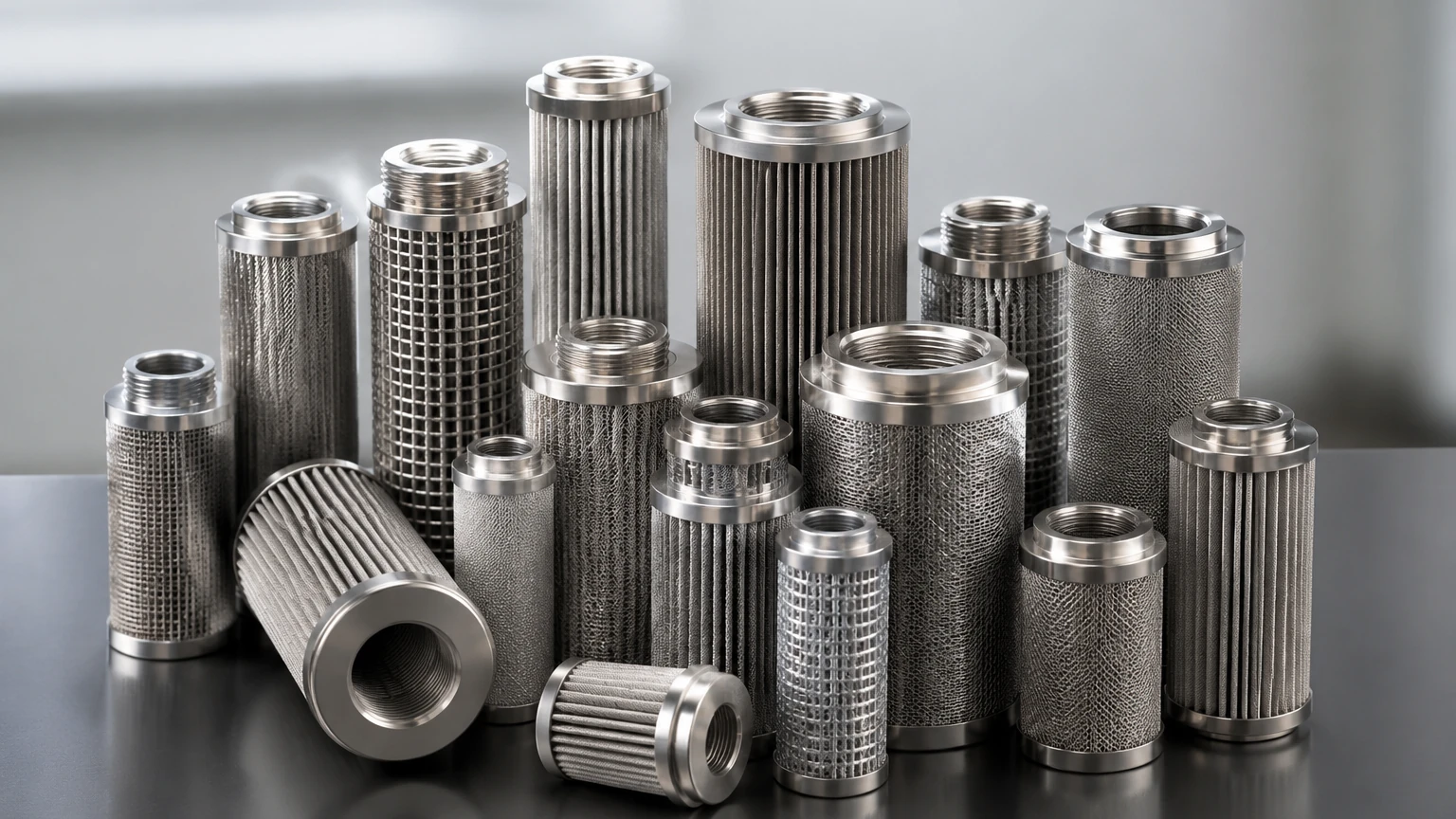
Stainless Steel Wire Mesh Filters
Woven wire mesh is the most versatile medium for abwasserfiltration. It offers a precise pore size and a high open-area percentage, which facilitates high flow rates. These are typically used in secondary and tertiary treatment stages where fine particle removal is required.
Sintered Metal Filter Cartridges
For applications involving high pressure or extremely fine filtration (down to sub-micron levels), sintered metal is the preferred choice. Sintering involves bonding multiple layers of wire mesh or metal powder through heat and pressure without the use of binders. This creates a porous, monolithic structure that is incredibly strong and resistant to migration of the filter media itself.
Wedge Wire Screens
In the early stages of abwasserfiltration, where large volumes of solids must be removed, wedge wire (V-wire) screens are highly effective. The V-shaped profile of the wire prevents clogging and provides a smooth surface that is easy to clean via mechanical scrapers or backpulsing.
Customization and OEM Solutions for Abwasserfiltration
Every industrial facility has unique constraints, from the physical footprint of the filtration housing to the specific chemical makeup of the effluent. Standard off-the-shelf filters often fail to meet these specific requirements, leading to bypass leakage or premature failure.
Kaifil’s engineering team works closely with global customers to develop customized filtration solutions. This includes:
* Custom Dimensions: Tailoring the length, diameter, and fitting types (such as NPT, BSP, or flange connections) to fit existing infrastructure.
* Material Selection: Advising on the use of specialized alloys like Hastelloy or Monel for environments where even standard 316L stainless steel may be insufficient.
* Reinforced Structures: Adding internal support cores or external cages to filter cartridges to handle extreme pressure surges.
* Multi-Layer Composites: Combining different mesh counts to create a gradient density filter, which allows for higher dirt-holding capacity and longer service life.
Maintenance, Cleaning, and Operational Efficiency
One of the primary drivers for choosing stainless steel in abwasserfiltration is the ability to clean the media. Effective maintenance protocols extend the life of the filter and ensure consistent water quality.
Cleaning Methods
* Backwashing: Reversing the flow of the filtrate to dislodge particles trapped on the surface of the mesh. This is often automated in continuous flow systems.
* Ultrasonic Cleaning: Using high-frequency sound waves in a solvent bath to remove fine particles embedded deep within the pores of sintered media.
* Chemical Cleaning (CIP): Using acids or alkaline solutions to dissolve organic or mineral scaling. The chemical inertness of stainless steel allows for aggressive cleaning agents that would destroy other materials.
* Burn-off/Thermal Cleaning: For filters used in polymer or heavy oil filtration, high-temperature ovens can be used to incinerate contaminants, leaving the metal filter clean and ready for reuse.
Total Cost of Ownership (TCO)
While the initial investment in a stainless steel filtration system is higher than that of disposable plastic filters, the TCO is significantly lower over a 3-to-5-year period. By eliminating the costs of replacement cartridges, disposal fees for contaminated waste, and the labor associated with frequent filter changes, facilities can see a rapid return on investment. Furthermore, the reliability of metal filters reduces the risk of unplanned downtime, which is often the most significant cost in industrial operations.
Application-Specific Requirements
Abwasserfiltration needs vary significantly across different sectors. Understanding these nuances is key to selecting the right component.
Chemical and Petrochemical Processing
In these industries, the primary concern is often the recovery of expensive catalysts or the removal of hazardous byproducts. The filtration system must be capable of handling volatile organic compounds (VOCs) and maintaining a seal under high pressure. Sintered metal cartridges are frequently used here for their robustness and precision.
Food and Beverage Industry
For food and beverage abwasserfiltration, the focus is on hygiene and the removal of organic solids. All filtration components must meet stringent food-grade standards. Stainless steel is the material of choice due to its smooth, non-porous surface that does not harbor bacterial growth and can withstand frequent sterilization.
Pharmaceutical Manufacturing
Pharmaceutical effluent often contains active pharmaceutical ingredients (APIs) that must be removed before discharge. This requires high-precision filtration with documented material traceability. Kaifil provides the necessary technical documentation and quality assurance to meet these regulatory demands.
Conclusion
Effective abwasserfiltration is a cornerstone of sustainable industrial operations. By selecting high-quality stainless steel filtration components, engineers can ensure their systems are durable, efficient, and capable of meeting the most demanding performance standards. Whether you are dealing with high-temperature chemical streams or large-scale water treatment, the choice of filter media will determine the success of your process.
As a professional manufacturer, Kaifil is committed to delivering precision-engineered metal filtration solutions that solve complex industrial challenges. Our expertise in material science and custom manufacturing allows us to support your project from the initial design phase through to long-term operation. For more information on how we can assist with your specific filtration needs, please review our product options and application support on our Main Page.
