


3 Stage Air Filter
In industrial environments, air quality is not merely a matter of comfort but a critical requirement for equipment longevity, process integrity, and regulatory compliance. A 3 stage air filter system represents a sophisticated approach to air purification, utilizing a tiered strategy to remove contaminants of varying sizes and types. By distributing the filtration load across three distinct phases, industrial facilities can achieve higher purity levels while significantly extending the service life of expensive high-efficiency components.
For engineers and procurement professionals, understanding the technical nuances of each stage—from material selection to pressure drop management—is essential for optimizing system performance. This guide explores the engineering principles behind three-stage filtration, focusing on the role of stainless steel components and custom-engineered solutions in demanding industrial applications.
Understanding the Architecture of a 3 Stage Air Filter
The fundamental principle of a 3 stage air filter is graduated filtration. Instead of forcing a single filter media to handle the entire spectrum of particulate matter, the system divides the task into coarse, intermediate, and fine filtration. This cascading architecture ensures that each filter operates within its optimal efficiency range.
In a typical industrial configuration, the stages are arranged as follows:
1. Stage 1: Pre-filtration. Designed to capture large debris, dust, and macro-particles.
2. Stage 2: Intermediate Filtration. Targets smaller particulates that bypass the first stage, often focusing on oils, mists, or finer dust.
3. Stage 3: Final Polishing. The highest efficiency stage, designed to remove sub-micron particles or specific gaseous contaminants to meet stringent clean-air standards.
By utilizing this tiered approach, the system prevents the final, most expensive filter from becoming prematurely clogged by large particles. This not only maintains consistent airflow but also reduces the total cost of ownership by minimizing the frequency of high-cost filter replacements.
Stage 1: The Role of Pre-Filtration in Industrial Systems
The first stage of a 3 stage air filter acts as the primary defense mechanism. In heavy-duty industrial settings, such as chemical processing or metal fabrication, the air often contains significant loads of coarse dust, metal shavings, or organic fibers.
For this stage, durability and high dirt-holding capacity are the primary engineering priorities. Stainless steel wire mesh is frequently the material of choice for pre-filters. Unlike synthetic or paper media, stainless steel mesh offers exceptional structural integrity and can withstand high-velocity air streams without deformation.
Engineering considerations for Stage 1 include:
* Micron Rating: Typically ranging from 50 to 200 microns.
* Cleanability: Stainless steel pre-filters are often washable, allowing for multiple reuse cycles, which is critical for reducing operational waste.
* Material Grade: Using 304 or 316L stainless steel ensures resistance to moisture and localized corrosion, which is common in intake systems exposed to the elements.
Stage 2: Intermediate Filtration and Particle Capture Efficiency
Once the macro-particulates are removed, the second stage focuses on intermediate contaminants. This stage is critical for protecting the final high-efficiency filter from "blinding"—a condition where fine particles coat the surface of a filter, causing a rapid and unsustainable increase in differential pressure.
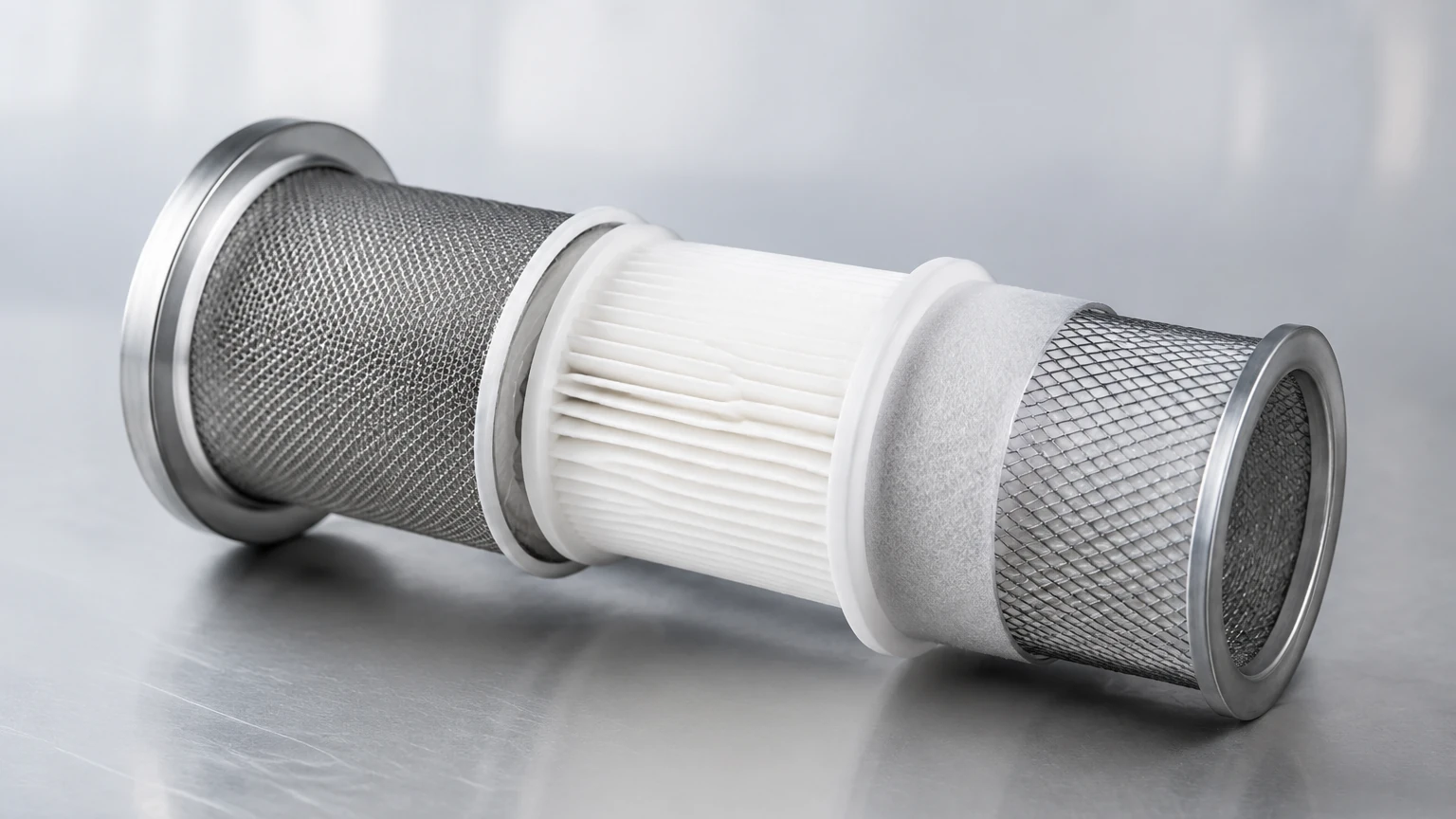
In many 3 stage air filter designs, the second stage utilizes a pleated metal mesh or a multi-layered wire cloth. Pleating the media significantly increases the effective surface area, which lowers the face velocity of the air passing through the filter. This reduction in velocity enhances the probability of particle capture through mechanisms such as interception and inertial impaction.
Intermediate filters typically target particles in the 5 to 20-micron range. In applications involving hydraulic systems or compressed air, this stage may also incorporate coalescing properties to remove oil aerosols and moisture droplets. The use of precision-woven stainless steel ensures that the pore size distribution remains uniform, providing predictable performance even under fluctuating pressure conditions.
Stage 3: High-Precision Polishing and Final Air Quality
The third and final stage is where the air reaches its required purity level. Depending on the application, this stage may involve HEPA-grade filtration or specialized stainless steel filter cartridges designed for sub-micron particle retention.
In sterile environments, such as pharmaceutical manufacturing or food and beverage processing, the third stage must eliminate bacteria and fine particulates that could compromise product safety. Sintered metal fiber felt or multi-layered sintered mesh are often employed here. These materials provide the high-efficiency filtration of a membrane with the mechanical strength of a metal component.
Key performance metrics for Stage 3 include:
* Absolute vs. Nominal Rating: For the final stage, an absolute micron rating is usually required to guarantee that 99.9% or more of particles above a certain size are captured.
* Sterilization Compatibility: In many B2B sectors, the final filter must be capable of undergoing Clean-in-Place (CIP) or Steam-in-Place (SIP) cycles. Stainless steel components excel in these scenarios, as they can withstand the high temperatures and harsh chemicals used in sterilization.
Engineering Parameters: Pressure Drop and Flow Dynamics
One of the most critical factors in designing a 3 stage air filter system is the management of pressure drop (Delta P). Every stage of filtration introduces resistance to the airflow. If the total pressure drop is too high, the system will require more energy to move the air, increasing operational costs and potentially straining blowers or compressors.
Engineers must balance filtration efficiency with permeability. A well-designed system ensures that the pressure drop is distributed logically across the three stages.
* Initial Pressure Drop: The resistance when filters are clean.
* Terminal Pressure Drop: The point at which the filters are considered loaded and must be cleaned or replaced.
Monitoring the differential pressure across each stage independently allows maintenance teams to identify exactly which stage is reaching its capacity. This targeted maintenance is a hallmark of efficient industrial filtration management.
Material Selection for Demanding Industrial Environments
The environment in which a 3 stage air filter operates dictates the materials used in its construction. While plastic or galvanized steel may suffice for standard HVAC applications, industrial processes often demand higher performance.
Stainless steel (specifically Type 316L) is the gold standard for industrial filtration for several reasons:
1. Corrosion Resistance: Essential in chemical plants or offshore environments where salt spray or acidic vapors are present.
2. Temperature Stability: Stainless steel filters maintain their mechanical properties at temperatures ranging from cryogenic levels to over 500°C, where synthetic media would melt or degrade.
3. Chemical Compatibility: Metal filters are inert to a wide range of solvents, oils, and cleaning agents, making them ideal for complex industrial air streams.
When selecting a manufacturer for these components, it is vital to verify that the material certifications meet the specific standards of your industry, such as FDA compliance for food contact or ASME standards for pressure vessels.
Maintenance, Cleaning, and Total Cost of Ownership
A primary advantage of using stainless steel components within a 3 stage air filter system is the impact on the Total Cost of Ownership (TCO). While the initial capital expenditure for metal filters is higher than for disposable alternatives, the long-term savings are substantial.
Disposable filters contribute to ongoing procurement costs, inventory management overhead, and waste disposal fees. In contrast, stainless steel wire mesh and sintered filters are designed for longevity.
Cleaning Methods for Metal Filters:
* Ultrasonic Cleaning: Effective for removing fine particles lodged deep within sintered media.
* Backwashing/Back-pulsing: Uses a reverse flow of air or fluid to dislodge accumulated dust from the surface.
* Chemical Cleaning: Employs specialized solvents to dissolve resins, oils, or organic buildup without damaging the filter structure.
By implementing a robust cleaning regimen, industrial facilities can reuse their filter elements for years, significantly reducing the environmental footprint and operational budget of the filtration system.
Customization and OEM Solutions for 3 Stage Systems
No two industrial processes are identical, and off-the-shelf filtration solutions often fall short of specific performance requirements. This is where customization becomes a critical value-add. Custom-engineered 3 stage air filter components allow for precise control over micron ratings, housing dimensions, and flow rates.
For OEM (Original Equipment Manufacturer) applications, integrating a custom filtration sub-system can be a competitive advantage. Manufacturers like Kaifil specialize in developing bespoke stainless steel filtration solutions that fit seamlessly into larger industrial machines. Whether it is a unique cartridge size for a hydraulic power unit or a specialized mesh configuration for a chemical vent, custom engineering ensures that the filtration system meets the exact demands of the application.
When evaluating a partner for custom filtration, engineers should look for capabilities in:
* Prototype Development: The ability to create and test small batches before full-scale production.
* Technical Support: Access to engineering expertise to help calculate flow rates and pressure drops.
* Quality Control: Rigorous testing protocols to ensure every filter element meets the specified micron rating and structural integrity standards.
Conclusion
Implementing a 3 stage air filter system is a strategic investment in process reliability and equipment protection. By understanding the specific roles of pre-filtration, intermediate capture, and final polishing, and by selecting high-quality materials like stainless steel, industrial operators can achieve superior air quality with optimized maintenance cycles.
For those looking to explore high-performance filtration components or seeking customized engineering support for their industrial applications, visiting the Main Page provides access to a wealth of technical resources and product specifications. Choosing the right filtration partner is the final step in ensuring that your 3 stage system delivers the performance and durability required for your specific industrial environment.
