


Gas Filter Separator Horizontal Configuration
In the midstream and downstream sectors of the oil and gas industry, as well as in high-demand industrial gas processing, the removal of solid particulates and liquid entrainment is a critical operational requirement. The gas filter separator horizontal configuration is a specialized vessel design engineered to handle significant volumes of gas while efficiently managing high liquid loads. Unlike vertical separators, which are often constrained by height and liquid handling capacity, the horizontal layout provides a distinct set of mechanical and process advantages that make it the preferred choice for compressor stations, city gate stations, and large-scale industrial filtration systems.
Selecting the right configuration involves a deep understanding of fluid dynamics, contaminant characteristics, and the mechanical integrity of the internal filtration media. As a manufacturer of precision stainless steel filtration solutions, Kaifil provides the technical components necessary to ensure these systems operate at peak efficiency under demanding conditions.
The Fundamentals of Horizontal Gas Filter Separators
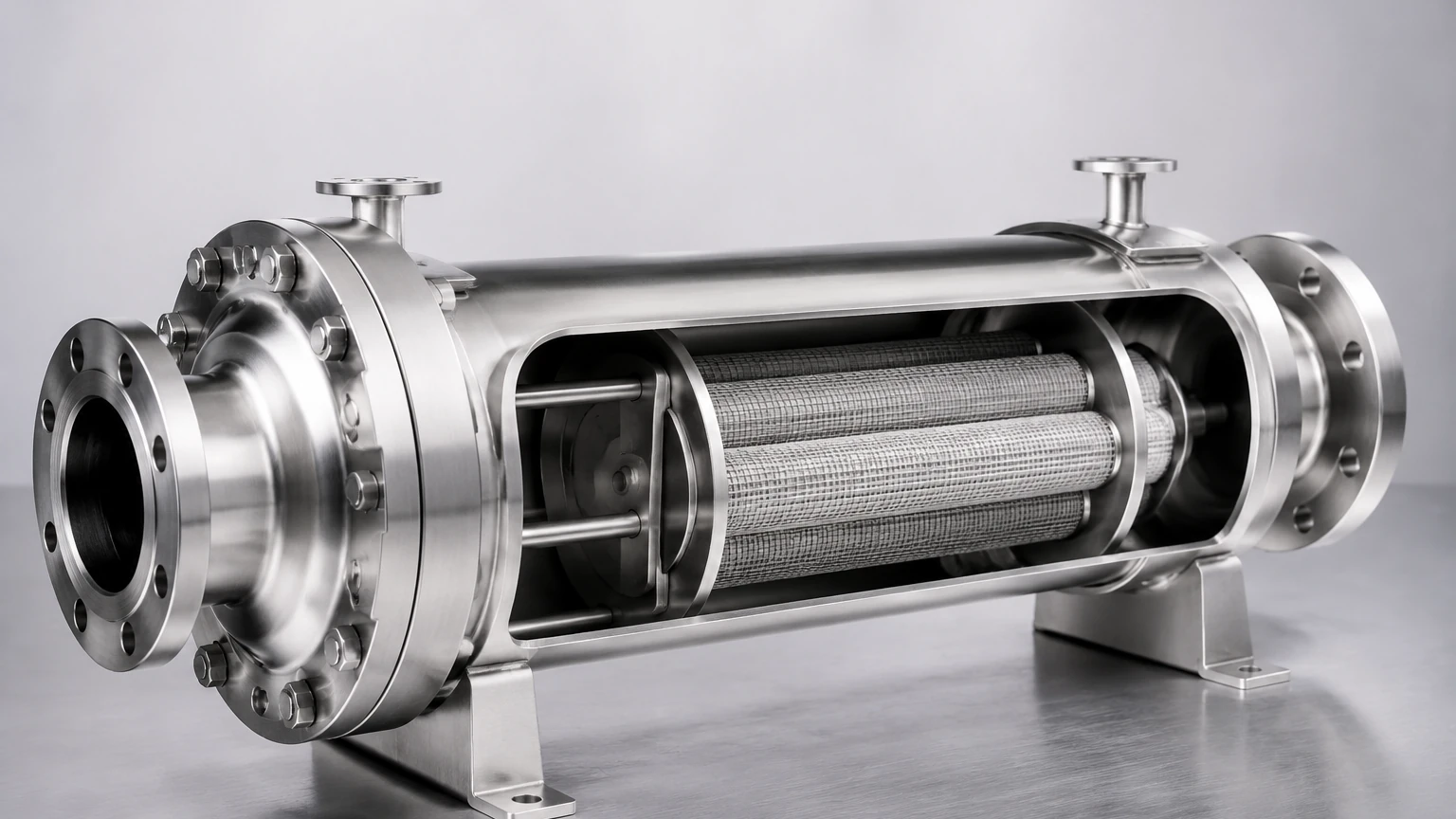
A gas filter separator is a two-stage vessel designed to remove both solids (such as pipe scale, rust, and dust) and liquids (such as water, hydrocarbons, and glycols) from a gas stream. The horizontal configuration refers to the orientation of the pressure vessel, which lies parallel to the ground. This orientation is particularly effective when the gas stream contains a high liquid-to-gas ratio or when the system must accommodate sudden "slugs" of liquid.
In a typical gas filter separator horizontal configuration, the process occurs in two distinct stages:
1. The Filtration/Coalescing Stage: The gas enters the vessel and passes through a bank of filter elements. These elements, often constructed from pleated stainless steel wire mesh or specialized fiber cartridges, capture solid particles through impingement and cause fine liquid droplets to coalesce into larger drops.
2. The Separation/Mist Extraction Stage: Once the liquids have coalesced, they fall out of the gas stream due to gravity or are captured by a secondary mist extractor, such as a vane pack or a wire mesh pad. The cleaned gas then exits the vessel, while the collected liquids are drained into a sump or a lower barrel.
Advantages of the Horizontal Configuration
Engineers often specify a horizontal layout over a vertical one based on several key performance and logistical factors.
Superior Liquid Handling
Horizontal vessels offer a larger surface area for the liquid-gas interface. This increased area allows for more effective gravity settling of larger droplets. Furthermore, horizontal separators can be designed with a "double-barrel" configuration, where the lower barrel acts as a dedicated liquid collection chamber. This prevents the re-entrainment of liquids into the gas stream, a common risk in vertical units during high-flow conditions.
Maintenance and Accessibility
From an operational standpoint, the horizontal configuration is significantly easier to maintain. Filter elements are positioned at a height that is accessible to technicians without the need for extensive scaffolding or specialized lifting equipment. The closure head of a horizontal vessel can be opened quickly, allowing for the rapid replacement of filter cartridges or the cleaning of stainless steel mesh internals. This reduces downtime and labor costs during scheduled maintenance intervals.
Footprint and Stability
While horizontal units require more ground space (footprint) than vertical units, they offer a lower center of gravity. This makes them inherently more stable in regions prone to high winds or seismic activity. In many industrial plants where height restrictions are a factor, the horizontal design is the only viable solution for high-capacity filtration.
Engineering Considerations for Filter Elements
The heart of the gas filter separator horizontal configuration lies in its internal filter elements. The performance of the entire system is dictated by the quality, material, and design of these components. Engineers must evaluate several technical parameters when selecting filtration media.
Material Compatibility and Durability
Industrial gas streams can be highly corrosive, especially those containing hydrogen sulfide (H2S), carbon dioxide (CO2), or various chemical additives. Stainless steel, particularly grades 304 and 316L, is the industry standard for these applications. Kaifil specializes in manufacturing stainless steel wire mesh and pleated cartridges that withstand high differential pressures and resist chemical degradation. The use of all-metal construction ensures that the elements do not shed fibers into the clean gas stream, a common failure point in fiberglass or cellulose-based media.
Filtration Accuracy (Micron Rating)
Determining the required micron rating is a balance between protection and pressure drop. Most industrial gas separators are designed to remove 99.9% of solids and liquids down to 0.3 to 1 micron. Achieving this level of precision requires high-density wire mesh or multi-layered sintered metal components that provide a tortuous path for contaminants while maintaining high porosity for gas flow.
Differential Pressure (Delta P)
As contaminants accumulate on the filter surface, the differential pressure across the elements increases. A well-engineered horizontal separator will include instrumentation to monitor this Delta P. Elements must be designed to withstand the maximum expected differential pressure without collapsing. For instance, stainless steel cartridges with reinforced inner cores provide the structural integrity needed to prevent bypass or mechanical failure during pressure surges.
The Role of Coalescing in Horizontal Systems
Coalescing is the process of merging small droplets into larger ones. In a horizontal gas filter separator, this is achieved through the first-stage filter elements. As the gas passes through the fine pores of the stainless steel mesh, the liquid droplets are forced into contact with the wire surfaces. Due to surface tension, the droplets adhere to the wires and merge with other droplets.
Once the droplets reach a sufficient size, the force of the gas flow pushes them through the media to the "clean" side of the element. In a horizontal vessel, gravity then pulls these larger drops down toward the liquid sump. The efficiency of this process depends on the "face velocity" of the gas—the speed at which the gas hits the filter surface. If the velocity is too high, the droplets may be sheared back into smaller mists, bypassing the separation stage. Horizontal configurations allow for longer filter elements, which increases the total surface area and lowers the face velocity, thereby enhancing coalescing efficiency.
Secondary Separation: Mist Extractors
After the gas passes through the primary filter elements, it usually encounters a secondary separation stage. This is often a vane pack or a stainless steel wire mesh mist eliminator. These components are designed to capture any remaining liquid droplets that were not removed in the first stage.
* Vane Packs: These consist of a series of closely spaced, zigzag-shaped plates. As the gas changes direction rapidly through the vanes, the heavier liquid droplets strike the plates and drain away. Vane packs are excellent for high-velocity gas streams and are resistant to fouling.
* Wire Mesh Pads: These are composed of knitted stainless steel wire. They provide a high surface area for impingement and are highly effective at capturing very fine mists. In a horizontal vessel, the mist extractor is typically placed near the gas outlet to ensure final polishing of the stream.
Selection and Customization Guide for Purchasing Teams
When procuring a gas filter separator horizontal configuration, or the replacement components for one, purchasing teams and engineers should confirm several critical details with the manufacturer. For a detailed look at available component specifications and customized engineering support, professionals can refer to the Kaifil Main Page.
Key Confirmation Points:
1. Design Pressure and Temperature: Ensure the vessel and the internal filter elements are rated for the maximum operating pressure (often following ASME Section VIII standards) and the full range of process temperatures.
2. Liquid Loading Capacity: Define the expected liquid volume, including the potential for liquid slugs. This determines the size of the sump or the necessity of a double-barrel design.
3. Contaminant Profile: Identify whether the solids are abrasive, sticky, or corrosive. This influences the choice of stainless steel grade and the weave pattern of the wire mesh.
4. Flow Rate (Minimum and Maximum): Filtration efficiency can drop if the flow is significantly lower or higher than the design point. Understanding the flow range is essential for sizing the elements correctly.
5. Seal Materials: The gaskets and O-rings used in the filter housing must be compatible with the gas and any liquid chemicals (like methanol or glycols) present in the stream. Common choices include Viton, Buna-N, or PTFE.
Total Cost of Ownership (TCO) Considerations
While the initial capital expenditure for a gas filter separator horizontal configuration and high-quality stainless steel elements may be higher than simpler alternatives, the Total Cost of Ownership is often lower. High-performance stainless steel filters from manufacturers like Kaifil are often cleanable and reusable, depending on the nature of the contaminants. This eliminates the recurring cost of purchasing and disposing of single-use cartridges.
Furthermore, superior separation efficiency protects expensive downstream equipment. A single liquid carryover event can cause catastrophic damage to a centrifugal compressor or foul the catalyst in a chemical reactor. By investing in a robust horizontal configuration with precision-engineered internals, facilities significantly reduce the risk of unplanned outages and expensive repairs.
Conclusion
The gas filter separator horizontal configuration is a cornerstone of modern industrial gas processing. Its ability to handle high liquid loads, coupled with the ease of maintenance and the durability of stainless steel filtration media, makes it an indispensable asset for ensuring gas quality. By focusing on technical parameters such as coalescing efficiency, material compatibility, and structural integrity, engineers can specify systems that provide reliable performance for decades. For organizations seeking to optimize their filtration processes, selecting high-quality, custom-manufactured components is the most effective way to ensure operational continuity and protect critical infrastructure.
Download Gas Filter Separator Horizontal Configuration as a PDF
