


Tank Sparger
In industrial processing, the efficiency of gas-liquid interactions often determines the overall productivity and quality of the final product. A tank sparger is a specialized component designed to introduce gas into a liquid medium through thousands of tiny pores, creating a vast surface area for mass transfer. Unlike simple drilled pipes, precision-engineered porous metal spargers—such as those manufactured by Kaifil—provide controlled bubble size and distribution, which are critical for applications ranging from bioreactor aeration to chemical hydrogenation.
Selecting the right sparger involves a deep understanding of fluid dynamics, material science, and the specific requirements of the process environment. This guide explores the technical aspects of tank sparger design, application, and selection to help engineers optimize their filtration and gas diffusion systems. For more information on custom filtration components, visit the Main Page of Kaifil’s technical resource center.
Understanding the Role of Tank Spargers in Industrial Processes
A tank sparger serves as the interface between a gas supply and a liquid volume. Its primary function is to break down a gas stream into discrete bubbles. The efficiency of this process is measured by the mass transfer rate, which is heavily influenced by the total surface area of the bubbles. Smaller bubbles, often referred to as "fine bubbles," provide a significantly higher surface-area-to-volume ratio than larger bubbles produced by traditional methods.
In a typical industrial tank, a sparger is installed at the bottom or integrated into a circulating loop. As gas is forced through the porous media of the tank sparger, the resistance of the material and the surface tension of the liquid work together to shear off tiny bubbles. These bubbles then rise through the liquid column, allowing for the absorption of gas into the liquid or the stripping of volatile components from the liquid.
Kaifil specializes in the production of sintered stainless steel spargers that offer superior mechanical strength and uniform porosity. These characteristics ensure that the gas is distributed evenly across the entire surface of the sparger, preventing "channeling" where gas escapes through a single path of least resistance, which would drastically reduce efficiency.
The Physics of Gas-Liquid Mass Transfer
To appreciate the necessity of a high-quality tank sparger, one must consider the fundamental physics of mass transfer, often described by the formula:
**N = kL * A * (Cs – C)**
Where:
* N is the mass transfer rate.
* kL is the liquid-side mass transfer coefficient.
* A is the total interfacial area (the surface area of all bubbles combined).
* Cs is the saturation concentration of the gas in the liquid.
* C is the actual concentration of the gas in the liquid.
Since kL and the concentration gradient (Cs – C) are often dictated by the chemical properties of the fluids and the operating pressure/temperature, the most effective way for an engineer to increase the mass transfer rate (N) is to maximize the interfacial area (A).
A precision tank sparger achieves this by utilizing sintered metal media with specific micron ratings. By controlling the pore size, manufacturers can dictate the initial bubble size. For instance, a 0.5-micron sintered sparger will produce much finer bubbles than a 10-micron version, though it will require a higher differential pressure to overcome the resistance of the smaller pores.
Material Engineering: Why Sintered Stainless Steel?
The choice of material for a tank sparger is dictated by the chemical compatibility of the process and the physical demands of the environment. Stainless steel, particularly Grade 316L, is the industry standard for most industrial applications due to its excellent corrosion resistance and thermal stability.
Durability and Structural Integrity
Unlike ceramic or plastic spargers, sintered stainless steel components can withstand high-pressure differentials and mechanical shocks. In large industrial tanks, the weight of the liquid and the turbulence caused by agitators can put significant stress on internal components. Sintered metal provides the structural integrity needed to remain functional for years without cracking or shedding particles into the process stream.
Thermal Resistance
Many chemical reactions, such as hydrogenation or steam stripping, occur at elevated temperatures. Sintered stainless steel maintains its pore structure and mechanical properties at temperatures where polymers would soften or fail. This makes them ideal for steam injection or high-temperature gas diffusion.
Cleanability
In the pharmaceutical and food and beverage industries, the ability to sterilize equipment is paramount. Stainless steel tank spargers are compatible with Clean-in-Place (CIP) and Sterilize-in-Place (SIP) protocols. They can be cleaned with aggressive chemicals, high-pressure backwashing, or ultrasonic baths to remove mineral scaling or biological fouling.
Critical Design Considerations for Tank Sparger Systems
When designing or specifying a tank sparger, several engineering parameters must be balanced to ensure optimal performance. Engineers must look beyond simple dimensions and consider the following:
1. Gas Flow Rate and Flux
Flux refers to the volume of gas passing through a unit area of the sparger surface per unit of time (e.g., CFM/ft²). If the flux is too high, bubbles may coalesce (merge) at the surface of the sparger, forming larger bubbles and defeating the purpose of the porous media. A lower flux generally results in smaller, more uniform bubbles.
2. Differential Pressure (Delta P)
There is an inherent pressure drop across any porous medium. The sparger must be designed so that the gas supply pressure is sufficient to overcome both the liquid head pressure (the weight of the liquid above the sparger) and the resistance of the sintered metal. Engineers must confirm that the system's compressors or gas cylinders can maintain the required flow at the calculated Delta P.
3. Tank Geometry and Placement
The location of the tank sparger relative to the tank walls and any internal agitators is crucial. In many cases, placing the sparger directly beneath an impeller allows the mechanical shear of the blades to further break down the bubbles, enhancing mass transfer even further. In stagnant tanks, multiple sparger elements may be required to ensure uniform gas distribution throughout the entire volume.
4. Connection Types
Industrial spargers must be securely integrated into the piping system. Common connections include NPT threads, flange mounts, or specialized sanitary tri-clamp fittings for hygienic applications. Kaifil provides customized connection options to ensure seamless integration into existing infrastructure.
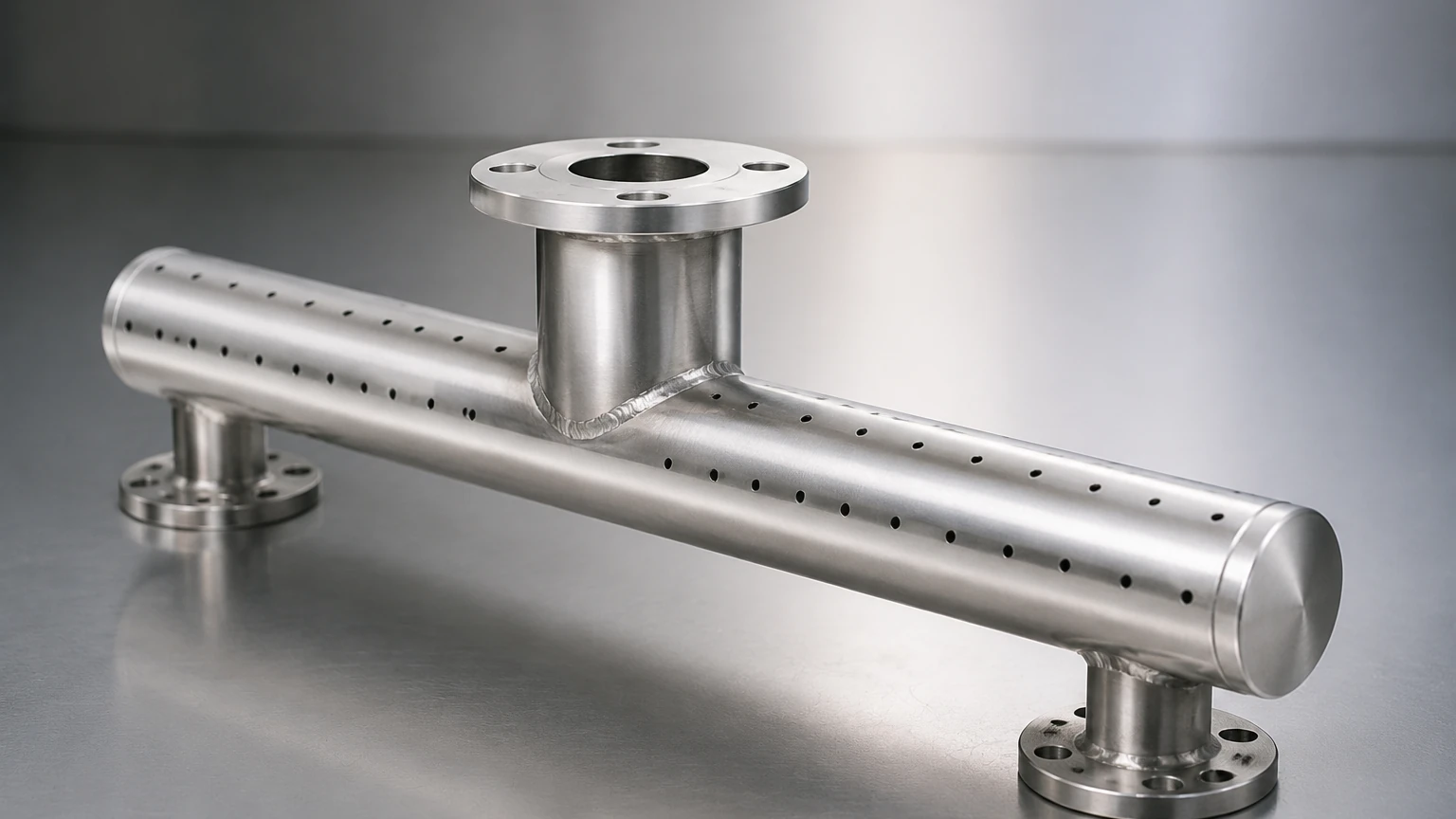
Industrial Applications and Performance Expectations
The versatility of the tank sparger makes it a staple in various sectors. Each application has unique performance expectations:
* Chemical Processing: In hydrogenation reactions, hydrogen gas must be thoroughly mixed with liquid reactants. A sintered sparger ensures that the hydrogen is available at the molecular level, increasing reaction rates and yields while reducing gas wastage.
* Food and Beverage: Carbonation and oxygenation are common uses. For example, in brewing, a sparger can be used to introduce oxygen into the wort to support yeast growth or to carbonate the finished beer. Precision control over bubble size prevents foaming issues.
* Pharmaceutical and Biotech: Bioreactors require precise aeration to provide oxygen to cell cultures without causing cell damage through excessive shear. Sintered spargers provide the gentle, fine-bubble aeration necessary for sensitive biological processes.
* Water Treatment: Ozone sparging is an effective method for disinfecting water and removing organic contaminants. The high efficiency of porous metal spargers ensures that the ozone is fully dissolved, maximizing its oxidative potential.
Selection Guidelines and Technical Specifications
To select the appropriate tank sparger, engineers should prepare a technical data sheet including the following information:
1. Liquid Properties: Viscosity, density, and surface tension (all of which affect bubble detachment).
2. Gas Properties: Type of gas (O2, N2, CO2, H2, etc.) and required flow rate.
3. Operating Conditions: Temperature and pressure at the point of injection.
4. Target Micron Rating: Typically ranging from 0.2 to 100 microns. Finer ratings are used for high mass transfer, while coarser ratings are used for high-flow agitation or steam injection.
5. Dimensions: The available space within the tank and the required surface area to maintain an acceptable flux.
As a professional manufacturer, Kaifil works closely with purchasing teams to develop customized filtration and sparging solutions. By evaluating the specific chemical environment and performance goals, Kaifil can recommend the optimal pore size and configuration for a given application.
Maintenance and Cleaning Procedures for Porous Spargers
While sintered metal spargers are incredibly durable, they are susceptible to fouling over time. Fouling can occur from mineral deposits (scaling), biological growth, or particulate matter in the gas or liquid streams. A decrease in gas flow at a constant pressure or an increase in required pressure to maintain flow are clear indicators that cleaning is necessary.
Backpulsing and Backwashing
This involves reversing the flow through the sparger. By forcing liquid or gas from the inside out at high pressure, particles trapped on the surface or within the pores can be dislodged. This is often the first line of defense in maintenance.
Chemical Cleaning
For organic fouling, a caustic wash may be required. For mineral scaling, a mild acid solution is often effective. Because Kaifil uses high-quality stainless steel, these spargers can withstand a wide range of pH levels during the cleaning process.
Ultrasonic Cleaning
For the most stubborn contaminants, the sparger element can be removed and placed in an ultrasonic bath. The high-frequency sound waves create cavitation bubbles that penetrate deep into the porous structure, effectively restoring the original permeability of the media.
Conclusion
The tank sparger is a deceptively simple component that plays a vital role in the efficiency of modern industrial processes. By choosing a precision-engineered sintered metal solution, engineers can achieve superior mass transfer, reduce gas consumption, and ensure long-term operational reliability. Whether the goal is pH control, aeration, or complex chemical synthesis, understanding the technical nuances of sparger design is the key to process optimization.
For technical professionals and purchasing teams seeking reliable, high-performance filtration and diffusion components, Kaifil offers the expertise and manufacturing capability to meet the most demanding specifications. Explore our full range of custom stainless steel solutions by visiting our Main Page and consulting with our engineering team today.
