


Olive Oil Filtering
In the industrial production of high-quality vegetable oils, the final stages of processing determine the product's shelf stability, clarity, and market value. Olive oil filtering is a critical unit operation that bridges the gap between the extraction process—typically involving decanters and vertical centrifuges—and the final bottling line. While many traditional methods rely on cellulose or diatomaceous earth, modern industrial facilities are increasingly turning to stainless steel filtration systems to achieve higher precision, better hygiene, and improved operational efficiency.
From an engineering perspective, filtering olive oil is not merely about aesthetics. It is a technical necessity to remove residual moisture, micro-particles of fruit pulp, and organic waxes that can catalyze oxidation or lead to anaerobic fermentation. This article explores the technical parameters, material considerations, and selection criteria essential for optimizing the filtration process in a commercial olive oil production environment.
The Critical Role of Filtration in Olive Oil Production
Freshly extracted olive oil, often referred to as "olio nuovo" or cloudy oil, contains suspended solids and small amounts of vegetation water. While some niche markets prefer unfiltered oil, the industrial standard requires filtration for several technical reasons. Suspended solids, which include fragments of the olive skin, pit, and pulp, settle over time to form a layer of sediment at the bottom of storage tanks. This sediment is prone to anaerobic fermentation, which produces defects such as "fusty" or "muddy sediment" flavors, significantly degrading the oil's sensory profile.
Furthermore, olive oil filtering is essential for oxidative stability. The micro-droplets of water and organic residues present in unfiltered oil contain enzymes and metals that accelerate the breakdown of triglycerides. By removing these impurities, producers can extend the shelf life of the oil and maintain its chemical integrity, specifically preserving the high levels of polyphenols and vitamin E that define extra virgin olive oil (EVOO). For large-scale operations, the goal is to achieve a brilliant, clear appearance while ensuring the process remains cost-effective and compliant with food safety regulations.
Technical Challenges in Olive Oil Filtering
The primary challenge in olive oil filtering is the fluid's physical properties, specifically its viscosity. Olive oil is a non-Newtonian fluid whose viscosity changes significantly with temperature. At standard processing temperatures (around 20°C to 25°C), the oil is relatively thick compared to water, which creates a higher resistance to flow through filter media. Engineers must account for this by selecting filter elements that can handle higher differential pressures without compromising the structural integrity of the mesh or cartridge.
Another challenge is the presence of waxes. Olives contain natural waxes on their skins which are extracted along with the oil. If the oil is filtered at low temperatures, these waxes can crystallize and rapidly clog (blind) the filter media. This requires precise temperature control or the selection of specific filtration accuracies that can capture solids without becoming prematurely saturated by organic waxes. Effective filtration design must balance the need for high clarity with the practical requirements of flow rate and throughput.
Stainless Steel Filter Media: Advantages for Food-Grade Applications
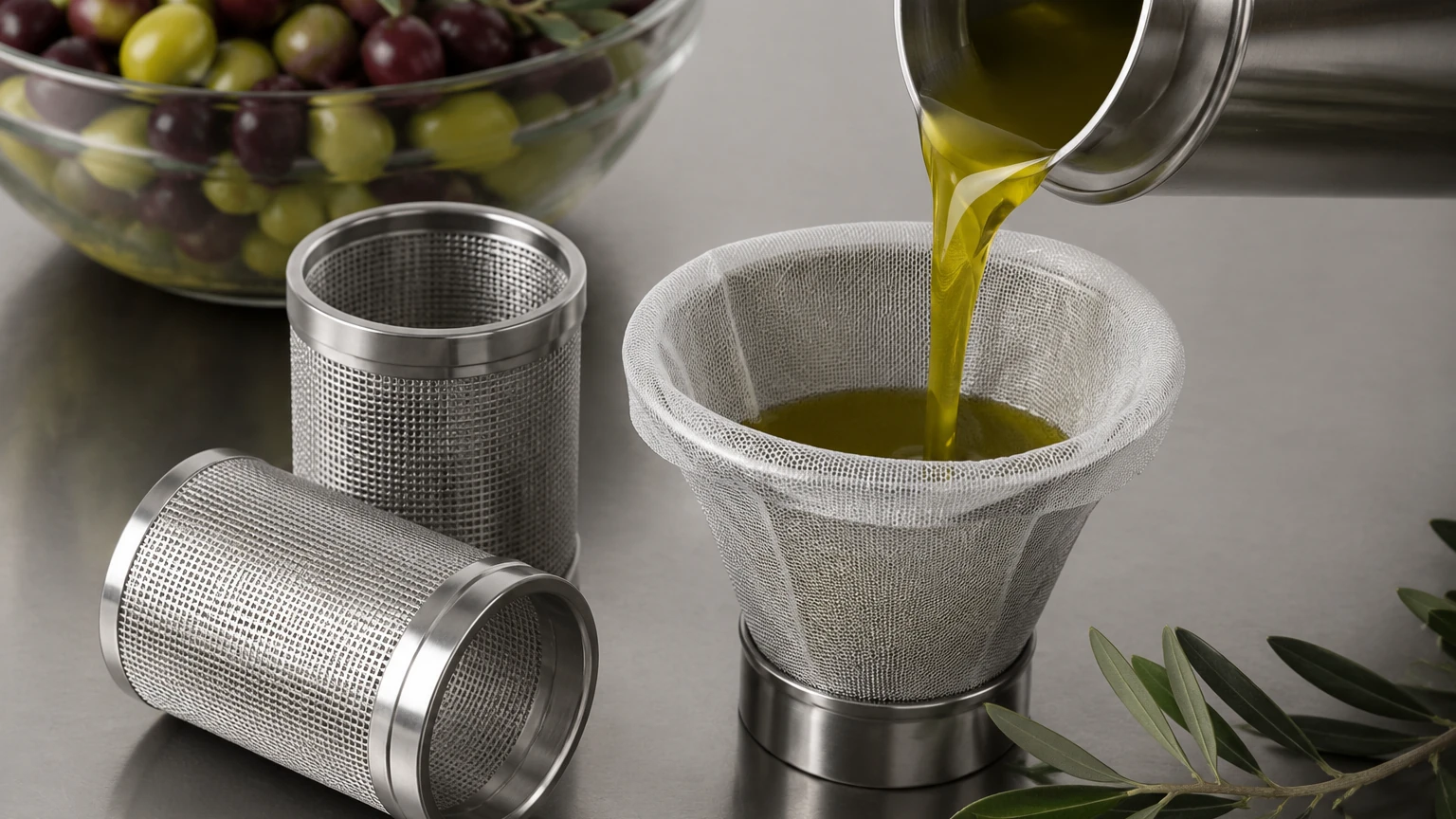
In the B2B sector, the choice of filter material is paramount. Stainless steel, particularly grades 304 and 316L, is the industry standard for olive oil filtering due to its durability and inert nature. Unlike disposable paper or cloth filters, stainless steel wire mesh and sintered metal cartridges offer several distinct advantages:
1. Chemical and Thermal Stability: Stainless steel does not react with the fatty acids in olive oil, ensuring no metallic taints are introduced. It also withstands the high temperatures used during Cleaning-in-Place (CIP) cycles.
2. Mechanical Strength: High-pressure filtration is often required to maintain flow rates with viscous oils. Stainless steel components can withstand significant differential pressures without deforming, which prevents "bypass"—where unfiltered oil leaks around a compromised filter element.
3. Reusability and Sustainability: Industrial stainless steel filters can be cleaned and reused for multiple seasons. This reduces the total cost of ownership compared to consumable media and minimizes the waste stream of the production facility.
4. Precision Engineering: Modern manufacturing allows for highly controlled pore sizes. Whether using a plain square weave or a complex Dutch weave, engineers can specify the exact micron rating needed to target specific particle sizes.
For those evaluating various hardware configurations for their production lines, reviewing the technical specifications on the Main Page can provide deeper insights into the structural capabilities of different metal filter types.
Selecting Filtration Accuracy for Different Olive Oil Grades
The "micron rating" is perhaps the most important specification in olive oil filtering. The choice depends on the desired final product and the stage of the filtration process. Industrial setups often utilize a multi-stage approach:
* Coarse Filtration (Roughing): In the initial stage, filters with a rating of 50 to 100 microns are used to remove large pulp fragments and pit pieces. This protects downstream equipment and prevents the finer filters from clogging too quickly.
* Fine Filtration (Polishing): To achieve the characteristic clarity of premium extra virgin olive oil, a finer filtration stage is employed, typically ranging from 5 to 20 microns. This stage removes the majority of suspended solids and micro-droplets of moisture.
* Final Guard Filtration: Before bottling, a guard filter (often 1 to 5 microns) may be used to ensure that no contaminants have entered the oil during storage or transport within the facility.
It is important to note that over-filtering can be detrimental. Extremely fine filtration (sub-micron) may remove some of the larger polyphenol molecules and flavor compounds, potentially stripping the oil of its unique character. Therefore, engineers must carefully calibrate the micron rating to balance clarity with flavor retention.
Operational Considerations: Flow Rates and Pressure Management
To maintain an efficient olive oil filtering operation, engineers must monitor the relationship between flow rate and differential pressure ($ΔP$). As the filter media captures particles, the effective open area decreases, leading to an increase in pressure. If the pressure exceeds the design limits of the filter housing or the element itself, there is a risk of structural failure or "particle shedding," where previously trapped contaminants are forced through the media.
In a B2B environment, the use of duplex filter systems is common. A duplex system allows the oil flow to be diverted from one filter housing to another without stopping the production line. This is essential during the height of the harvest season when downtime can lead to a backlog of unprocessed fruit. By monitoring pressure gauges, operators can identify exactly when a stainless steel cartridge needs to be removed for cleaning, ensuring continuous operation and consistent product quality.
Maintenance and Cleaning of Industrial Olive Oil Filters
The longevity of a stainless steel filter system depends heavily on the cleaning protocol. In olive oil filtering, the primary residue is organic and fatty. Standard cleaning procedures involve:
* Hot Water Rinse: To melt and flush away residual oils and waxes.
* Alkaline Cleaning Agents: Using food-grade caustic solutions to saponify remaining fats and break down organic biofilms.
* Ultrasonic Cleaning: For sintered metal or fine wire mesh filters, ultrasonic baths are highly effective at removing deeply embedded particles that manual scrubbing or backwashing cannot reach.
Because stainless steel is resistant to corrosion, these aggressive cleaning methods can be used repeatedly without degrading the filter's performance. This reliability is a key factor for purchasing teams looking to optimize the total cost of ownership (TCO) over a five-to-ten-year horizon.
Long-Term ROI and Performance Optimization
Investing in high-quality stainless steel filtration components offers a significant return on investment for olive oil producers. While the initial capital expenditure (CAPEX) for stainless steel systems is higher than for plastic or disposable alternatives, the reduction in operational expenditure (OPEX) is substantial. The elimination of constant consumable purchases, combined with reduced product loss (as less oil is trapped in disposable media), leads to a faster payback period.
Furthermore, the precision of metal filters allows for better control over the final product's quality. In the competitive global market for olive oil, consistency is a major selling point. By utilizing engineered filtration solutions, producers can guarantee that every bottle meets the required standards for clarity and stability. Engineers and procurement specialists should look for suppliers who provide detailed material certifications and pressure-drop curves to ensure the selected components are fit for the demanding conditions of oil processing.
For technical professionals seeking to integrate these solutions into their existing workflows, exploring the comprehensive range of custom filtration options on the Main Page is a recommended next step. Understanding the nuances of mesh geometry and housing design can lead to more efficient solid-liquid separation and a superior final product.
