


Wastewater Filtration Equipment
Industrial wastewater treatment is a critical process across various sectors, including chemical processing, food and beverage, pharmaceuticals, and power generation. The primary objective of wastewater filtration equipment is to remove suspended solids, contaminants, and particulate matter from process water to meet environmental discharge standards or to facilitate water reuse within a facility. Unlike domestic water treatment, industrial wastewater often contains high concentrations of corrosive chemicals, abrasive particles, and fluctuating temperatures, necessitating robust and highly engineered filtration solutions.
Selecting the appropriate filtration components requires a deep understanding of the physical and chemical properties of the effluent. Stainless steel has emerged as the industry standard for high-performance wastewater filtration due to its mechanical strength, thermal stability, and resistance to corrosion. As a specialized manufacturer of precision metal filter components, Kaifil provides the technical expertise required to design and produce filtration solutions that withstand these demanding environments.
The Role of Stainless Steel in Wastewater Filtration Equipment
In the context of industrial wastewater, the choice of material for filtration media is as important as the filtration rating itself. While plastic or fabric media may suffice for low-pressure, ambient-temperature applications, they often fail in industrial settings where the following conditions are present:
* Corrosive Environments: Wastewater from chemical plants or food processing facilities often has extreme pH levels. Stainless steel grades such as 304 and 316L offer varying degrees of resistance to oxidation and chemical attack.
* High Pressure and Flow Rates: Industrial systems often operate under significant hydraulic pressure. Stainless steel wire mesh and cartridges maintain their structural integrity, preventing media migration or collapse.
* Temperature Fluctuations: Many wastewater streams are the result of cooling processes or steam cleaning. Metal filters can operate at temperatures that would melt or degrade polymer-based filters.
By utilizing stainless steel as the primary material for wastewater filtration equipment, engineers can ensure a longer service life and more predictable performance. For a comprehensive overview of available materials and configurations, professionals can visit the Main Page of the Kaifil website.
Core Components of Industrial Filtration Systems
Effective wastewater treatment typically involves multiple stages of filtration, ranging from coarse screening to fine particulate removal. The following components are essential in modern industrial setups:
Stainless Steel Wire Mesh Filters
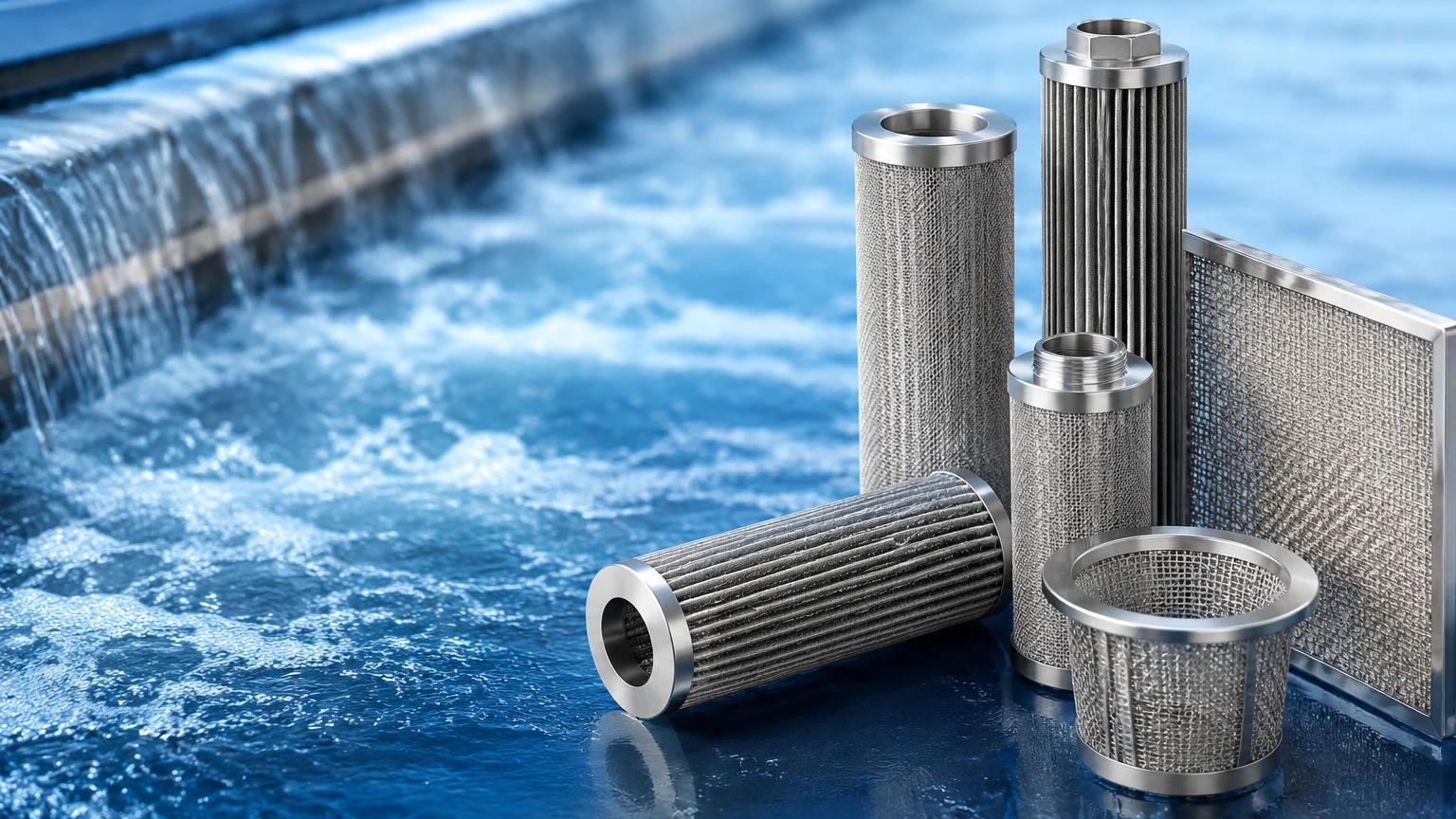
Wire mesh is a versatile filtration medium used for both primary and secondary treatment. It is characterized by its precise pore size and high open area, which allows for high flow rates with minimal pressure drop. In wastewater applications, multi-layered sintered wire mesh is often used to provide the necessary mechanical strength while maintaining fine filtration accuracy.
Stainless Steel Filter Cartridges
For more demanding applications requiring high dirt-holding capacity and fine filtration, stainless steel filter cartridges are the preferred choice. These can be designed as pleated elements to increase the surface area or as cylindrical depth filters. Pleated designs are particularly effective in wastewater systems where space is limited but high throughput is required.
Precision Metal Filter Components
Customized components such as wedge wire screens, perforated metal supports, and specialized strainers are often integrated into larger wastewater filtration equipment. These components are engineered to handle the initial "heavy lifting" of removing large debris before the water reaches finer filtration stages, thereby protecting downstream equipment like pumps and membranes.
Engineering Considerations for Filter Selection
When specifying filters for wastewater applications, engineers must balance several technical parameters to optimize system performance and minimize operational costs.
Filtration Accuracy (Micron Rating)
The micron rating determines the size of particles the filter will capture. In wastewater treatment, it is common to use a graduated approach—starting with a coarse filter (e.g., 100-500 microns) and moving to finer stages (e.g., 5-20 microns). Choosing a micron rating that is too fine for the initial stage can lead to rapid clogging and excessive maintenance.
Flow Rate and Pressure Drop
The flow rate of the wastewater stream dictates the size and number of filter elements required. Every filter introduces a degree of resistance, known as pressure drop (ΔP). As the filter accumulates solids, the pressure drop increases. Engineers must design the system to handle the maximum expected flow while ensuring the "terminal pressure drop"—the point at which the filter must be cleaned or replaced—is within the system’s operating limits.
Total Suspended Solids (TSS) Loading
The concentration of solids in the wastewater significantly impacts the choice of filtration technology. High TSS loads may require self-cleaning filters or backwashable systems to prevent frequent manual intervention. Stainless steel mesh is particularly well-suited for backwashing because it can withstand the reverse pressure required to dislodge particles from the surface.
Customization and OEM Solutions
No two industrial wastewater streams are identical. Factors such as particle shape, fluid viscosity, and chemical composition vary wildly between a textile mill and a pharmaceutical lab. Consequently, off-the-shelf filtration products often fall short of performance expectations.
Customization is at the heart of effective wastewater filtration equipment design. This includes:
1. Tailored Dimensions: Designing filter cartridges or mesh screens to fit existing housings or specialized machinery.
2. Specific Alloy Selection: Utilizing 316L for high-chloride environments or specialized alloys for extreme chemical resistance.
3. Structural Reinforcement: Adding internal cores or external cages to filter elements to handle high-differential pressure spikes.
As an OEM partner, Kaifil works closely with system integrators and plant engineers to develop bespoke filtration components that meet these specific requirements. This collaborative approach ensures that the filtration system is optimized for the specific contaminants present in the facility's effluent.
Maintenance and Total Cost of Ownership (TCO)
In the B2B sector, the purchase price of a filter is only one part of the economic equation. The Total Cost of Ownership (TCO) includes installation, energy costs (related to pressure drop), maintenance labor, and replacement frequency.
Stainless steel filters offer a significant advantage in TCO because they are often cleanable and reusable. Unlike disposable paper or plastic cartridges, stainless steel elements can be cleaned using various methods:
* Backwashing: Reversing the flow of fluid to flush out trapped particles.
* Ultrasonic Cleaning: Using high-frequency sound waves in a cleaning solution to remove fine particulates from deep within the mesh or pleats.
* Chemical Cleaning: Using specific solvents or acids to dissolve organic or inorganic scaling, provided the filter material is compatible.
By investing in high-quality stainless steel wastewater filtration equipment, facilities can reduce the volume of waste generated by used filter media and lower their long-term procurement costs.
Applications Across Key Industries
Wastewater filtration equipment is employed in diverse settings, each with its own set of challenges:
* Chemical Processing: Filters must resist aggressive solvents and maintain performance under high temperatures. Stainless steel is essential for removing catalysts and preventing downstream contamination.
* Food and Beverage: Filtration is used to manage wash water and process effluent. Here, 316L stainless steel is often required to meet sanitary standards and resist the corrosive effects of organic acids and cleaning agents.
* Pharmaceuticals: Precision is paramount. Filtration components must provide absolute ratings to ensure that fine particulates and microorganisms are effectively removed from wastewater before treatment or discharge.
* Hydraulic and Cooling Systems: In many industrial plants, water is used for cooling. Filtration equipment removes scale and debris that could otherwise cause mechanical wear in pumps and heat exchangers.
Conclusion: Making Informed Filtration Decisions
Effective wastewater management is a technical challenge that requires a balance of material science and mechanical engineering. By focusing on durable materials like stainless steel and considering the specific flow and loading characteristics of the waste stream, engineers can implement wastewater filtration equipment that is both reliable and cost-effective.
Whether you are designing a new treatment plant or optimizing an existing system, selecting the right filtration components is essential for operational efficiency. For further technical details, product specifications, and support in selecting the right stainless steel filtration solutions for your industrial needs, please explore the Main Page of our website. Kaifil remains committed to providing the precision-engineered components necessary to meet the most demanding industrial filtration requirements.
