


Woven Wire Cloth Mesh: A Technical Guide for Industrial Filtration
In the landscape of industrial separation and filtration, woven wire cloth mesh remains a cornerstone technology due to its structural integrity, precise aperture control, and exceptional durability. As a versatile medium, it serves critical functions in industries ranging from chemical processing and pharmaceuticals to food production and hydraulic systems. For engineers and procurement specialists, selecting the appropriate mesh involves more than identifying a micron rating; it requires a deep understanding of weave geometry, material science, and mechanical performance under stress.
At Kaifil, we specialize in manufacturing custom stainless steel filtration solutions that address these complex requirements. This guide provides a technical overview of woven wire cloth mesh to assist in the selection and implementation of high-performance filtration components.
Understanding the Fundamentals of Woven Wire Mesh
Woven wire mesh is produced by weaving individual metal wires on industrial looms, creating a structured grid with precise openings. Unlike non-woven media or perforated metals, woven mesh offers a unique combination of high open-area percentages and mechanical strength. The performance of the mesh is primarily dictated by the relationship between wire diameter, mesh count, and the specific weave pattern employed.
For industrial applications, the choice of mesh often centers on two primary goals: achieving a specific filtration accuracy (measured in microns) and maintaining the structural stability of the filter element under operational pressure. Because the wires are mechanically interlocked, the mesh maintains consistent pore sizes even when subjected to high flow rates or mechanical vibration, provided the material and weave are correctly specified for the load.
Comparative Analysis of Weave Types
The geometry of the weave determines the flow characteristics, particle retention, and cleaning efficiency of the mesh. While there are numerous specialized patterns, most industrial applications rely on three primary configurations.
Plain Weave
Plain weave is the most common and straightforward pattern, where each weft wire passes over and under each warp wire in a 1:1 ratio. This results in square or rectangular openings. It is ideal for general-purpose screening and filtration where high flow rates and low pressure drops are required. However, because the wires must bend sharply over each other, there are limits to the wire thickness that can be used for a given mesh count.
Twill Weave
Twill weave involves the weft wire passing over and under two warp wires. This reduces the stress on the wires during the weaving process, allowing for the use of heavier wire diameters in relation to the mesh count. Twill weave is often selected when the application requires a higher mechanical load capacity than a plain weave can provide at the same filtration grade.
Dutch Weaves (Plain and Twill)
Dutch weaves utilize different wire diameters for the warp and weft. Typically, a heavier warp wire is combined with a finer, more densely packed weft wire. This creates a "tortuous path" for the fluid, resulting in superior filtration accuracy and high pressure resistance.
* Plain Dutch Weave: Offers high strength and is easy to clean via backwashing.
* Twill Dutch Weave: Allows for the finest filtration levels, often reaching down to the low micron range, by layering the weft wires so closely that they create a three-dimensional pore structure.
For those seeking specific configurations, Kaifil provides Plain, twill and dutch woven wire mesh in SS304/316L — rolls, cut mesh and framed panels. Send mesh count or micron target for a technical quote.
Material Science: Selecting Alloys for Demanding Environments
The longevity of woven wire cloth mesh is heavily dependent on its resistance to the operating environment. In industrial filtration, stainless steel is the standard due to its corrosion resistance and thermal stability.
1. Stainless Steel 304: The most widely used grade, offering excellent cost-to-performance for water treatment, food processing, and general industrial use. It resists most oxidizing acids but may be susceptible to chloride-induced pitting.
2. Stainless Steel 316L: Containing molybdenum, 316L provides superior resistance to chlorides and marine environments. The "L" denotes low carbon content, which minimizes carbide precipitation during welding, making it the preferred choice for pharmaceutical and chemical processing where welded filter cartridges are used.
3. Specialized Alloys: For extreme conditions, such as high-temperature petrochemical processing or highly acidic environments, alloys like Monel, Inconel, or Hastelloy may be required to prevent premature failure due to stress corrosion cracking or oxidation.
Technical Specifications and Filtration Calculations
When specifying woven wire mesh, engineers must balance several mathematical variables to ensure the component meets the system's hydraulic requirements.
Mesh Count vs. Aperture
Mesh count refers to the number of openings per linear inch. However, the aperture (the actual clear opening) is the critical dimension for filtration. It is calculated as:
$$Aperture = \frac{25.4}{Mesh Count} – Wire Diameter$$
(Where dimensions are in millimeters). A common error in procurement is specifying only the mesh count without considering wire diameter, which can lead to significant variations in both filtration accuracy and flow resistance.
Open Area Percentage
The percentage of open area determines the flow capacity and pressure drop across the filter. A higher open area reduces the initial pressure drop but may result in a more fragile mesh. In high-pressure hydraulic systems, a lower open area with thicker wires is often necessary to prevent wire displacement or mesh migration.
Micron Rating
Micron ratings can be absolute or nominal. For woven wire mesh, the absolute rating is typically determined by the largest glass bead that can pass through the mesh under laboratory conditions. Engineers should confirm whether their application requires an absolute cutoff to protect sensitive downstream equipment, such as high-pressure pumps or precision nozzles.
Customization and Fabrication for OEM Applications
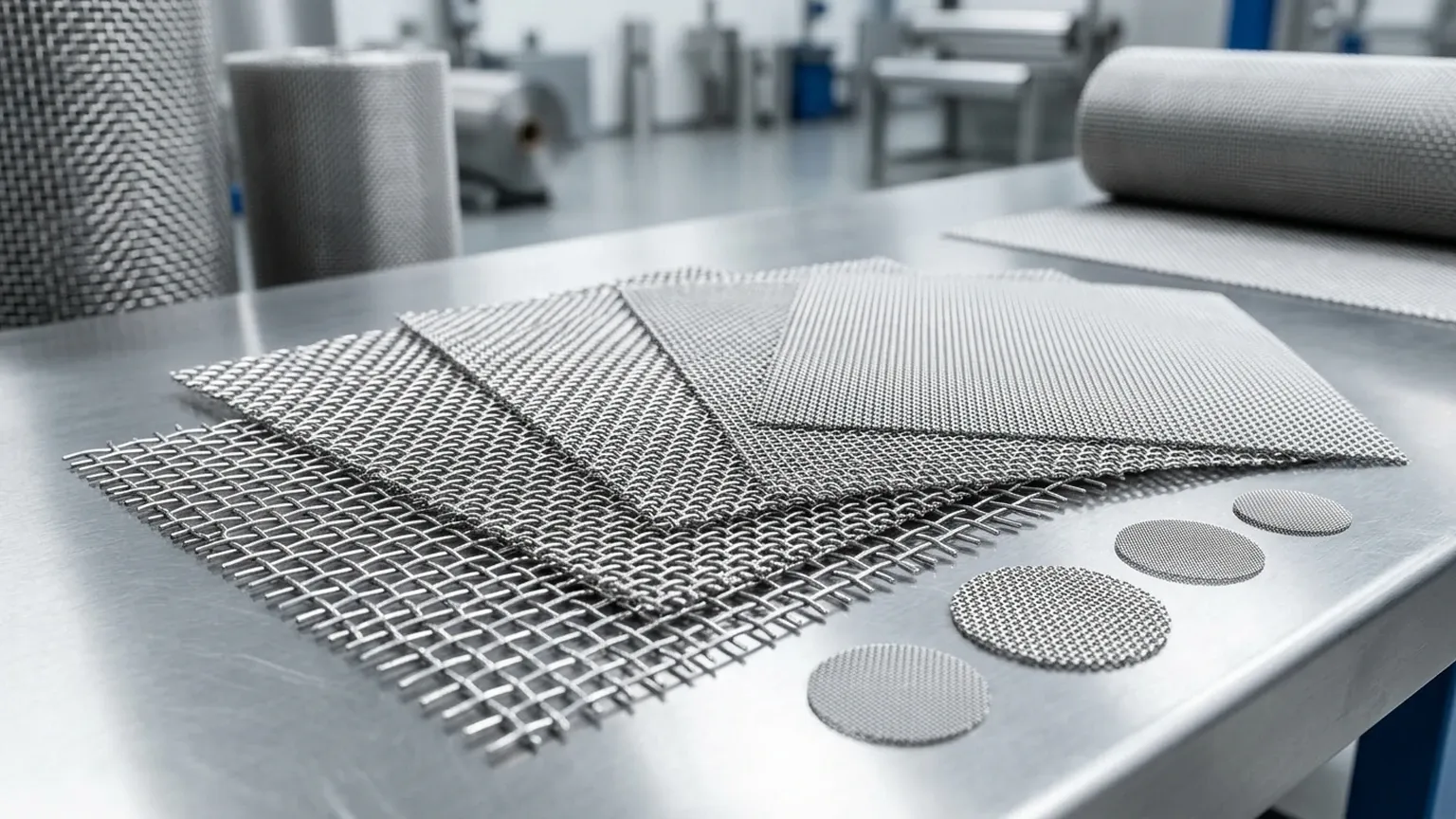
Industrial filtration often requires more than just raw mesh rolls. Most applications demand semi-finished or finished components tailored to specific equipment housings. Kaifil’s manufacturing capabilities allow for extensive customization, including:
* Cut-to-Size Pieces: Precision laser or mechanical cutting to ensure clean edges and dimensional accuracy for disc filters or rectangular screens.
* Framed Panels: Mesh tensioned and secured within stainless steel frames to provide structural rigidity for vibrating screens or large-scale intake filters.
* Multi-Layer Sintered Mesh: For applications involving extreme pressures, multiple layers of woven wire cloth mesh can be sintered together. This process fuses the contact points of the wires, creating a porous plate that combines fine filtration with the mechanical strength of heavy-duty plate steel.
* Cylindrical and Pleated Cartridges: Woven mesh can be formed into cylinders or pleated to increase the effective filtration area, extending the service life between cleaning cycles.
Evaluation Criteria for Procurement and Maintenance
To ensure the total cost of ownership is optimized, purchasing teams should evaluate woven wire cloth mesh based on several performance-related factors:
Mechanical Stability
In vibrating or high-flow environments, the mesh must resist "weaving fatigue." This is where the wires rub against each other at crossover points, leading to thinning and eventual breakage. Choosing a twill weave or a sintered mesh can mitigate this risk.
Cleaning and Regeneration
One of the primary advantages of stainless steel woven wire mesh is its cleanability. Unlike disposable polymer filters, metal mesh can be cleaned via ultrasonic baths, chemical cleaning, or backpulsing. The ease of cleaning is influenced by the weave; plain weaves are generally easier to regenerate than complex twill dutch weaves, which may trap particles more deeply within the structure.
Replacement Cycles
While stainless steel mesh is durable, it is not infinite. Factors such as erosion (caused by abrasive particles in the fluid stream) and chemical thinning will eventually necessitate replacement. Establishing a baseline for pressure drop ($ΔP$) is the most effective way to monitor filter health. When the "clean" pressure drop after a maintenance cycle begins to rise significantly, it indicates that the mesh pores are becoming permanently blinded or deformed.
Conclusion: Optimizing Filtration Performance
Selecting the right woven wire cloth mesh is a technical exercise that requires balancing filtration precision, mechanical strength, and chemical compatibility. By understanding the nuances of weave patterns and material grades, engineers can specify components that not only protect downstream equipment but also reduce downtime through extended service lives and efficient cleaning cycles.
Kaifil remains committed to providing high-performance, customized filtration solutions. Whether your application requires standard rolls or complex, framed filtration panels, our engineering team is available to assist in material selection and technical specification to ensure your filtration goals are met with precision and reliability.
