


Custom Woven Wire Mesh: An Engineering Guide to Industrial Filtration Selection
In industrial filtration and separation processes, the efficiency of a system often depends on the precision of its primary filter medium. Woven Wire Mesh serves as a critical component across diverse sectors, including chemical processing, pharmaceuticals, and food production. While standard specifications meet general needs, many high-performance applications require custom woven wire mesh to address specific challenges related to flow rates, particle retention, and mechanical stress.
Selecting the right mesh involves more than identifying a hole size. It requires a comprehensive understanding of weave geometries, material properties, and the environmental factors that influence the longevity and performance of the filter. This guide examines the technical parameters engineers must evaluate when specifying custom filtration solutions.
Technical Fundamentals of Woven Wire Mesh Geometries
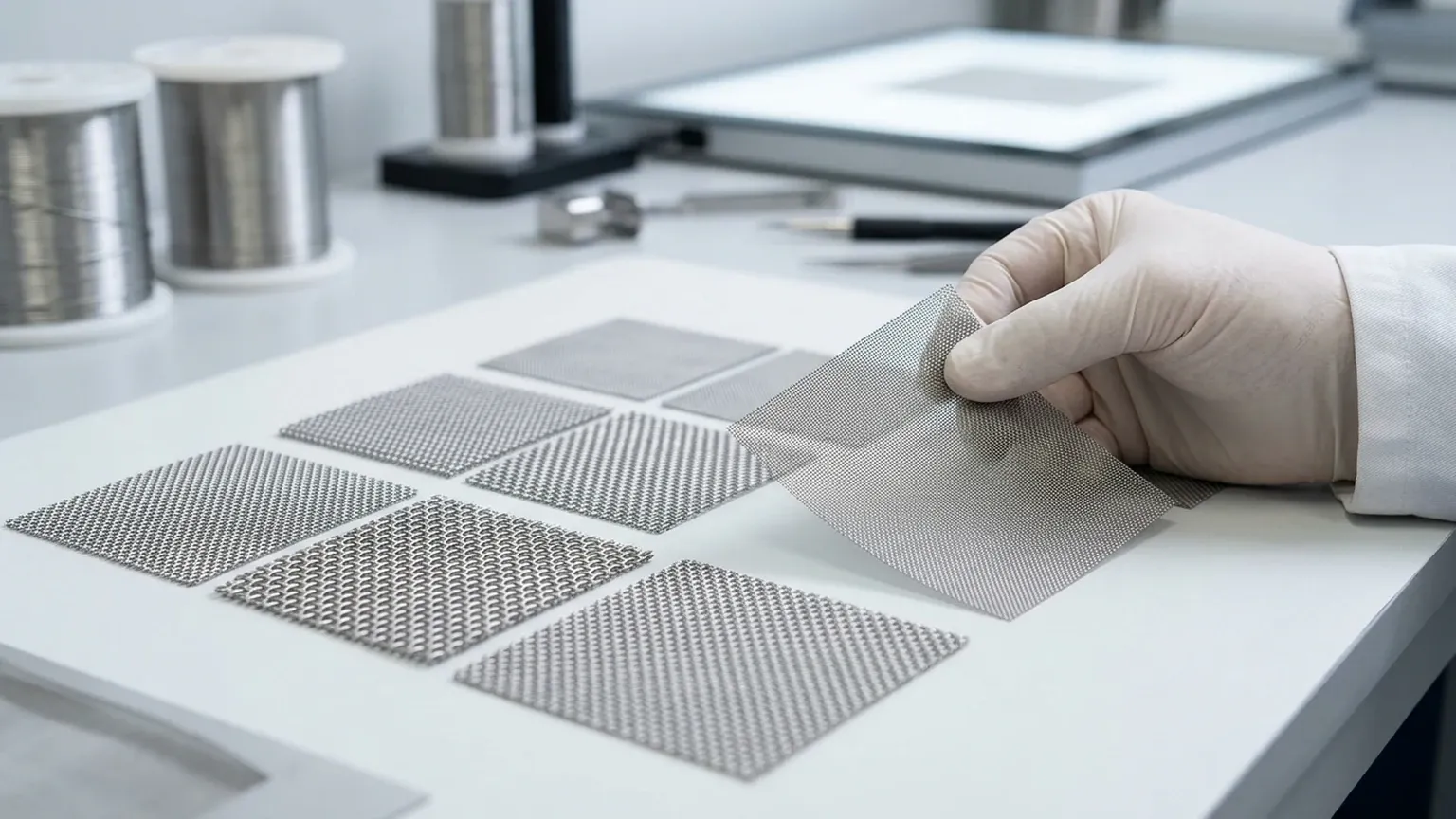
The performance of a wire mesh is primarily determined by its weave pattern. The way the warp (vertical) and shute (horizontal) wires intersect dictates the pore shape, stability, and filtration accuracy of the medium.
Plain Weave
This is the most common and straightforward construction. Each shute wire passes over and under one warp wire. Plain weave provides a high percentage of open area and is ideal for applications requiring high flow rates with relatively low pressure drops. However, it is generally limited to larger micron ratings compared to more complex weaves.
Twill Weave
In a twill weave, each shute wire passes over and under two warp wires in a staggered pattern. This allows for the use of heavier wires for a given mesh count, increasing the mechanical strength of the mesh. Twill weave is often used when a finer mesh is required than what can be achieved with plain weave at a specific wire diameter.
Dutch Weave (Plain and Twill)
Dutch weaves utilize different wire diameters for the warp and shute. Typically, the shute wires are smaller and driven closer together, creating a dense, tortuous path for the fluid. This results in a "zero-open-area" appearance on the surface, where filtration occurs within the depth of the mesh. Dutch weaves are the standard for high-pressure applications and precision filtration down to the single-digit micron range.
For specialized requirements, Plain, twill and dutch woven wire mesh in SS304/316L — rolls, cut mesh and framed panels. Send mesh count or micron target for a technical quote. to ensure the geometry aligns with your specific pressure and retention needs.
Material Selection: Beyond Corrosion Resistance
Material choice is the first line of defense against premature filter failure. In industrial environments, the chemical composition of the fluid, operating temperatures, and the presence of abrasive particles dictate the necessary alloy.
1. Stainless Steel 304: The industry standard for general-purpose filtration. It offers excellent mechanical properties and basic corrosion resistance suitable for water treatment and many food-grade applications.
2. Stainless Steel 316L: Containing molybdenum, 316L provides superior resistance to chlorides and pitting. It is the preferred choice for marine environments, chemical processing, and pharmaceutical manufacturing where strict hygiene and chemical stability are required.
3. High-Temperature Alloys: For applications exceeding 400°C, specialized alloys may be integrated into the custom woven wire mesh design to prevent oxidation and maintain structural integrity.
When specifying materials, engineers must also consider the "L" grade (low carbon) in stainless steels to prevent carbide precipitation during welding processes, which can lead to intergranular corrosion at the joints of a filter cartridge or frame.
Engineering Parameters for Custom Specifications
To move from a standard product to a custom solution, several quantitative factors must be calculated and confirmed. These parameters define how the mesh will behave under operational loads.
Mesh Count vs. Micron Rating
Mesh count refers to the number of openings per linear inch. While useful for general categorization, it does not account for wire diameter. Engineers should focus on the Micron Rating, which defines the maximum particle size that can pass through the mesh. Customizing the wire diameter allows for a balance between the aperture size and the physical strength of the screen.
Percentage of Open Area
The open area determines the flow capacity and the initial pressure drop across the filter. A higher open area reduces the energy required for pumping but may sacrifice the structural rigidity of the mesh. In custom designs, varying the wire-to-hole ratio can optimize the filter for high-viscosity fluids or high-velocity gas streams.
Mechanical Strength and Burst Pressure
In hydraulic systems or high-pressure chemical reactors, the mesh must withstand significant differential pressure ($ΔP$). Customization often involves multi-layer constructions or the addition of support mesh (coarser layers) to prevent the fine filtration layer from deforming or tearing under load.
Advanced Customization and Fabrication Options
Standard rolls of mesh are rarely the final product in an industrial setting. Custom woven wire mesh usually involves secondary fabrication to integrate the medium into a larger system. These processes include:
* Precision Slitting and Cutting: Utilizing laser or ultrasonic cutting to ensure clean edges that do not fray, which is critical for preventing downstream contamination.
* Framing and Edging: Adding U-binders, custom flanges, or reinforced borders to allow the mesh to be bolted or clamped into housings securely.
* Pleating: Increasing the surface area of the mesh within a fixed volume. Pleated mesh cartridges can offer 3 to 5 times the filtration area of a cylindrical filter, significantly extending the time between cleaning cycles.
* Sintering: For the most demanding environments, multiple layers of mesh are diffusion-bonded (sintered) together. This creates a monolithic structure that combines fine filtration, drainage, and high-strength support layers into a single, non-deformable plate.
Application-Specific Considerations
Chemical and Petrochemical Processing
In these sectors, filters are exposed to aggressive solvents and high pressures. Customization focuses on material compatibility and the ability of the mesh to withstand backwashing—a process where fluid flow is reversed to dislodge accumulated solids.
Food and Beverage Production
Hygiene is the priority. Custom mesh for this industry must be free of lubricants used during the weaving process and designed with "clean-in-place" (CIP) capabilities in mind. Smooth surface finishes and precise aperture control ensure that no organic matter becomes trapped in the mesh interstices.
Hydraulic and Lubrication Systems
Protecting sensitive valves and pumps requires absolute filtration ratings. Custom woven wire mesh in these applications is often designed as a last-chance filter, where the mesh must maintain its integrity even during cold-start conditions when fluid viscosity is high.
Evaluating Quality and Total Cost of Ownership
When sourcing industrial filters, the initial purchase price is only one component of the total cost. Engineers should evaluate the following to ensure long-term value:
* Dimensional Accuracy: Variations in wire spacing can lead to "bypass," where particles larger than the target micron rating pass through the filter. High-quality manufacturers use automated optical inspection (AOI) to verify mesh consistency.
* Cleaning and Reusability: Unlike disposable synthetic filters, stainless steel mesh can often be cleaned and reused. The ability to withstand ultrasonic cleaning or chemical baths significantly reduces the long-term operational expenditure (OPEX).
* Supplier Technical Support: A reliable partner should assist in calculating pressure drops and recommending weave types based on fluid dynamics rather than just selling a catalog part.
Conclusion: The Path to Optimized Filtration
Implementing a custom woven wire mesh solution is a strategic decision that impacts the reliability of the entire production line. By moving beyond standard specifications and focusing on the nuances of weave geometry, material science, and mechanical reinforcement, engineers can achieve higher purity levels, lower maintenance costs, and improved system uptime.
Before finalizing a design, it is essential to confirm the chemical environment, maximum operating pressure, and the specific particle distribution of the contaminant. This data allows for the engineering of a filtration component that is purpose-built for the application's unique demands. For more detailed technical specifications and to explore custom configuration options, engineers should consult with specialists who understand the intersection of wire weaving and industrial fluid dynamics.
