


Basket Type Strainers
In industrial fluid handling systems, the protection of downstream equipment such as pumps, valves, and flow meters is a critical engineering priority. Basket type strainers serve as a primary line of defense, utilizing a closed vessel design with a removable internal screening element to capture and retain solid contaminants from a process stream. Unlike Y-strainers, which are often preferred for smaller pipelines or steam applications where space is limited, basket type strainers are engineered for high-capacity debris retention and ease of maintenance in larger-scale liquid applications.
As a specialized manufacturer of stainless steel filtration solutions, Kaifil provides precision-engineered components designed to withstand the rigorous demands of chemical processing, food and beverage production, and hydraulic systems. Understanding the technical nuances of these components—from material selection to flow dynamics—is essential for engineers seeking to optimize system longevity and minimize operational downtime.
Understanding the Role of Basket Type Strainers in Industrial Piping
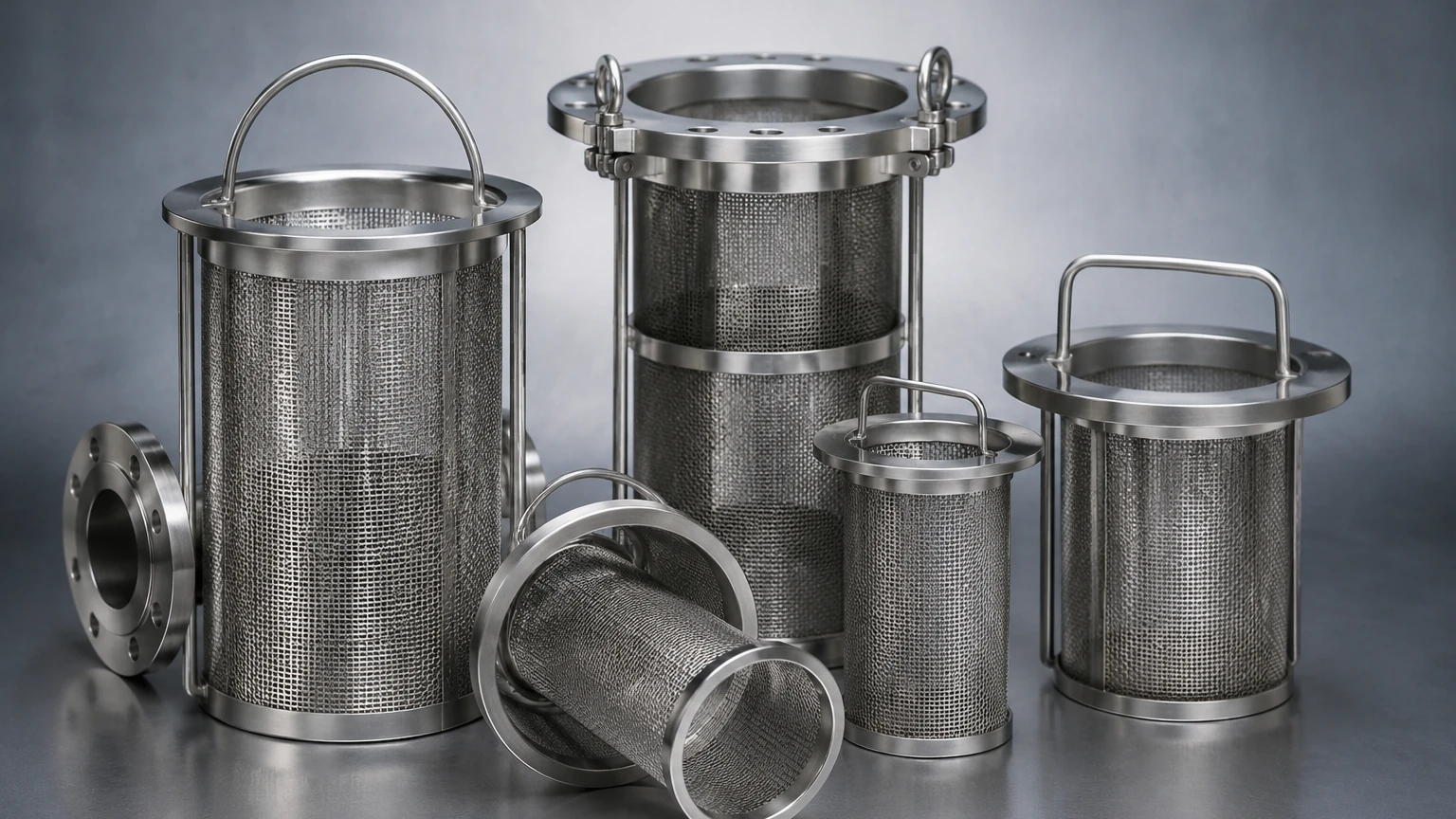
Basket type strainers are characterized by their vertical chamber design, which allows for a significantly larger filtration surface area compared to other strainer configurations. This increased surface area directly translates to a greater dirt-holding capacity, which in turn reduces the frequency of cleaning cycles. In many industrial contexts, these strainers are positioned on the suction side of pumps to prevent particulate matter from entering and damaging impellers or mechanical seals.
One of the defining features of a basket strainer is its top-opening design. This allows maintenance personnel to access the internal basket without draining the entire piping system, provided the flow is bypassed or temporarily halted. For continuous operation requirements, duplex basket strainers are utilized, consisting of two separate chambers connected by a diversion valve. This allows one side to be serviced while the other remains in operation, ensuring zero downtime for the process line.
Engineering Considerations: Flow Dynamics and Pressure Drop
When specifying basket type strainers, the relationship between flow rate and pressure drop ($ΔP$) is a fundamental engineering consideration. Every strainer introduces a degree of resistance to the fluid flow. If the pressure drop is too high, it can lead to cavitation in pumps or insufficient flow to downstream processes.
The Importance of the Open Area Ratio
The efficiency of a basket strainer is often measured by its "Open Area Ratio" (OAR). This is the ratio between the total open area of the strainer basket holes and the cross-sectional area of the inlet pipe. A common industry standard is an OAR of 6:1 or 8:1. A higher ratio indicates that the strainer can operate longer before the accumulation of debris causes a significant increase in differential pressure. Engineers must calculate the expected pressure drop based on the fluid's viscosity, specific gravity, and the mesh size of the basket to ensure the system operates within safe parameters.
Flow Velocity and Turbulence
High velocity within the strainer body can lead to increased turbulence, which may cause vibration or premature wear on the internal mesh. Most industrial designs aim for a velocity that maintains laminar flow as much as possible while passing through the filtration media. Properly sized basket type strainers mitigate these risks by providing a larger internal volume that allows the fluid to slow down as it enters the basket chamber, facilitating more efficient particle separation.
Material Selection and Chemical Compatibility
The durability of a strainer is largely dictated by the materials used in its construction. Stainless steel is the industry standard for high-performance filtration due to its mechanical strength and resistance to oxidation. Kaifil specializes in utilizing specific grades of stainless steel to meet diverse environmental challenges.
* Grade 304 Stainless Steel: Suitable for general-purpose industrial applications, offering good corrosion resistance and cost-effectiveness for water treatment or non-corrosive chemical lines.
* Grade 316/316L Stainless Steel: Contains molybdenum, which provides superior resistance to chlorides and pitting. This is the preferred choice for marine environments, pharmaceutical manufacturing, and the food and beverage industry where stringent hygiene and chemical resistance are required.
* Specialty Alloys: In cases involving highly aggressive acids or extreme temperatures, manufacturers may employ duplex stainless steels or other high-nickel alloys to ensure the structural integrity of the strainer body and the basket element.
Selecting the correct material prevents galvanic corrosion and ensures that the Main Page of the filtration system remains intact over years of service. Engineers should always cross-reference the fluid's chemical composition with material compatibility charts before finalizing a specification.
Filtration Media: Perforated Metal vs. Wire Mesh
The internal basket of these strainers can be constructed using different types of media, depending on the required filtration accuracy.
Perforated Plate Baskets
For coarse filtration (removing large stones, scale, or welding slag), perforated metal plates are used. These are robust and can withstand high differential pressures without deforming. The hole size is typically measured in fractions of an inch or millimeters. Perforated baskets often serve as the structural support for finer mesh linings.
Wire Mesh Linings
When finer filtration is required—down to the micron level—the perforated basket is lined with a precision-woven wire mesh. Wire mesh provides a high percentage of open area, allowing for efficient flow even at very fine filtration levels. Kaifil’s expertise in custom wire mesh filters allows for the production of multi-layered baskets that combine mechanical strength with high-precision particle retention. These are essential in applications like hydraulic oil filtration or the protection of fine-mist spray nozzles.
Operational Maintenance and Cleaning Protocols
The total cost of ownership for basket type strainers is heavily influenced by maintenance requirements. A strainer that is difficult to clean or prone to clogging will lead to increased labor costs and potential system failures.
Differential Pressure Monitoring
It is standard practice to install pressure gauges on both the inlet and outlet sides of the strainer. The difference between these two readings (differential pressure) indicates the level of clogging. Most manufacturers recommend cleaning or replacing the basket once the $ΔP$ reaches a predetermined limit, typically around 5 to 10 psi above the clean pressure drop. Ignoring these signals can result in the basket collapsing under pressure, which would release all captured contaminants back into the downstream flow.
Cleaning Procedures
Because basket type strainers are designed for easy access, cleaning usually involves removing the top cover (often secured by swing bolts or a quick-release clamp), lifting out the basket, and flushing it with a cleaning agent or high-pressure water. For sticky or viscous fluids, ultrasonic cleaning may be required to remove particles embedded deep within the wire mesh pores. Regular inspection of the basket seals and cover gaskets is also necessary to prevent external leaks or internal bypassing.
Customization and OEM Integration for Specialized Applications
Standard off-the-shelf strainers may not always meet the specific geometric or performance requirements of complex industrial systems. This is where custom manufacturing becomes vital. OEM providers like Kaifil work closely with engineering teams to develop tailored basket type strainers that fit specific spatial constraints or unique flow conditions.
Custom Geometry and Connections
In many retrofit projects, the piping layout is already fixed, requiring a strainer with custom inlet/outlet offsets or specific flange ratings (such as ANSI, DIN, or JIS). Furthermore, the internal basket can be modified with magnetic inserts to capture fine ferrous particles that might otherwise pass through a standard mesh, providing an extra layer of protection for high-precision machinery.
Industry-Specific Requirements
In the food and beverage industry, strainers must meet sanitary standards, which involve polished internal surfaces (low Ra values) to prevent bacterial growth and the use of FDA-approved gasket materials. Conversely, in the oil and gas sector, the focus may be on high-pressure ratings and the ability to handle high-viscosity fluids. Custom filtration solutions ensure that every component is optimized for its specific environment, rather than relying on a "one size fits all" approach.
Procurement Checklist: Technical Specifications to Confirm
Before placing an order for basket type strainers, purchasing and engineering teams should confirm several key technical parameters to ensure the product is fit for purpose:
1. Fluid Characteristics: Confirm the viscosity, density, and chemical composition of the fluid.
2. Operating Conditions: Define the maximum operating pressure and temperature, as well as the design pressure of the system.
3. Filtration Level: Specify the required micron rating or mesh count. Determine if a perforated plate alone is sufficient or if a mesh lining is required.
4. Flow Rate: Provide the minimum, normal, and maximum flow rates to allow for accurate pressure drop calculations.
5. Connection Type: Specify flange size and rating, or NPT/socket weld requirements.
6. Material Standards: Ensure the stainless steel grade matches the corrosion resistance needs of the application.
By addressing these factors, engineers can select a filtration solution that provides the best balance between performance, durability, and cost. For those looking to explore specific product configurations or seeking technical support for custom filtration projects, the Main Page of the Kaifil website offers a comprehensive overview of available manufacturing capabilities and engineering resources.
Conclusion
Basket type strainers are indispensable components in modern industrial fluid systems. Their ability to protect expensive downstream equipment while offering high dirt-holding capacity and ease of maintenance makes them a preferred choice across various sectors. By focusing on high-quality materials like stainless steel and prioritizing precision engineering in basket design, manufacturers like Kaifil help industries achieve greater operational efficiency. Whether through standard designs or highly customized OEM solutions, the correct implementation of basket type strainers is a vital step in ensuring the reliability and longevity of industrial processes.
