


Maple Syrup Pressure Filter
In the industrial production of maple syrup, achieving the highest standards of clarity and purity is a critical requirement for marketability and shelf stability. While small-scale producers may rely on gravity-fed felt bags, commercial operations require a more robust, efficient, and precise solution. The maple syrup pressure filter represents the professional standard for removing "sugar sand" (nitre) and other suspended solids from hot syrup. This technical guide explores the engineering principles, material requirements, and selection criteria for pressure filtration systems in the maple syrup industry.
The Role of Pressure Filtration in Syrup Processing
Maple syrup is produced by concentrating the sap of maple trees through evaporation or reverse osmosis. During the boiling process, minerals—primarily calcium and magnesium—precipitate out of the solution, forming a cloudy sediment known as sugar sand or nitre. If not removed, this sediment affects the syrup's clarity, alters its flavor profile, and can lead to fermentation or crystallization in the final packaging.
A maple syrup pressure filter utilizes mechanical force, typically provided by a pump, to drive the hot syrup through a series of filter media. Unlike gravity filtration, which is slow and prone to clogging, pressure filtration allows for high-throughput processing while maintaining a consistent micron rating. This process is usually performed when the syrup is at or near its finishing temperature (approximately 180°F to 210°F), as the reduced viscosity of hot syrup allows for more efficient flow through the filter media.
For engineers and facility managers, the choice of filtration components is vital. Utilizing high-quality stainless steel filtration elements ensures that the system can withstand the high temperatures and pressures required for continuous operation. Information regarding specialized metal filter components can be found on our Main Page, where we detail our manufacturing capabilities for industrial filtration.
Technical Components of a Pressure Filter System
A standard industrial maple syrup pressure filter system consists of several integrated components designed to work under demanding thermal conditions:
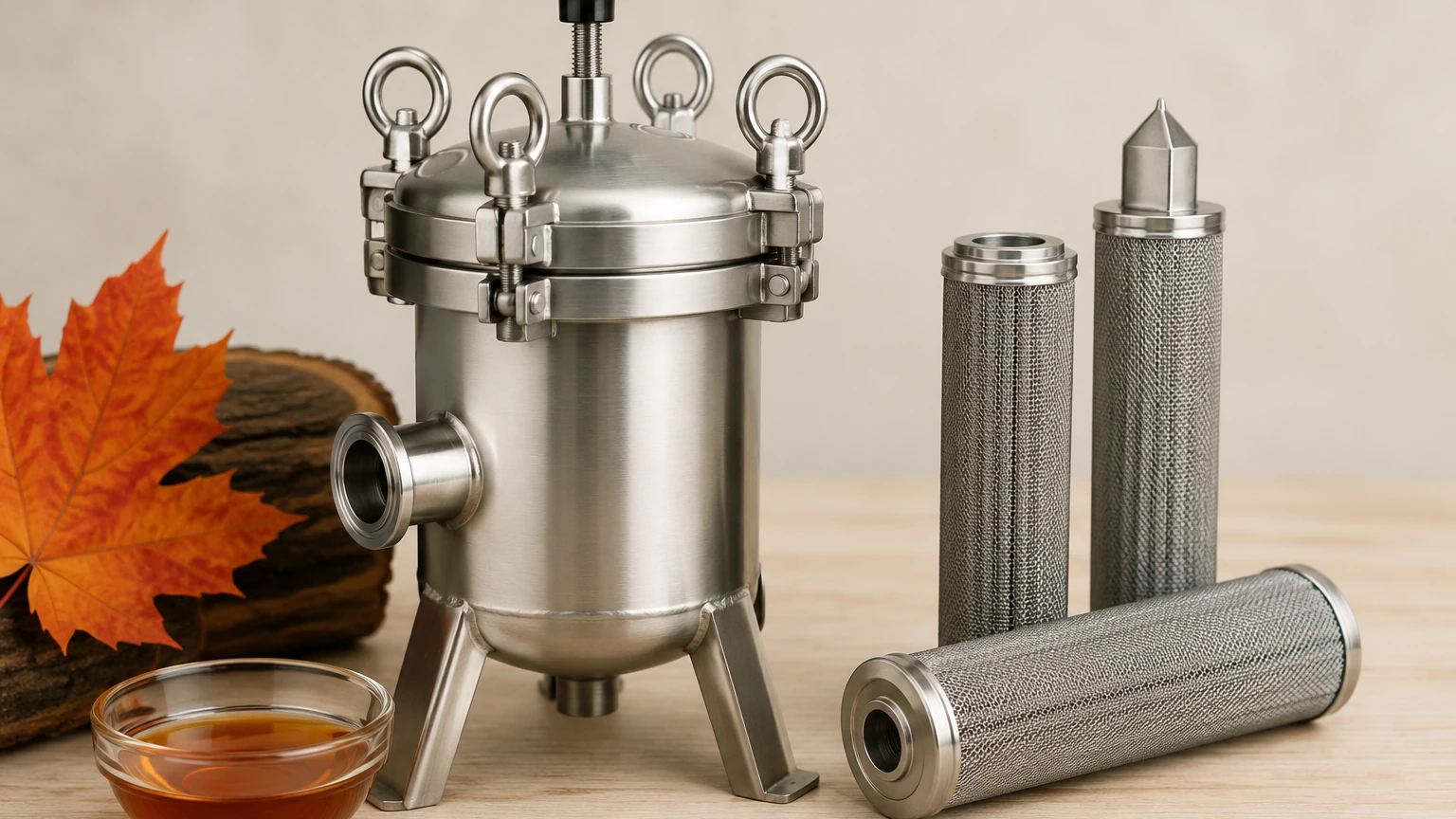
1. The Pressure Vessel: A sealed housing, typically constructed from 304 or 316 stainless steel, designed to contain the syrup and the filter media under pressure.
2. Filter Media: This can include filter paper, cloth, or increasingly, permanent stainless steel wire mesh elements. In many commercial setups, Diatomaceous Earth (DE) or a similar filter aid is used to create a "pre-coat" on the media to enhance fine particle capture.
3. The Pump: A food-grade pump (often a positive displacement or centrifugal pump) that moves the syrup from the evaporator or finishing pan into the filter press.
4. Internal Support Structures: These include plates, frames, or perforated metal tubes that prevent the filter media from collapsing under the force of the pump.
From an engineering perspective, the integrity of the internal filter element is paramount. If the support structure or the mesh itself fails, the entire batch of syrup may become contaminated with nitre or filter aid, requiring costly reprocessing.
Material Selection: Why Stainless Steel is Essential
In food and beverage processing, material selection is governed by both performance requirements and regulatory compliance. For a maple syrup pressure filter, stainless steel is the industry standard for several reasons:
Thermal Stability
Maple syrup must be filtered hot to maintain a low enough viscosity for the pump to operate efficiently. Stainless steel components maintain their structural integrity at temperatures exceeding 210°F without the risk of leaching or warping, which can occur with certain plastics or lower-grade alloys.
Corrosion Resistance
Although maple syrup is not highly acidic, the cleaning processes used in industrial facilities often involve caustic chemicals or high-pressure steam. 304-grade stainless steel offers excellent resistance to most standard cleaning agents, while 316L-grade is preferred for environments where superior corrosion resistance is needed to prevent pitting and ensure long-term durability.
Hygiene and Cleanability
Stainless steel provides a non-porous surface that resists bacterial growth. In pressure filtration, where syrup can become trapped in crevices, the ability to perform a thorough Clean-In-Place (CIP) cycle is essential. Precision-engineered wire mesh filters from Kaifil are designed with smooth surface finishes to facilitate easier cleaning and sterilization.
Filtration Accuracy and Micron Ratings
The effectiveness of a maple syrup pressure filter is measured by its ability to remove particles of specific sizes. Sugar sand particles can vary significantly in size, but a professional-grade system typically aims for a filtration accuracy between 1 and 10 microns for the final polish.
* Coarse Filtration (25-50 microns): Used in the early stages to remove larger debris or as a pre-filter to protect more sensitive downstream equipment.
* Fine Filtration (1-10 microns): The target range for achieving "brilliant" clarity in the final product. This level of filtration removes the microscopic nitre that causes cloudiness.
When selecting a stainless steel filter cartridge or wire mesh element, engineers must balance the micron rating with the flow rate. A tighter mesh (lower micron rating) provides higher clarity but increases the differential pressure across the filter, which may slow down production or require a more powerful pump. Kaifil specializes in custom wire mesh configurations that optimize this balance, ensuring high-performance filtration without unnecessary flow restriction.
Engineering Considerations for Flow Rate and Pressure
Designing or selecting a maple syrup pressure filter requires a deep understanding of fluid dynamics. Several factors influence the performance of the system:
Differential Pressure (ΔP)
As the filter media captures sugar sand, a layer of solids (the filter cake) builds up. This increases the resistance to flow, leading to a rise in differential pressure—the difference in pressure between the inlet and the outlet of the filter. If the ΔP becomes too high, the filter element may deform, or the pump may reach its bypass limit. Monitoring ΔP is the primary method for determining when a filter needs to be cleaned or the media replaced.
Viscosity and Temperature
The viscosity of maple syrup changes drastically with temperature. At room temperature, syrup is thick and difficult to pump through a fine mesh. By maintaining the syrup at approximately 190°F, the viscosity drops, allowing for a much higher flow rate through the maple syrup pressure filter. Engineering the system to handle these thermal loads is critical for maintaining consistent throughput.
Surface Area
To handle high volumes of syrup, the filter must have sufficient surface area. This is often achieved through pleated filter designs or multi-plate presses. Increasing the surface area reduces the velocity of the fluid through the mesh, which improves filtration efficiency and extends the time between cleaning cycles.
Maintenance and Replacement Cycles
For B2B operations, downtime is a significant cost factor. The durability of the filtration components directly impacts the total cost of ownership. While disposable paper filters are common, many industrial processors are moving toward permanent, cleanable stainless steel filter elements.
Cleaning Procedures
Stainless steel filters can be cleaned using backwashing, ultrasonic baths, or chemical soaking. This reusability eliminates the recurring cost of disposables and reduces waste. However, the cleaning process must be rigorous to ensure no residual sugars remain, which could lead to microbial growth during the off-season.
Inspection for Wear
Over time, the high-pressure environment can cause mechanical fatigue in the wire mesh or the seals of the filter housing. Regular inspection of the mesh integrity is necessary to ensure that no "bypass" is occurring, where unfiltered syrup leaks around the edges of the media. High-quality manufacturing ensures that these components can withstand hundreds of cleaning cycles before requiring replacement.
Customization for Industrial Scales
Every maple syrup production facility has unique requirements based on their tap count and evaporation capacity. A one-size-fits-all approach rarely provides the best efficiency. Customization options for a maple syrup pressure filter include:
* Custom Micron Ratings: Tailoring the mesh weave to the specific mineral profile of the sap in a particular region.
* Fitting and Connection Types: Ensuring the filter housing integrates seamlessly with existing NPT, Tri-Clamp, or flanged piping systems.
* Housing Geometry: Designing compact units for smaller sugar shacks or large-scale multi-cartridge housings for major industrial packers.
At Kaifil, we work closely with engineers to develop customized filtration solutions that meet these specific industrial demands. From material selection to final production, our focus is on providing reliable components that enhance the efficiency of the filtration process.
Conclusion: Selecting the Right Filtration Partner
Investing in a high-quality maple syrup pressure filter system is an investment in the quality of the final product. For commercial producers, the goal is to achieve maximum clarity with minimal syrup loss and operational downtime. By understanding the technical requirements of micron ratings, material science, and fluid dynamics, purchasing teams can make informed decisions that benefit their production line for years to come.
Choosing a manufacturer that understands the nuances of stainless steel filtration is essential for ensuring the longevity and performance of your equipment. For more information on our range of stainless steel filter cartridges, wire mesh filters, and custom filtration components, please visit our Main Page. Our engineering team is ready to support your specific application requirements with durable, high-precision filtration solutions.
