


Mott Filters Sintered Metal
In the landscape of industrial filtration, sintered metal technology represents the pinnacle of durability and precision. High-performance porous media, often associated with the standards set by Mott filters sintered metal, are essential components in environments where traditional polymer or glass fiber filters fail due to extreme temperatures, high pressures, or corrosive chemical exposure. For engineers and procurement specialists, understanding the technical nuances of sintered metal is critical for optimizing process efficiency and ensuring the longevity of filtration systems.
Sintered metal filters are engineered through a powder metallurgy process where metallic powders—typically stainless steel, nickel alloys, or titanium—are fused together without melting the base material. This results in a rigid, porous structure with highly controlled pore sizes. This article examines the technical characteristics, selection criteria, and industrial applications of sintered metal filtration solutions, providing a factual framework for technical decision-making.
Technical Fundamentals of Sintered Metal Filtration
The performance of sintered metal media is defined by its structural integrity and the precision of its pore geometry. Unlike woven wire mesh, which relies on the intersection of wires to create openings, sintered powder metal creates a tortuous path for fluids. This depth-filtration characteristic allows for high particle retention even at sub-micron levels.
The Sintering Process
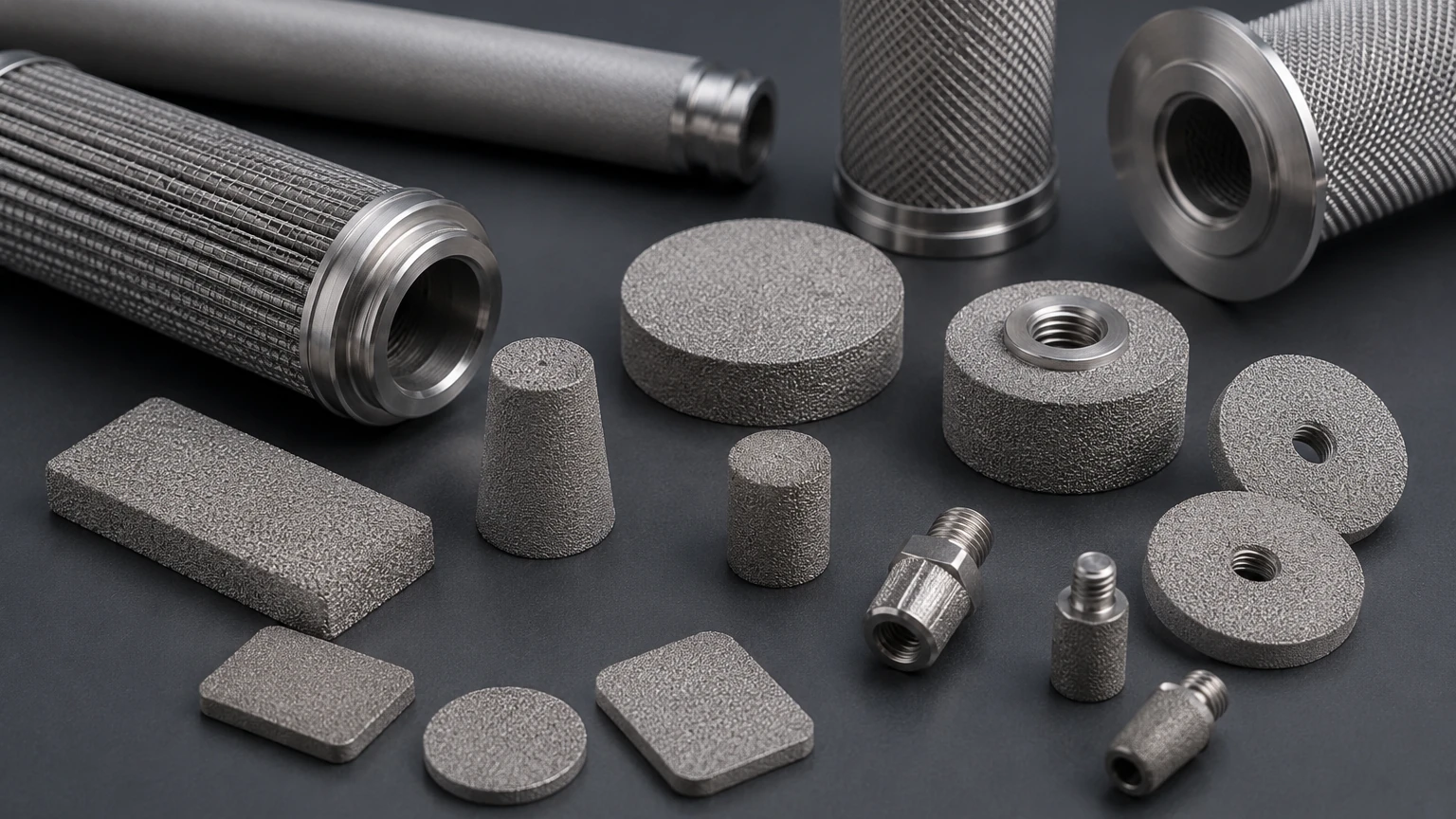
Sintering involves heating compacted metal powder to a temperature just below its melting point in a controlled atmosphere. This causes the particles to bond at their contact points through molecular diffusion. The resulting structure is a monolithic component that retains the chemical properties of the base alloy while gaining mechanical strength and a defined porosity. This process allows for the creation of various shapes, including tubes, discs, and complex custom geometries required for specific industrial housings.
Porosity and Permeability
The two most critical factors in evaluating sintered metal are porosity (the volume of open space) and permeability (the ability of fluid to flow through the media). High-quality sintered components achieve a balance where the pore size distribution is narrow, ensuring consistent filtration efficiency. Engineers must evaluate the "bubble point"—the pressure required to force air through a liquid-saturated filter—to verify the maximum pore size and ensure the media meets the required micron rating.
Material Selection for Harsh Environments
One of the primary reasons for selecting sintered metal over other media is its exceptional resistance to environmental stressors. The choice of alloy is the first step in the engineering process, as it dictates the filter's compatibility with the process fluid and its thermal limits.
* 316L Stainless Steel: The industry standard for general chemical resistance and high-temperature stability. It is widely used in food and beverage, pharmaceutical, and general industrial applications.
* Hastelloy C-276/C-22: Utilized in highly corrosive environments involving strong acids, chlorides, and oxidizing agents where standard stainless steel would suffer from pitting or stress corrosion cracking.
* Inconel 600/625: Preferred for extreme high-temperature applications, such as gas filtration in power generation or chemical synthesis, where oxidation resistance is paramount.
* Monel 400: Often selected for applications involving hydrofluoric acid or seawater due to its resistance to salt-induced corrosion.
Selecting the correct material ensures that the filter does not leach contaminants into the process stream and maintains its structural integrity over thousands of cleaning cycles.
Engineering Selection Criteria for Sintered Metal
When specifying sintered metal filters, engineers must move beyond simple micron ratings. A comprehensive evaluation includes the following performance metrics:
Filtration Efficiency and Micron Rating
Sintered metal filters are available in absolute ratings ranging from 0.1 microns to over 100 microns. It is vital to distinguish between nominal ratings (which indicate a general range) and absolute ratings (which guarantee the retention of a specific particle size). In critical applications like catalyst recovery, absolute retention is necessary to prevent the loss of expensive materials.
Pressure Drop (Delta P)
The initial pressure drop across a clean filter is a function of the fluid’s viscosity, flow rate, and the filter’s permeability. A well-designed sintered metal element provides a low initial Delta P to maximize the available operating pressure before a cleaning cycle is required. High-porosity designs help reduce energy consumption in pumping systems by minimizing resistance to flow.
Mechanical Strength and Differential Pressure
Sintered metal components are inherently robust and can withstand high differential pressures without deforming. This is particularly important in high-pressure hydraulic systems or gas filtration where sudden pressure surges may occur. The burst pressure and collapse pressure of the filter element must be calculated based on the maximum possible system pressure to ensure safety and prevent process downtime.
Comparing Sintered Powder and Sintered Wire Mesh
While both are referred to as sintered metal, there are distinct differences between sintered powder and sintered wire mesh that impact their application.
1. Sintered Powder Metal: Offers superior depth filtration and is ideal for capturing fine particles. It provides a more tortuous path, which is better for gas-solid separation and liquid applications requiring high precision. It is also more rigid and can be machined into precise shapes.
2. Sintered Wire Mesh: Consists of multiple layers of woven wire cloth sintered together. This media is typically thinner and offers higher flow rates with lower pressure drops. It is often used for surface filtration where backwashing or mechanical cleaning is frequent, as the particles are trapped on the surface rather than within the depth of the media.
For many B2B buyers, the choice depends on the specific balance required between filtration fineness and the ease of cleaning. Sintered powder is often the choice for the most demanding technical specifications, similar to the performance profiles found in Mott filters sintered metal products.
Industrial Applications and Performance Expectations
The versatility of sintered metal makes it a staple in several high-stakes industries. Its ability to be cleaned and reused provides a significant advantage in terms of total cost of ownership compared to disposable cartridges.
Chemical and Petrochemical Processing
In these industries, sintered metal filters are used for catalyst recovery from slurry streams. The high-temperature capability allows for the filtration of hot gases and liquids directly from reactors, improving thermal efficiency by eliminating the need to cool the fluid before filtration.
Pharmaceutical and Biotechnology
Sintered metal is used for sterile venting, steam filtration, and gas sparging. Because these filters can be sterilized in place (SIP) or autoclaved, they meet the stringent hygiene requirements of the pharmaceutical sector. The smooth surface finish of sintered components also prevents bacterial growth and facilitates thorough cleaning.
Food and Beverage Production
From carbonation sparging in breweries to filtering steam used for direct food contact, sintered metal provides a reliable, non-shedding medium. Unlike fiber-based filters, there is no risk of media migration—where filter fibers break off and enter the product stream.
Cleaning, Maintenance, and Longevity
One of the most significant advantages of sintered metal is its cleanability. Unlike disposable filters that contribute to waste and recurring procurement costs, sintered metal elements can be restored to near-original performance through various cleaning methods:
* Backpulsing/Backwashing: The most common method in continuous processes, where a reverse flow of gas or liquid dislodges the filter cake from the surface.
* Ultrasonic Cleaning: Uses high-frequency sound waves in a cleaning solution to remove fine particles trapped deep within the porous structure.
* Chemical Cleaning: Involves soaking the filter in solvents, acids, or caustic solutions to dissolve specific contaminants that cannot be removed mechanically.
* Thermal Cleaning (Burn-off): Used for removing organic contaminants by heating the filter in a controlled furnace, effectively carbonizing the debris.
A properly maintained sintered metal filter can last for years, significantly reducing the long-term operational costs of a filtration system. When evaluating suppliers, engineers should confirm the recommended cleaning protocols and the expected number of cycles before the structural integrity of the media might be compromised.
Customization and Sourcing for OEM Requirements
For many industrial applications, off-the-shelf filtration solutions do not meet the specific spatial or performance requirements of a system. Customization is often necessary, involving specific alloy selections, unique geometries, and integrated fittings. Manufacturers like Kaifil specialize in providing these tailored solutions, ensuring that the filtration component integrates seamlessly into the larger industrial process.
When sourcing sintered metal components, it is essential to work with a partner that understands the engineering complexities of fluid dynamics and material science. Whether you are replacing existing Mott filters sintered metal elements or designing a new system from the ground up, verifying the manufacturer's quality control processes—such as pore size verification and material certification—is a critical step.
To explore specific filtration components or discuss technical requirements for your industrial application, you can visit the Main Page for detailed product specifications and engineering support. Accessing professional guidance early in the design phase can prevent costly errors in material selection and ensure that the filtration system meets the required performance benchmarks for years to come.
In summary, sintered metal filtration offers a robust, high-precision solution for the most challenging industrial environments. By focusing on material compatibility, pore structure, and cleanability, engineers can implement filtration systems that provide both technical excellence and economic value.
