


Maple Filter Press
In the professional production of maple syrup, the transition from evaporated concentrate to a shelf-ready product requires a rigorous purification process. The primary challenge in this industry is the removal of "sugar sand" or niter—a precipitate composed mainly of calcium malate that forms during the boiling process. For industrial-scale operations, the maple filter press is the standard engineering solution for achieving the high level of clarity and brilliance demanded by commercial grading standards.
This article examines the technical design, material requirements, and operational considerations of the maple filter press from an industrial manufacturing perspective, providing engineers and production managers with the data needed to optimize their filtration stages.
The Engineering Principles of Pressure Filtration in Syrup Production
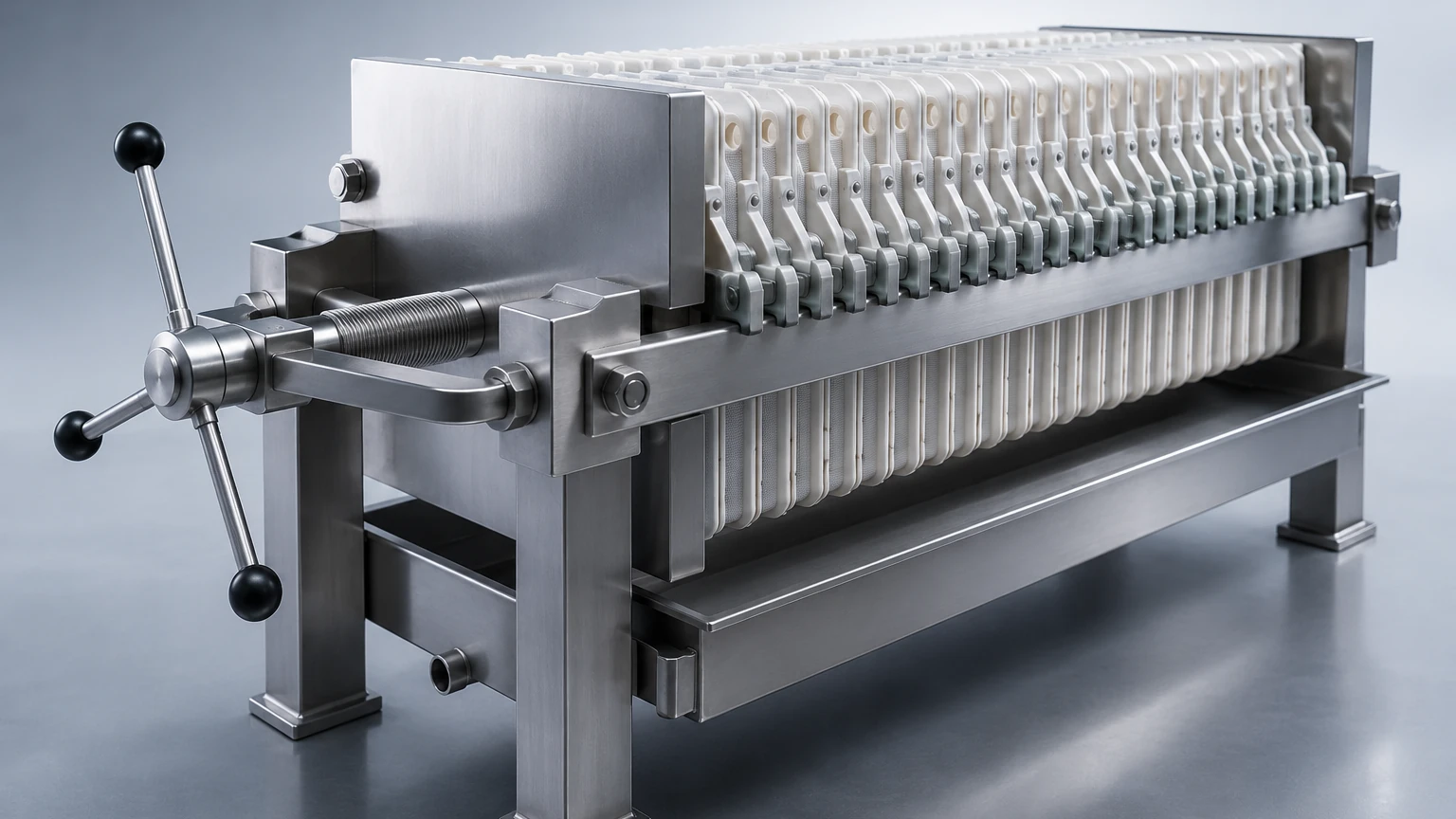
Unlike gravity-fed systems or cone filters used in smaller hobbyist operations, a maple filter press utilizes mechanical pressure to force hot syrup through a series of filter media. The system typically consists of a sequence of plates and frames (or recessed plates) held together by a heavy-duty chassis.
When the syrup is pumped into the press, it fills the chambers between the plates. The solid particles—the niter—are trapped by the filter media (usually a combination of filter paper and a pre-coat of diatomaceous earth), while the clarified syrup passes through and exits via a discharge manifold.
From a fluid dynamics standpoint, the efficiency of this process is governed by the relationship between pressure, surface area, and the viscosity of the syrup. Because maple syrup is highly viscous, particularly at the standard 66-67% Brix concentration, maintaining a high operating temperature (typically between 180°F and 190°F) is essential to reduce viscosity and ensure adequate flow rates through the filter cake.
Material Selection: The Necessity of Stainless Steel
In food and beverage processing, material integrity is paramount. For a maple filter press, stainless steel is the industry-standard material for all wetted parts, including the plates, frames, manifold, and pump housing.
Corrosion Resistance and Longevity
While maple syrup itself is not highly corrosive, the cleaning protocols required in food-grade environments often involve caustic or acidic agents to remove mineral scaling and organic residues. Type 304 stainless steel offers excellent resistance for most applications, but Type 316L is often preferred for its superior resistance to pitting and crevice corrosion, especially in facilities using chlorinated sanitizers.
Thermal Stability
Maple filtration occurs at temperatures near the boiling point. Stainless steel components provide the necessary thermal stability to prevent warping or structural failure under repeated thermal cycling. This ensures that the sealing surfaces between the plates remain tight, preventing leaks that could lead to product loss or safety hazards.
Hygiene and Compliance
Stainless steel is non-porous and can be manufactured with a high-quality surface finish (often measured in Ra or Roughness Average). A smooth finish prevents the adhesion of bacteria and simplifies the Clean-in-Place (CIP) process, ensuring compliance with FDA and international food safety regulations.
Technical Specifications and Selection Criteria
When selecting or designing a maple filter press, several technical parameters must be evaluated to ensure the equipment matches the production volume and desired product quality.
1. Filter Surface Area: The total area available for filtration determines how much syrup can be processed before the filter media becomes blinded by niter. Industrial presses often use 7-inch, 10-inch, or 15-inch square plates. Increasing the number of plates in the stack allows for longer production runs.
2. Chamber Volume: This refers to the space available for the accumulation of the "filter cake" (the mixture of niter and filter aid). If the chamber volume is too small, the press will require frequent teardowns and cleaning, reducing overall equipment effectiveness (OEE).
3. Pressure Capability: Most maple filter presses operate at pressures between 40 and 60 PSI. The pump—typically a diaphragm pump or a food-grade gear pump—must be sized to maintain this pressure consistently as the cake thickness increases.
4. Micron Rating: While the primary filtration is often handled by the filter aid (diatomaceous earth), the supporting wire mesh or filter paper must be sized to prevent the migration of the filter aid into the final product. Precision-engineered stainless steel support meshes can provide a durable foundation for these media.
The Role of Filter Aids and Pre-coating
In the context of maple syrup, the filter press rarely works alone. Diatomaceous earth (DE), a food-grade powder made of fossilized diatoms, is used as a filter aid.
Before the main batch of syrup is processed, a "pre-coat" of DE and syrup is circulated through the press. This builds a porous layer on the filter media. As the production run begins, additional DE (known as "body feed") is often added to the raw syrup. This prevents the niter from forming an impermeable layer on the surface of the filter, instead incorporating it into a porous, three-dimensional cake that allows for sustained flow.
Engineering a system that accurately doses the body feed is critical for maintaining a constant filtration rate and achieving the "brilliant" clarity required for Grade A maple syrup.
Operational Best Practices for Industrial Efficiency
To maximize the ROI of a maple filter press, operators should adhere to specific technical protocols:
* Temperature Monitoring: If the syrup temperature drops below 180°F, the viscosity increases exponentially, leading to a sharp rise in backpressure and a decrease in flow. Integrated thermal sensors and insulated piping are recommended for large-scale installations.
* Pressure Management: Operators should monitor the pressure differential across the press. A sudden spike in pressure indicates that the chambers are full or the media is blinded, signaling the need for a cleaning cycle.
* Gasket Integrity: The seals between the plates must be inspected regularly. In high-pressure maple applications, even a minor seal failure can result in significant product loss and a messy cleanup. Using high-temperature food-grade silicone or EPDM gaskets is standard practice.
Maintenance and Component Replacement
Industrial filtration is a demanding process, and the longevity of the equipment depends on a structured maintenance schedule. For a maple filter press, the primary wear components are the gaskets and the filter media supports.
Stainless steel support screens and precision wire mesh components should be inspected for deformation or clogging. Over time, mineral deposits (calcium malate) can become embedded in the mesh, requiring ultrasonic cleaning or specialized chemical descaling. Replacing these components with high-quality, custom-manufactured stainless steel parts ensures that the press maintains its original performance specifications.
For facilities looking to upgrade their existing systems or source high-performance filtration components, visiting the Main Page of a specialized manufacturer like Kaifil provides access to technical expertise in custom stainless steel filtration solutions. Professional guidance can help in selecting the right mesh sizes and material grades to optimize the clarity and throughput of the filtration line.
Customization and OEM Solutions
Every maple production facility has unique requirements based on their sap chemistry, evaporation method, and throughput goals. OEM (Original Equipment Manufacturer) solutions allow for the customization of the filter press to fit specific footprints or integrate with existing automated control systems.
Customization options often include:
* Automated Hydraulic Closure: Replacing manual screw closures with hydraulic systems to ensure consistent sealing pressure and reduce labor costs during teardowns.
* Manifold Configurations: Custom inlet and outlet manifolds to accommodate specific piping layouts or to allow for multi-stage filtration within a single frame.
* Skid-Mounted Systems: Integrating the pump, motor, controls, and filter press onto a single stainless steel skid for easy installation and mobility within the plant.
Total Cost of Ownership (TCO) Considerations
When evaluating a maple filter press, it is important to look beyond the initial capital expenditure. The total cost of ownership includes the cost of filter media (paper and DE), labor for cleaning and setup, energy for heating and pumping, and the cost of replacement parts.
Investing in high-quality stainless steel plates and precision-engineered filtration components can significantly reduce TCO by extending the service life of the equipment and reducing the frequency of unscheduled maintenance. Furthermore, a more efficient press reduces product loss—syrup trapped in the filter cake—which directly impacts the bottom line of the production facility.
In conclusion, the maple filter press is a sophisticated piece of industrial equipment that requires careful selection of materials and components. By understanding the engineering principles of pressure filtration and the specific challenges of maple syrup processing, production managers can ensure a high-quality, consistent product that meets the most stringent industry standards.
