


Coarse Screening
In the hierarchy of industrial fluid management, coarse screening serves as the critical first line of defense. It is the process of removing large-scale particulates, debris, and macro-solids from a process stream before they can reach sensitive downstream equipment or interfere with fine filtration stages. For engineers and facility managers, selecting the right coarse screening solution is not merely about choosing a mesh size; it involves a complex evaluation of fluid dynamics, material compatibility, and mechanical integrity.
As a specialized manufacturer of stainless steel filtration components, Kaifil provides the technical expertise required to navigate these variables. Understanding the nuances of coarse screening ensures that industrial systems operate with minimal downtime, protected against the abrasive and obstructive nature of raw process fluids. Whether in chemical processing, water treatment, or food production, the efficiency of the entire system often hinges on the performance of the initial screening stage.
The Role of Coarse Screening in Industrial Systems
Coarse screening is typically defined by the removal of particles ranging from several millimeters down to approximately 50 to 100 microns. Unlike fine filtration, which focuses on microscopic clarity, coarse screening is designed for high-volume throughput and the protection of mechanical assets.
In many industrial environments, the primary objective is the protection of pumps, heat exchangers, and spray nozzles. Large solids—such as scale, metal shavings, plastic fragments, or organic matter—can cause catastrophic failure if they enter a high-speed pump or clog a precision orifice. By implementing a robust screening solution at the intake or early in the process line, engineers can significantly extend the Mean Time Between Failures (MTBF) for expensive downstream components.
Furthermore, coarse screening acts as a pre-filter. By removing the bulk of the solid load, it prevents the premature "blinding" or clogging of more expensive, high-precision filter cartridges. This tiered approach to filtration optimizes the total cost of ownership (TCO) by ensuring that each stage of the process handles the particle size it was specifically designed for.
Engineering Considerations for Media Selection
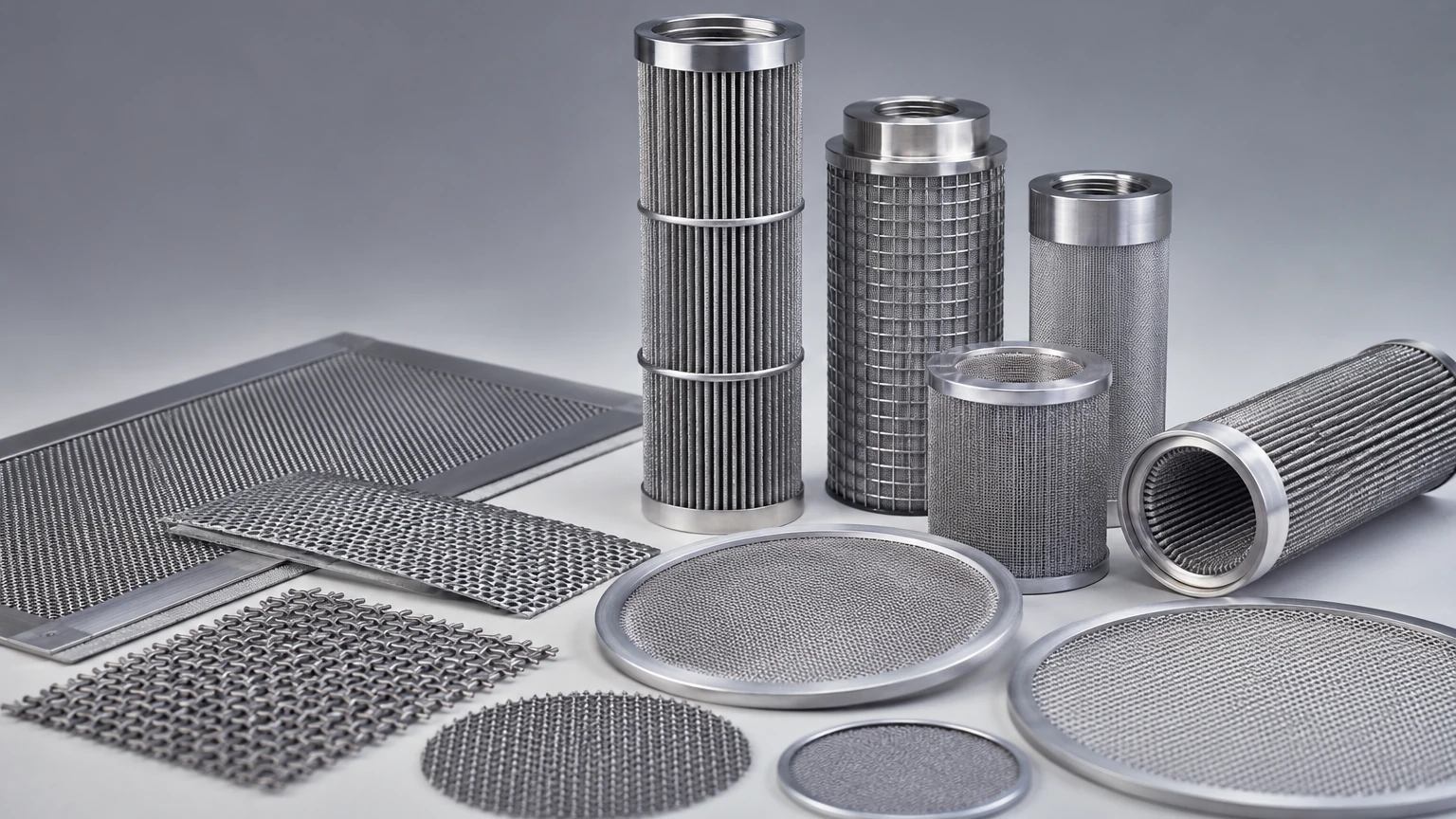
When specifying a coarse screening component, the choice of media is the most significant factor affecting performance. At Kaifil, we focus on stainless steel solutions due to their inherent durability and versatility. The three most common types of media used in these applications are woven wire mesh, perforated metal, and wedge wire.
Woven Wire Mesh
Woven wire mesh offers a high percentage of open area, which translates to lower initial pressure drops and higher flow rates. It is highly customizable, with various weave patterns (such as plain, twilled, or Dutch weaves) available to suit specific particle retention needs. For coarse screening, plain weaves are often preferred for their simplicity and ease of cleaning. However, mesh can be susceptible to mechanical damage if not properly supported by a perforated core or cage.
Perforated Metal
Perforated metal is often the preferred choice when mechanical strength is the primary concern. These screens are manufactured by punching holes into a solid sheet of stainless steel. While the open area is generally lower than that of woven mesh, the structural integrity is significantly higher. Perforated screens are ideal for applications involving high-pressure surges or heavy solid loads where a mesh might deform or tear.
Wedge Wire (V-Wire)
Wedge wire is a premium screening solution characterized by its non-clogging design. It consists of V-shaped profiles welded onto support rods. The narrow gap between the wires creates a precise slot width. Because the opening widens inwardly, particles that pass the initial gap are unlikely to become stuck, a phenomenon known as "pegging." This makes wedge wire exceptionally effective for sticky or fibrous materials often found in food processing and wastewater applications.
Material Science: Why Stainless Steel?
The operating environment dictates the material requirements. In industrial filtration, stainless steel is the gold standard for coarse screening components. Kaifil utilizes high-grade alloys to ensure longevity in demanding conditions.
1. Corrosion Resistance: Grade 304 stainless steel is suitable for many general-purpose industrial applications. However, in environments involving chlorides, high acidity, or marine conditions, Grade 316L is required. The addition of molybdenum in 316L provides superior resistance to pitting and crevice corrosion.
2. Temperature Stability: Many chemical and petrochemical processes operate at elevated temperatures that would degrade polymer-based screens. Stainless steel maintains its mechanical properties and dimensional stability across a wide thermal range.
3. Hygienic Properties: In the food, beverage, and pharmaceutical industries, the ability to sanitize equipment is paramount. Stainless steel is non-porous and can withstand aggressive Clean-in-Place (CIP) chemicals and high-pressure steam sterilization without leaching contaminants into the process stream.
Evaluating Performance: Flow Rate and Pressure Drop
A common challenge in designing a coarse screening system is balancing filtration efficiency with hydraulic performance. Every screen introduces a restriction to the flow, resulting in a pressure drop ($ΔP$). Engineers must ensure that the clean pressure drop is low enough to maintain system pressure requirements while allowing for a "dirt-holding capacity" before cleaning is required.
Open Area Percentage is the key metric here. It is the ratio of the total area of the openings to the total area of the screen. A higher open area reduces the velocity of the fluid as it passes through the screen, which minimizes the pressure drop and reduces the likelihood of particles being forced through the media or causing erosion.
When selecting a screen, it is essential to calculate the Flux Rate—the flow rate per unit area of the screen. If the flux rate is too high, the screen will clog rapidly, leading to frequent maintenance cycles. Increasing the physical size of the filter housing or using a pleated design can increase the surface area, thereby reducing the flux rate and extending the service life between cleanings.
Common Risks: Blinding and Pegging
In the context of coarse screening, two primary failure modes can disrupt operations: blinding and pegging.
* Blinding: This occurs when a thin layer of solids (often fats, oils, or fine silts) coats the surface of the screen, effectively sealing the openings. This is common in applications with high concentrations of deformable or sticky solids. Selecting a media with a smoother surface finish or implementing automated backwashing can mitigate this risk.
* Pegging: This happens when near-size particles (particles roughly the same size as the screen opening) become wedged in the holes. Once a hole is pegged, it is difficult to clear without manual intervention. Wedge wire is specifically engineered to prevent pegging due to its diverging slot geometry.
Understanding the particle size distribution (PSD) of the influent is vital. If a process contains a high percentage of particles near the screen's micron rating, engineers should consider either a slightly larger opening to allow them to pass or a smaller opening to ensure they are captured on the surface where they can be easily removed.
Maintenance and Replacement Cycles
While stainless steel coarse screens are designed for durability, they are not indestructible. A proactive maintenance schedule is necessary to prevent mechanical failure.
Differential Pressure Monitoring is the most effective way to determine when a screen needs cleaning or replacement. By installing pressure gauges upstream and downstream of the screening unit, operators can track the increase in $ΔP$. Once a predetermined threshold is reached, the screen should be cleaned via backflushing, ultrasonic cleaning, or manual washing.
Signs that a screen requires replacement include:
* Mechanical Deformation: Visible bowing or crushing of the media, often caused by exceeding the maximum allowable differential pressure.
* Erosion: Thinning of the wires or hole edges due to high-velocity abrasive particles.
* Fatigue Cracking: Often found in applications with high-frequency pressure pulsations or vibration.
Customization and OEM Integration
Off-the-shelf screening solutions rarely meet the specific needs of complex industrial systems. Engineering teams often require customized dimensions, specific flange connections, or reinforced structures to fit into existing infrastructure.
At Kaifil, we work closely with global customers to develop tailored filtration components. This includes selecting the optimal mesh-to-support ratio, designing custom end-caps, and ensuring that the final product meets the exact tolerances required for the application. For those seeking to optimize their current filtration setup or develop a new system, visiting our Main Page provides a comprehensive overview of our manufacturing capabilities and technical support services.
Conclusion: Making Informed Purchasing Decisions
Coarse screening is a fundamental engineering requirement that protects the integrity of industrial processes. By focusing on material quality, structural design, and hydraulic efficiency, engineers can ensure their systems remain productive and cost-effective.
Before finalizing a purchase, technical professionals should confirm the following:
1. Chemical Compatibility: Is the stainless steel grade appropriate for the fluid and cleaning chemicals?
2. Mechanical Load: Can the screen withstand the maximum possible differential pressure if it becomes fully clogged?
3. Particle Characteristics: Is the media type (mesh vs. wedge wire) suited to the shape and stickiness of the contaminants?
4. Operational Flow: Does the open area support the required flow rate without excessive pressure loss?
By addressing these factors during the design and procurement phase, organizations can implement a coarse screening solution that provides reliable performance in even the most demanding industrial environments.
