


Water Filter Cartridge Types
In industrial water treatment and process fluid management, the selection of filter cartridges is a critical engineering decision that directly impacts system efficiency, product purity, and operational costs. Unlike residential applications where simple sediment removal is often the primary goal, industrial environments demand specific performance characteristics regarding chemical compatibility, temperature resistance, and mechanical strength. Understanding the various water filter cartridge types is essential for engineers and procurement teams tasked with optimizing filtration systems for chemical processing, food and beverage production, or pharmaceutical manufacturing.
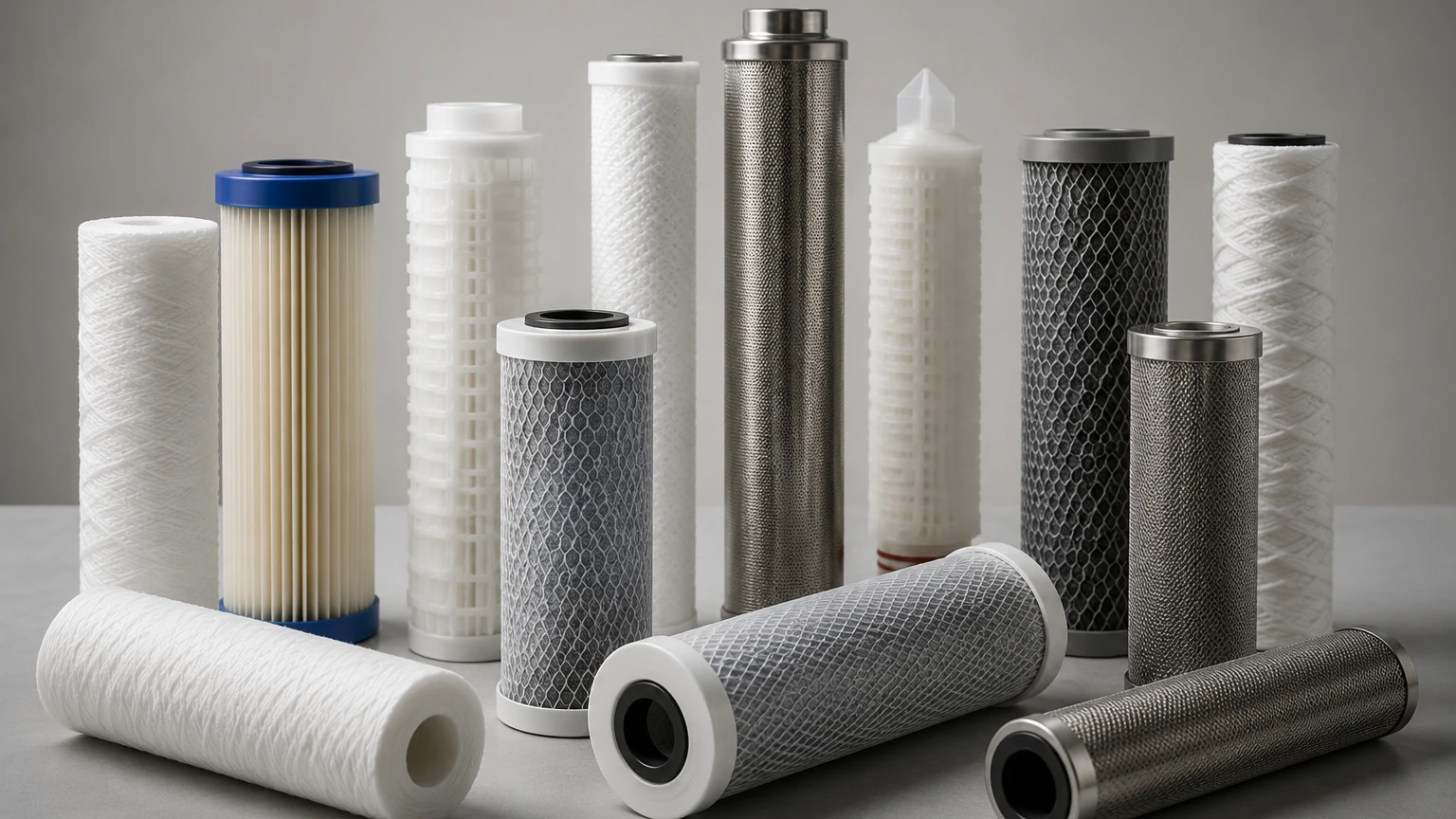
Industrial filtration typically categorizes cartridges based on their construction material, filtration mechanism, and structural design. For heavy-duty applications, stainless steel filtration solutions have become the standard due to their durability and ability to be cleaned and reused, contrasting sharply with disposable polymer-based alternatives.
1. Classification by Filtration Mechanism: Surface vs. Depth
Before selecting a specific cartridge, it is necessary to understand the two primary mechanisms by which water filter cartridge types capture contaminants: surface filtration and depth filtration.
Surface Filtration
Surface filters capture particles on the upstream side of the filter medium. The medium is typically a thin layer, such as a fine wire mesh or a thin membrane. The pore size is precisely controlled, ensuring that any particle larger than the pore is blocked.
* Advantages: High precision, predictable performance, and ease of cleaning through backwashing.
* Common Materials: Stainless steel wire mesh, pleated metal fabrics.
* Typical Use Case: Final stage filtration where absolute micron ratings are required to protect downstream equipment or ensure product quality.
Depth Filtration
Depth filters utilize a thick, porous medium to capture particles throughout the entire cross-section of the material. Contaminants are trapped within the tortuous paths of the filter matrix. These are often used as pre-filters because they can hold a significant volume of solids before the pressure drop becomes excessive.
* Advantages: High dirt-holding capacity and effective removal of deformable particles.
* Common Materials: Sintered metal powders, felted fibers, or wound yarns.
* Typical Use Case: Raw water intake or pre-filtration for reverse osmosis (RO) systems.
2. Stainless Steel Filter Cartridge Varieties
Stainless steel is the material of choice for demanding industrial water filtration due to its structural integrity and resistance to corrosion and high temperatures. Manufacturers like Kaifil specialize in several distinct metal cartridge designs.
Sintered Metal Cartridges
Sintered cartridges are manufactured by bonding metal powders or multiple layers of wire mesh through a high-temperature diffusion process known as sintering. This creates a rigid, self-supporting structure that does not require an internal core. Sintered metal cartridges are ideal for high-pressure environments where fiber migration must be eliminated. They offer exceptional mechanical strength and can withstand aggressive cleaning cycles, including ultrasonic cleaning and chemical baths.
Pleated Stainless Steel Cartridges
Pleating the filter medium—whether it is thin wire mesh or metal fiber felt—significantly increases the effective filtration surface area within a standard cartridge footprint. This design allows for higher flow rates and lower initial pressure drops compared to cylindrical designs. Pleated cartridges are frequently used in high-purity water systems and hydraulic applications where space is limited but high throughput is required.
Wire Mesh Filter Cartridges
These cartridges utilize various weave patterns, such as plain weave, twill weave, or Dutch weave, to achieve specific filtration ratings. Dutch weave, for instance, provides a dense, strong mesh capable of fine filtration while maintaining high flow capacity. These are often the preferred water filter cartridge types for industrial strainers and coarse filtration stages.
3. Technical Evaluation Criteria for Selection
When evaluating different water filter cartridge types, engineers must look beyond the basic dimensions (e.g., 10-inch or 20-inch lengths) and focus on technical performance specifications.
Micron Rating: Absolute vs. Nominal
* Nominal Rating: An approximate value indicating that the filter will trap a large percentage of particles of a certain size (e.g., 95% of 10-micron particles). This is suitable for non-critical applications.
* Absolute Rating: A definitive value representing the size of the largest particle that can pass through the filter under specific test conditions (usually 99.9% efficiency). For pharmaceutical or precision chemical processes, absolute-rated stainless steel cartridges are mandatory.
Pressure Drop and Flow Rate
The "clean pressure drop" is the resistance the filter offers to the fluid flow when it is new. A high initial pressure drop reduces the available pressure for downstream processes and increases energy consumption. Metal cartridges generally offer better flow-to-surface-area ratios than thick depth filters, allowing for more efficient system designs.
Chemical and Thermal Compatibility
While synthetic cartridges (PP, PES, PTFE) are common, they have strict temperature limits (often below 80°C) and may degrade in the presence of certain solvents or high-pH cleaning agents. Stainless steel cartridges, particularly those made from 316L, can operate at temperatures exceeding 300°C and are resistant to a wide array of industrial chemicals, making them essential for steam filtration and hot process water.
4. Material Science: SS304 vs. SS316L
The choice of alloy is as important as the cartridge design. For most industrial water applications, two grades of stainless steel dominate the market:
* SS304: Suitable for general-purpose water filtration, including cooling water and some food processing. It offers good corrosion resistance at a lower cost.
* SS316L: Contains molybdenum, which provides significantly higher resistance to chlorides and pitting corrosion. This is the standard for marine environments, pharmaceutical production, and applications involving high-salinity water or aggressive chemical additives.
Engineers should consult the Main Page of their supplier to confirm the specific alloy properties and ensure they meet the regulatory requirements for their specific industry, such as FDA compliance for food contact.
5. Application-Specific Industry Requirements
Different sectors prioritize different water filter cartridge types based on their unique operational challenges:
* Food and Beverage: Requires cartridges that can be sterilized in place (SIP) using steam or hot water. Stainless steel pleated filters are favored here because they do not shed fibers and can withstand repeated sterilization cycles without losing integrity.
* Chemical Processing: Often involves high-viscosity fluids or corrosive reagents. Sintered metal cartridges are preferred for their ability to maintain pore structure under high differential pressures.
* Water Treatment (Pre-RO): High-flow wire mesh cartridges are used to protect expensive RO membranes from particulate damage. The cleanable nature of metal filters reduces the total cost of ownership compared to replacing thousands of disposable melt-blown cartridges annually.
* Hydraulic Systems: Precision metal filter components are used to remove fine metallic wear particles that could otherwise damage pumps and valves. These cartridges must handle high-pressure pulses without collapsing.
6. Maintenance, Cleaning, and Total Cost of Ownership
A common misconception in B2B procurement is focusing solely on the initial purchase price. Disposable cartridges have a low unit cost but high recurring expenses due to replacement labor, disposal costs, and system downtime.
In contrast, stainless steel water filter cartridge types represent a higher initial investment but offer a lower Total Cost of Ownership (TCO) over the long term. Their ability to be regenerated is a key factor. Common cleaning methods include:
1. Backwashing: Reversing the flow of fluid to dislodge surface contaminants.
2. Chemical Cleaning: Using acids or alkalis to dissolve organic or inorganic scaling (specifically effective for SS316L).
3. Ultrasonic Cleaning: Using high-frequency sound waves in a liquid bath to remove fine particles trapped deep within sintered or mesh structures.
4. Burn-off/Pyrolysis: For cartridges used in polymer or resin filtration, heating the cartridge to high temperatures can vaporize organic contaminants without damaging the metal structure.
By implementing a proper cleaning protocol, a single stainless steel cartridge can remain in service for several years, whereas a synthetic equivalent might require replacement every few weeks.
7. Customization and Engineering Considerations
Off-the-shelf filtration products often fail to meet the exact needs of specialized industrial equipment. OEM manufacturers like Kaifil provide customized filtration solutions that allow engineers to specify:
* End Cap Configurations: Standard DOE (Double Open End), SOE (Single Open End) with various O-ring codes (e.g., Code 7, Code 3) to ensure a bypass-free seal.
* Reinforced Cores: For applications with extreme pressure spikes.
* Custom Dimensions: Non-standard lengths and diameters to fit existing legacy housing units.
* Layered Media: Combining different mesh counts to create a multi-stage filtration effect within a single cartridge.
When sourcing these components, it is vital to work with a manufacturer that understands the nuances of fluid dynamics and material stress. Technical professionals should verify the manufacturer's quality control processes, such as bubble point testing, which ensures the integrity of the filter media and the absence of bypass leaks.
Conclusion
Selecting the right water filter cartridge types requires a balanced analysis of the fluid characteristics, the required purity levels, and the long-term operational budget. While disposable filters serve a purpose in low-demand environments, industrial-scale operations benefit significantly from the durability, precision, and reusability of stainless steel filtration components. By focusing on technical specifications like absolute micron ratings, material grades, and cleaning compatibility, engineers can ensure their filtration systems provide reliable protection for downstream equipment and maintain the highest standards of product quality. For detailed technical specifications and to explore customized filtration components, engineers are encouraged to review product options and application support on the manufacturer's Main Page.
