


Reticulated Foam
In the landscape of industrial filtration and advanced material science, reticulated foam stands out as a critical component for applications requiring high porosity, low density, and a high surface-area-to-volume ratio. For engineers and procurement specialists, understanding the technical nuances of this material—particularly when transitioned from polymer bases to high-performance metal structures—is essential for optimizing system performance. As a manufacturer specializing in custom stainless steel filtration solutions, Kaifil provides the engineering expertise necessary to integrate these complex structures into demanding industrial environments.
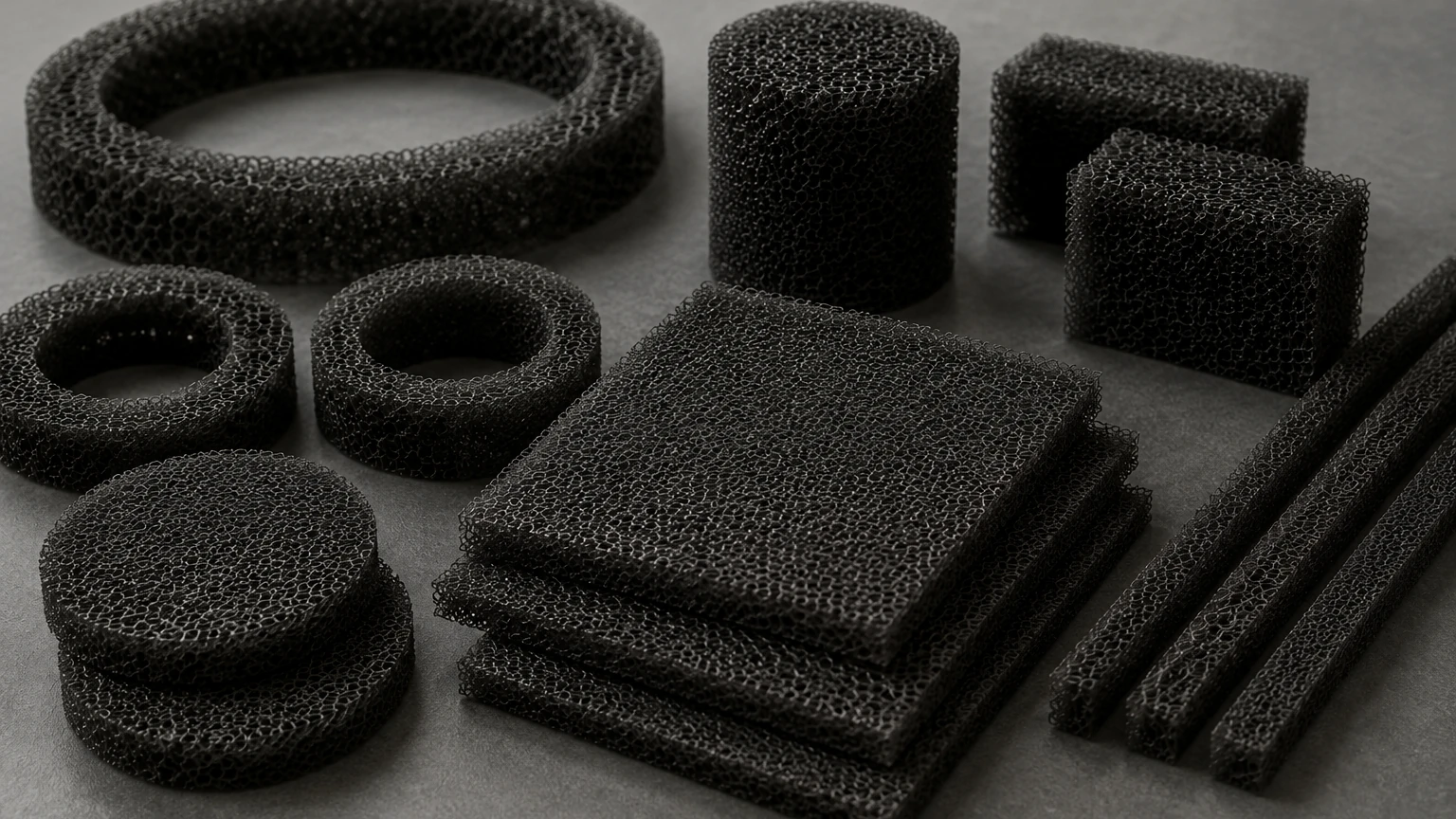
Reticulated foam is defined by its open-cell structure, where the "windows" or membranes between the cell ligaments have been removed, leaving only a continuous three-dimensional skeletal network. This architecture allows for the unhindered flow of gases and liquids while providing a tortuous path for particle entrapment or thermal exchange. Whether utilized in chemical processing, aerospace, or hydraulic systems, the selection of reticulated media requires a deep dive into material properties, pore geometry, and mechanical durability.
The Fundamentals of Reticulated Foam Structure
The defining characteristic of reticulated foam is its void fraction, which typically ranges from 90% to 98%. Unlike conventional closed-cell foams used for insulation or structural support, reticulated foam undergoes a process called "reticulation"—often involving a controlled thermal or chemical explosion—that strips away the thin membranes between the cells. What remains is a dodecahedron-like geometry of interconnected ligaments.
Pores Per Inch (PPI) and Pore Size
In industrial specifications, the most common metric for reticulated foam is Pores Per Inch (PPI). This value indicates the linear density of the pores. A lower PPI (e.g., 10 PPI) indicates large, coarse pores suitable for high-flow pre-filtration or mist elimination, while a high PPI (e.g., 80 or 100 PPI) indicates a fine, dense structure capable of capturing smaller particulates.
It is important for engineers to distinguish between PPI and absolute filtration ratings. While PPI provides a general guide to the texture and surface area, the actual filtration efficiency depends on the thickness of the foam media, the flow velocity, and the specific gravity of the particles being filtered. In precision metal filtration, these parameters are strictly controlled to ensure consistency across batches.
Ligament Uniformity and Void Fraction
The mechanical strength of the foam is derived from its ligaments. In high-quality reticulated metal foams, such as those used in stainless steel filter cartridges, the uniformity of these ligaments determines the material's resistance to compression and pressure surges. A high void fraction ensures a low initial pressure drop, which is a critical KPI for reducing energy consumption in pumping and ventilation systems.
Material Selection and Engineering Considerations
While reticulated foams can be manufactured from various polymers (polyurethane, ceramic, or carbon), industrial applications often demand the thermal and chemical resilience of metals. Stainless steel reticulated foam is frequently the preferred choice for engineers dealing with aggressive solvents, high temperatures, or high-pressure differentials.
Stainless Steel Grades: 304 vs. 316L
Material selection begins with the chemical environment. Grade 304 stainless steel offers excellent mechanical properties and basic corrosion resistance suitable for many industrial air and water filtration tasks. However, for applications involving chlorides, acids, or pharmaceutical-grade purity, Grade 316L is the standard. The addition of molybdenum in 316L provides superior resistance to pitting and crevice corrosion, ensuring the structural integrity of the reticulated network over long service cycles.
Thermal Stability and Conductivity
One of the unique advantages of metal reticulated foam is its ability to operate in extreme temperature ranges where polymer foams would melt or degrade. Metal foams can withstand temperatures exceeding 500°C (depending on the alloy), making them ideal for exhaust gas filtration, flame arrestors, and heat exchangers. Furthermore, the high thermal conductivity of the metal ligaments allows the foam to act as an efficient heat sink or thermal spreader in electronic and aerospace cooling systems.
Performance Metrics: Pressure Drop and Filtration Efficiency
For any engineer specifying a filtration component, the relationship between pressure drop (Delta P) and filtration efficiency is the primary trade-off. Reticulated foam offers a unique advantage in this regard due to its high permeability.
Understanding Flow Resistance
Because the internal structure is almost entirely open space, the resistance to fluid flow is significantly lower than that of granular beds or dense felt media. This allows for higher face velocities without a corresponding spike in energy requirements. When designing a system, engineers must calculate the permeability coefficient of the foam, which is influenced by the PPI and the thickness of the media.
Depth Filtration Capabilities
Unlike surface filtration media (such as thin wire mesh), reticulated foam provides depth filtration. As fluid passes through the 3D network, particles are trapped not just on the surface, but throughout the entire thickness of the foam. This "tortuous path" increases the dirt-holding capacity of the filter, leading to longer intervals between maintenance or replacement. For many technical teams, this translates to a lower total cost of ownership (TCO) by reducing downtime and labor costs associated with filter changes.
Applications in Industrial Filtration and Beyond
The versatility of reticulated foam allows it to serve multiple roles across diverse sectors. Its application is rarely limited to simple particulate removal; it often performs secondary functions such as flow equalization or noise reduction.
* Chemical and Petrochemical Processing: In these environments, reticulated metal foams are used for catalyst support and mist elimination. Their resistance to corrosive chemicals and high temperatures ensures that the catalytic surface area remains stable even under volatile conditions.
* Hydraulic and Lubrication Systems: High-density reticulated foam serves as a secondary or safety filter in hydraulic circuits. It captures large debris that could cause catastrophic pump failure while maintaining the high flow rates required for system responsiveness.
* Food and Beverage Production: Stainless steel reticulated components are used in steam filtration and sparging applications. The inert nature of 316L stainless steel ensures that no contaminants are introduced into the product stream, meeting stringent hygiene standards.
* Aerospace and Defense: Beyond filtration, the high strength-to-weight ratio of metal foam makes it an excellent material for acoustic dampening in jet engines and structural reinforcement in lightweight panels.
Comparing Reticulated Foam with Sintered Wire Mesh
When selecting a metal filtration medium, engineers often compare reticulated foam with sintered wire mesh or sintered metal powders. Each has distinct advantages depending on the application requirements.
| Feature | Reticulated Metal Foam | Sintered Wire Mesh |
| :— | :— | :— |
| Porosity | Extremely High (up to 98%) | Moderate (30% – 60%) |
| Filtration Type | Depth Filtration | Surface or Thin-Depth |
| Pressure Drop | Very Low | Moderate to High |
| Cleanability | Moderate (requires ultrasonic) | Excellent (backwashable) |
| Mechanical Strength | Moderate (compressive) | High (tensile/burst) |
| Surface Area | Extremely High | Moderate |
While sintered wire mesh provides more precise absolute ratings for fine particle removal, reticulated foam is superior for high-volume flow applications where a low pressure drop is paramount. In many advanced systems, these materials are used in tandem—a reticulated foam pre-filter to handle high dirt loads, followed by a precision wire mesh stage for final polishing. For those looking to explore these combinations, the Main Page of Kaifil offers a comprehensive overview of how different metal media can be integrated into a single custom solution.
Customization and OEM Solutions
Industrial filtration is rarely a one-size-fits-all endeavor. The effectiveness of reticulated foam is highly dependent on how it is integrated into the larger assembly. Customization is where engineering expertise becomes most valuable.
Custom Geometry and Housing Integration
Reticulated foam can be machined, EDM-cut, or molded into specific shapes to fit unique housing configurations. Whether it is a cylindrical cartridge, a flat disc, or a complex 3D plug, the edges must be sealed effectively to prevent bypass. Kaifil specializes in the precision manufacturing of these components, ensuring that the interface between the foam and the stainless steel housing is robust and leak-proof.
Layered and Graded Density Media
Advanced filtration challenges often require graded density. By layering different PPI foams—starting with a coarse outer layer and moving to a fine inner core—engineers can maximize the dirt-holding capacity of a single filter element. This approach prevents the surface from blinding prematurely and utilizes the full volume of the filter media.
Maintenance, Cleaning, and Total Cost Considerations
A common question among purchasing teams concerns the longevity and reusability of reticulated metal filters. Unlike disposable polymer filters, stainless steel reticulated foam is a long-term investment.
Cleaning Protocols
Because of the complex internal structure, cleaning reticulated foam requires more than a simple surface wipe. Ultrasonic cleaning is the most effective method, as the high-frequency waves create cavitation bubbles that reach deep into the pores to dislodge trapped particulates. Chemical cleaning (CIP) and high-pressure backwashing are also viable, provided the chemical agents are compatible with the metal grade.
Evaluating Total Cost of Ownership (TCO)
While the initial procurement cost of a reticulated metal foam filter is higher than that of a disposable plastic or paper alternative, the TCO is often significantly lower. Factors contributing to this include:
1. Reduced Replacement Frequency: Metal foams can last for years with proper maintenance.
2. Energy Savings: Lower pressure drops reduce the load on pumps and compressors.
3. Waste Reduction: Eliminating disposable filters aligns with corporate sustainability goals and reduces hazardous waste disposal costs.
Conclusion: Selecting the Right Partner for Filtration Solutions
Specifying reticulated foam for industrial use requires a balance of fluid dynamics, material science, and mechanical engineering. Engineers must confirm the chemical compatibility, thermal requirements, and expected flow rates before finalizing a design. By focusing on precision-engineered stainless steel components, manufacturers can ensure that these filters perform reliably in the most demanding environments.
As a professional manufacturer, Kaifil works closely with global customers to develop high-performance filtration products tailored to specific application requirements. From material selection to the final production of customized cartridges and components, our team provides the technical support necessary to optimize your filtration processes. To learn more about our capabilities and explore our full range of stainless steel filtration solutions, visit our Main Page and consult with our engineering team for your next project.
