


Filtration Flask Laboratory
In industrial research and development, the filtration flask laboratory setup—often referred to as a Büchner flask or vacuum flask—serves as the foundational environment for liquid-solid separation. While the laboratory scale typically utilizes borosilicate glass and small-scale media, the principles established during these benchtop experiments dictate the engineering parameters for full-scale industrial production. For engineers and technical professionals, understanding the mechanics of laboratory filtration is the first step toward designing robust, high-capacity filtration systems that utilize stainless steel mesh and precision filter cartridges.
Vacuum filtration is preferred in laboratory settings because it significantly accelerates the filtration process compared to gravity-fed methods. By creating a pressure differential across the filter media, the liquid (filtrate) is forced through the pores while the solids (residue or filter cake) are retained. This process is critical in chemical processing, pharmaceuticals, and environmental testing, where purity and recovery rates are paramount.
The Role of Vacuum Filtration in Industrial Research
A filtration flask laboratory environment is designed to simulate larger industrial processes on a manageable scale. Technical teams use these setups to determine the specific resistance of a filter cake, evaluate the compatibility of various solvents with different filter media, and establish the required micron ratings for optimal clarity.
In the context of B2B manufacturing and process engineering, the laboratory phase is where the "proof of concept" for a filtration cycle occurs. If a pharmaceutical manufacturer needs to isolate a specific compound, the laboratory filtration step allows them to test different mesh sizes and materials before investing in large-scale stainless steel filtration housing. This stage is crucial for minimizing the total cost of ownership by preventing premature clogging or material failure in the production line.
Key Components of a Filtration Flask Laboratory Setup
A standard vacuum filtration assembly consists of several specialized components, each playing a vital role in the integrity of the separation process:
1. The Filtration Flask: Unlike standard Erlenmeyer flasks, a filtration flask features thick walls designed to withstand the atmospheric pressure differential without imploding. It includes a side arm or "hose barb" for connection to a vacuum source.
2. The Funnel (Büchner or Hirsch): This component holds the filter media. In a laboratory setting, these are often ceramic or plastic, but for pilot-plant applications, stainless steel funnel assemblies are frequently used to ensure durability and chemical resistance.
3. Filter Media: This is the heart of the system. While filter paper is common in basic labs, industrial-grade filtration flask laboratory work often employs wire mesh discs or sintered metal membranes to better mimic industrial conditions.
4. Vacuum Source: This can range from a simple water aspirator to a dedicated mechanical vacuum pump. The level of vacuum must be carefully controlled to avoid "pulling through" fine particles or damaging the filter cake.
5. Sealing Gaskets: Usually made of silicone or rubber (Büchner rings), these ensure an airtight seal between the funnel and the flask, maintaining the pressure differential necessary for efficient flow.
Engineering Criteria for Selecting Laboratory Filtration Systems
When engineers evaluate a filtration flask laboratory setup, they must look beyond simple liquid collection. Several technical factors influence the selection of components and the subsequent transition to industrial equipment.
Pressure Differential and Implosion Protection
Because vacuum filtration involves negative pressure, the structural integrity of the flask is a primary safety concern. Engineers must ensure the glassware is rated for the specific vacuum levels required. In high-pressure industrial environments, this risk is mitigated by moving away from glass toward stainless steel pressure vessels and filter housings, which can handle significantly higher delta-P (pressure drop) values.
Chemical Compatibility
The materials used in the laboratory must be compatible with the fluids being processed. For instance, highly acidic or alkaline solutions may degrade standard rubber stoppers or certain types of glass. In these cases, PTFE or stainless steel components are preferred. This laboratory-stage testing informs the material selection for industrial filters, where 304 or 316L stainless steel is the standard for its corrosion resistance and longevity.
Pore Size and Retention Efficiency
The "micron rating" chosen in the lab must be reproducible at scale. If a 10-micron filter paper is used in the filtration flask laboratory, the industrial equivalent—perhaps a pleated stainless steel cartridge—must provide a matching or superior retention profile. Engineers analyze the particle size distribution (PSD) of the feed liquid to select the appropriate mesh weave, such as plain weave, twill weave, or Dutch weave.
From Lab Bench to Production: Scaling Filtration Processes
The ultimate goal of most laboratory filtration work is to scale the process for commercial production. This transition requires a shift from batch-based laboratory flasks to continuous or semi-continuous industrial filtration systems.
Kaifil specializes in bridging this gap by providing custom stainless steel filtration solutions that mirror the precision of laboratory results but with the durability required for 24/7 industrial operations. When a process moves out of the filtration flask laboratory, it typically transitions to one of the following:
* Stainless Steel Filter Cartridges: These offer high surface area and can be cleaned and reused, unlike disposable lab media.
* Wire Mesh Filters: Ideal for high-temperature and high-pressure applications where glass and plastic would fail.
* Custom Filter Elements: Designed to fit specific housing dimensions while maintaining the filtration accuracy established during the R&D phase.
For those looking to explore these industrial-scale options, the Main Page provides a comprehensive overview of available filtration technologies and engineering support.
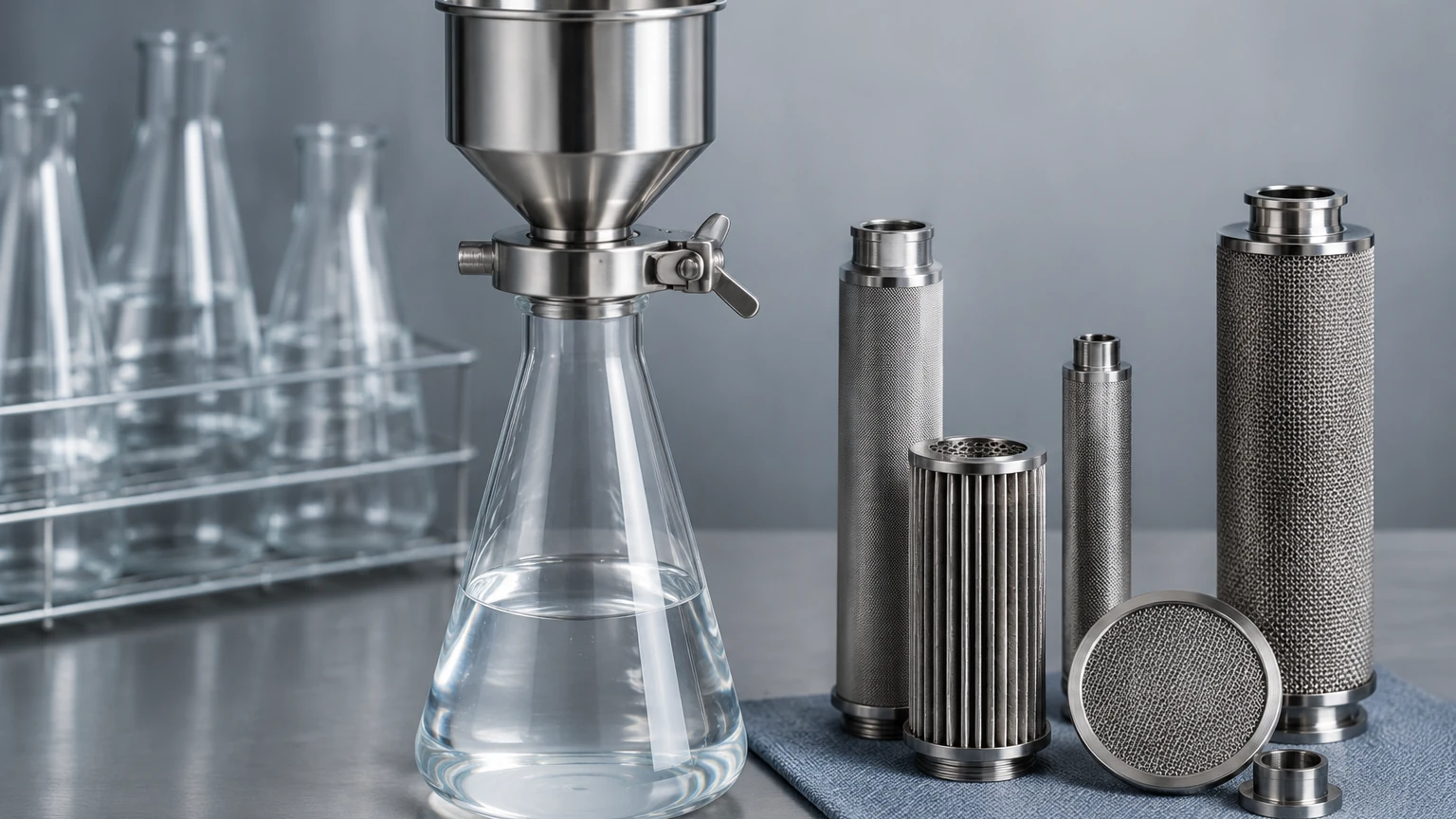
Material Selection: Moving Beyond Borosilicate to Stainless Steel
In a filtration flask laboratory, borosilicate glass is the standard due to its transparency and thermal shock resistance. However, as the scale increases, glass becomes a liability due to its fragility and size limitations.
Industrial filtration relies heavily on metal components. Stainless steel (specifically grades 304, 316, and 316L) is the material of choice for several reasons:
* Mechanical Strength: Unlike glass, stainless steel can withstand high mechanical stress and vibration common in industrial pumping systems.
* Cleanability: Stainless steel filters can be subjected to Clean-in-Place (CIP) procedures, ultrasonic cleaning, or backwashing, which is not feasible with most laboratory-scale disposable media.
* Temperature Tolerance: Many industrial processes occur at temperatures well above the safe operating range for laboratory plastics or standard glass seals.
* Precision: Advanced manufacturing techniques allow for the creation of sintered mesh and wedge wire with extremely tight tolerances, ensuring that the filtration performance remains consistent from the first gallon to the millionth.
Optimizing Filtration Efficiency and Throughput
To achieve maximum efficiency, engineers must balance flow rate (throughput) with filtration fineness. In a filtration flask laboratory, this is often managed by adjusting the vacuum strength. In an industrial setting, this is managed through the design of the filter element itself.
Surface Area vs. Depth Filtration
Laboratory flasks typically use surface filtration (a single layer of media). Industrial systems often utilize pleated designs to vastly increase the surface area within the same footprint. This reduces the flux (flow per unit area), which in turn lowers the pressure drop and extends the time between cleaning cycles.
Cake Management
In many laboratory applications, the "filter cake" that builds up on the media actually assists in filtration by acting as a secondary depth filter. Engineers must study this phenomenon in the lab to determine if the industrial system should be designed to accommodate cake build-up or if a self-cleaning mechanical scraper system is required.
Safety and Operational Best Practices
Operating a filtration flask laboratory setup requires strict adherence to safety protocols to prevent equipment failure.
1. Inspection: Always check glassware for star cracks or scratches, as these are points of failure under vacuum.
2. Gradual Vacuum Application: Do not apply full vacuum immediately. Gradually increasing the pressure differential helps seat the filter media and prevents "breakthrough."
3. Proper Tubing: Use heavy-walled vacuum tubing that will not collapse under pressure.
4. Trap Flasks: When using a mechanical vacuum pump, always use a trap flask between the filtration flask and the pump to prevent liquid carryover from damaging the pump internals.
As processes evolve from these controlled laboratory environments to demanding industrial applications, the need for reliable, high-performance filtration components becomes critical. Selecting a manufacturing partner who understands the technical nuances of filtration—from the initial laboratory testing to the final production scale—is essential for operational success. To learn more about how precision-engineered metal filters can optimize your process, visit the Kaifil Main Page for detailed technical specifications and customized solution options.
By carefully documenting the results obtained in the filtration flask laboratory, engineers can make informed decisions about material selection, micron ratings, and system design, ensuring a seamless transition to industrial-scale filtration that meets the highest standards of quality and efficiency.
