


Semiconductor Filtration
In the high-stakes environment of microelectronics manufacturing, the margin for error is virtually non-existent. As nodes shrink and wafer diameters remain constant or increase, the density of transistors on a single chip reaches billions. In this context, even a sub-micron particle can lead to a catastrophic failure, known as a "killer defect." Consequently, semiconductor filtration is not merely a utility but a critical component of yield management and process stability.
For engineers and procurement specialists, selecting the right filtration media requires an understanding of fluid dynamics, material science, and the specific chemical interactions present in the cleanroom environment. This guide explores the technical requirements of filtration in semiconductor manufacturing, focusing on the role of stainless steel and precision metal components in maintaining the highest levels of purity.
The Critical Role of Filtration in Yield Management
Semiconductor fabrication involves hundreds of sequential steps, including photolithography, etching, ion implantation, and chemical mechanical planarization (CMP). Each of these steps relies on the delivery of ultrapure water (UPW), specialty gases, and aggressive chemicals. Any impurity—whether it be a suspended solid, a dissolved organic compound, or a trace metal ion—can alter the electrical properties of the silicon or physically obstruct the lithographic pattern.
Semiconductor filtration systems are designed to remove these contaminants at various points of use (POU) and in bulk delivery systems. The primary goal is to ensure that the fluids reaching the wafer surface meet the stringent International Roadmap for Devices and Systems (IRDS) standards. For many modern processes, this means removing particles as small as 10 nanometers. While polymer-based filters are common in certain low-temperature liquid applications, stainless steel filtration solutions are increasingly favored for gas delivery and high-temperature chemical processes due to their mechanical integrity and lack of outgassing.
Material Selection: Why Stainless Steel Matters
When evaluating components for a semiconductor filtration system, material compatibility is the first engineering hurdle. The industry frequently utilizes highly corrosive acids, bases, and solvents. Furthermore, gas delivery systems often operate under high pressure or extreme temperatures where standard polymers might fail or shed particles.
316L Stainless Steel and Beyond
For many industrial filtration applications, 316L stainless steel is the gold standard. Its low carbon content minimizes carbide precipitation during welding, ensuring that the filter remains corrosion-resistant at the joints. In semiconductor environments, the surface finish of the metal is equally important. Electropolishing is often employed to create a smooth, passive chromium-oxide layer, which prevents the entrapment of contaminants and reduces the surface area available for chemical reactions.
Sintered Metal Fiber vs. Wire Mesh
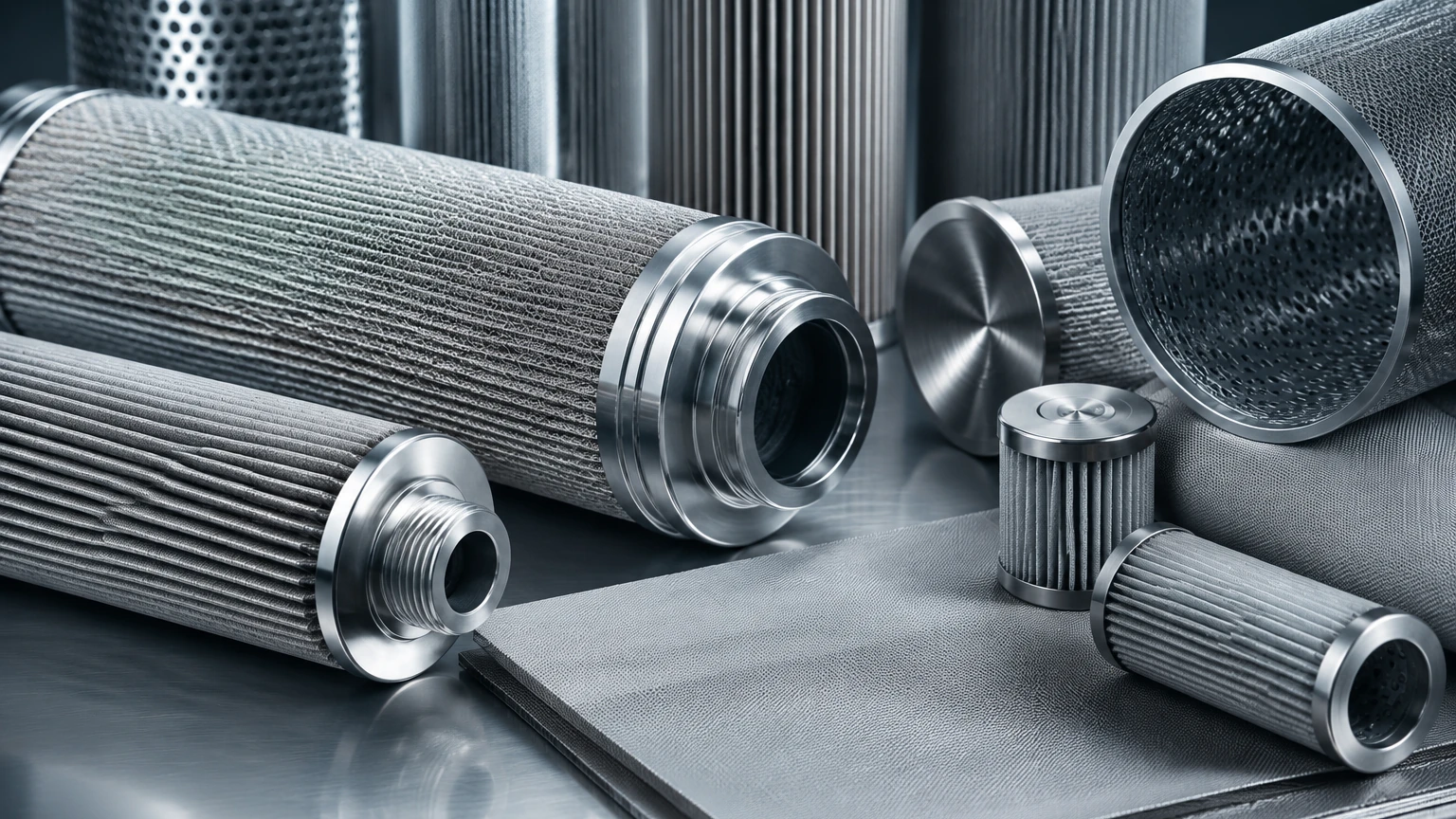
In the design of stainless steel filter cartridges, two primary structures are used: sintered metal fiber and woven wire mesh.
1. Sintered Metal Fiber: This medium consists of fine stainless steel fibers that are randomly laid and then sintered together. This creates a highly porous, three-dimensional structure. For semiconductor filtration, sintered fibers offer a high dirt-holding capacity and low pressure drop, which is essential for maintaining flow rates in high-purity gas lines.
2. Woven Wire Mesh: This is a more traditional structure where wires are woven into a precise geometric pattern. While it offers less depth than fiber felt, it provides exceptional pore size uniformity and mechanical strength. It is often used as a support layer or for coarse filtration in the early stages of fluid processing.
Key Performance Metrics for Engineering Selection
Engineers must look beyond nominal micron ratings when specifying filters for semiconductor applications. A "1-micron filter" from one manufacturer may perform very differently than a 1-micron filter from another if the testing standards vary.
Absolute vs. Nominal Ratings
In semiconductor filtration, absolute ratings are the requirement. An absolute rating signifies that the filter will remove 99.9% (or higher) of particles at the specified size under controlled laboratory conditions. Nominal ratings, which indicate a lower efficiency (often 60% to 90%), are generally insufficient for the precision required in wafer fabrication.
Beta Ratio
The Beta ratio ($β$) provides a more accurate picture of filtration efficiency. It is the ratio of the number of particles of a specific size in the upstream fluid to the number of particles in the downstream fluid. For high-purity processes, a $β$ value of 1000 or 5000 is often targeted, indicating 99.9% or 99.98% efficiency, respectively.
Differential Pressure (Delta P)
Pressure drop is a critical consideration for system design. As a filter captures contaminants, the resistance to flow increases. If the initial pressure drop is too high, the operational life of the filter is shortened, and the system may require more powerful pumps or compressors, increasing the total cost of ownership. Stainless steel filters, particularly those using sintered fiber technology, are engineered to provide a high void volume (up to 80%), which minimizes initial Delta P.
Application Areas in the Semiconductor Fab
To effectively implement semiconductor filtration, one must understand the specific demands of different process streams. You can Review product options and application support at the Kaifil Main Page to see how specific designs cater to these needs.
Gas Filtration (Bulk and POU)
Semiconductor gases, such as silane, ammonia, and hydrogen chloride, must be delivered with parts-per-trillion (ppt) purity. Metal filters are the preferred choice for gas filtration because they do not shed fibers and can withstand the high-pressure pulses common in gas delivery systems. Furthermore, stainless steel filters can be baked out at high temperatures to remove moisture, a critical step in preventing the formation of corrosive byproducts in the gas lines.
Ultrapure Water (UPW) Systems
UPW is used in almost every stage of the fabrication process. While the primary filtration is often handled by membrane systems, stainless steel mesh filters are frequently used in the pre-filtration stages or as "police filters" to protect expensive downstream components from catastrophic failure of upstream equipment.
Chemical Delivery Systems (CDS)
Aggressive chemicals used in etching and cleaning require filters that can withstand chemical attack without leaching impurities. While fluoropolymers like PTFE are common here, stainless steel is often used for solvent filtration where static dissipation is a concern. Metal filters are inherently conductive, reducing the risk of electrostatic discharge (ESD) which can cause fires or damage sensitive electronic components.
Common Risks and Mitigation Strategies
Failure to properly specify a filter can lead to several risks that directly impact the bottom line of a semiconductor facility.
1. Particle Shedding: If a filter is not properly manufactured or if the material is incompatible with the fluid, the filter itself can become a source of contamination. This is why high-quality sintering and cleanroom packaging are essential.
2. Chemical Incompatibility: Even "corrosion-resistant" metals can succumb to certain halogenated gases or strong acids if the temperature and concentration are high enough. Engineers must verify the specific alloy grade (e.g., 316L vs. Nickel alloys) against the chemical profile of the process.
3. Outgassing: In vacuum processes, the release of trapped gases from the filter material (outgassing) can ruin the vacuum integrity and contaminate the wafer. Metal filters are superior in this regard as they do not contain the plasticizers or binders found in many polymer filters.
Customization and OEM Considerations
Off-the-shelf filtration solutions often fail to meet the unique spatial or performance constraints of specialized semiconductor equipment. This is where custom engineering becomes vital. When working with a manufacturer like Kaifil, engineers can specify custom dimensions, end-cap configurations (such as 222 or 226 O-ring styles), and specific filtration layers to balance flow rate and efficiency.
Customization also extends to the structural design. For example, in high-pressure hydraulic systems used in some lithography tools, the filter must be reinforced with internal cores and external cages to prevent collapse. Providing detailed application data—including flow rates, fluid viscosity, operating temperature, and maximum allowable pressure drop—allows for the development of a tailored solution that optimizes performance.
Total Cost of Ownership and Maintenance
In the B2B procurement process, the initial purchase price of a filter is only one part of the equation. The Total Cost of Ownership (TCO) includes the cost of downtime for filter changes, the cost of disposal, and the potential cost of lost product due to filtration failure.
Stainless steel filters offer a unique advantage in TCO: cleanability. Unlike disposable polymer cartridges, many metal filters can be cleaned using ultrasonic baths, chemical cleaning, or back-pulsing. While the initial investment is higher, the ability to reuse the filter multiple times, combined with its extreme durability and reliability, often results in a lower cost per liter of fluid processed over the life of the equipment.
Conclusion: Moving Toward Optimized Filtration
Selecting a partner for semiconductor filtration requires more than just a catalog search. It requires a collaborative engineering approach to ensure that every component is optimized for the specific demands of the fab. Before moving forward with a procurement decision, technical teams should confirm the absolute micron rating, the chemical compatibility of the housing and seals, and the availability of custom configurations to fit existing hardware.
By focusing on high-quality stainless steel and precision metal components, semiconductor manufacturers can achieve the rigorous purity levels required for next-generation device fabrication while ensuring long-term operational stability.
