


Open Pipe Sparger
In industrial gas-liquid contact processes, the method of introducing gas into a liquid medium significantly impacts the efficiency of chemical reactions, mixing, and aeration. Among the various technologies available, the open pipe sparger remains a critical component for applications requiring high flow rates, low pressure drops, and resistance to fouling. Unlike porous media that rely on micro-pores for gas dispersion, open pipe spargers utilize engineered orifices or open-ended pipes to deliver gas directly into the process stream.
For engineers and procurement teams, selecting the right sparging technology involves balancing mass transfer efficiency with operational reliability. While sintered metal filters and porous spargers offer superior surface area for gas-liquid contact, the open pipe sparger is often the preferred choice for handling fluids with high solids content or when the primary goal is agitation rather than maximum gas absorption. Understanding the technical nuances of these components is essential for optimizing industrial filtration and gas injection systems. For more detailed technical specifications on custom filtration and injection components, you can visit the Main Page of Kaifil’s industrial resource center.
The Fundamentals of Open Pipe Sparger Design
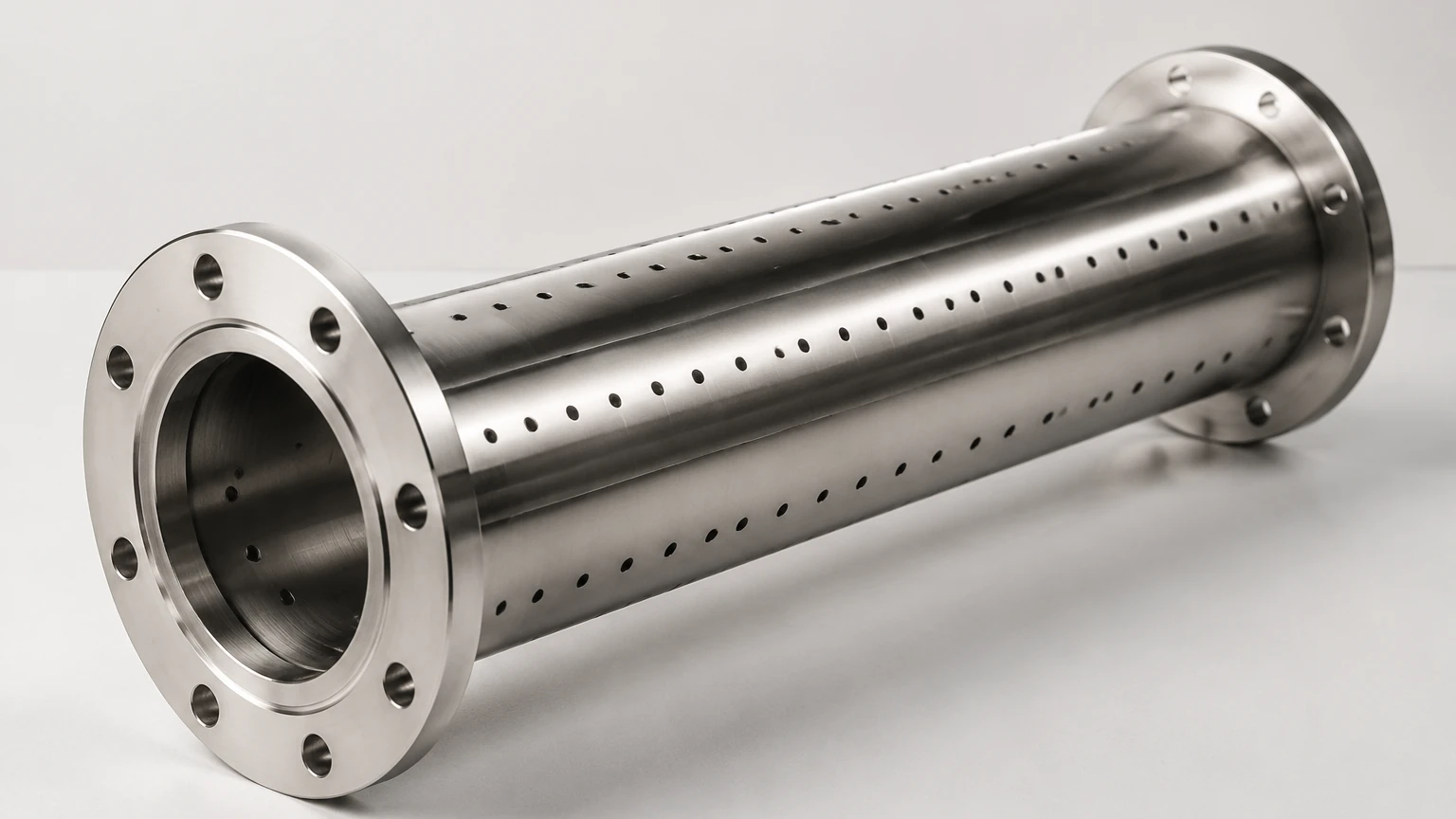
An open pipe sparger, often referred to as an orifice sparger or a pipe distributor, consists of a length of tubing or pipe—typically stainless steel—with one or more openings. The design can range from a simple single-point injection pipe to a complex manifold system with multiple lateral branches. The primary function is to introduce a gas (such as air, oxygen, nitrogen, or carbon dioxide) into a liquid at a controlled rate.
Bubble Formation and Dynamics
In an open pipe system, bubble size is primarily determined by the orifice diameter and the gas velocity. When gas exits an orifice, it forms bubbles that are significantly larger than those produced by porous sintered media. The size of these bubbles is governed by the balance between buoyancy forces and surface tension. In high-velocity applications, the gas jet may break up into smaller bubbles due to shear forces within the liquid, but the overall surface-area-to-volume ratio remains lower than that of micro-porous alternatives.
Orifice Configuration
The arrangement of holes in an open pipe sparger is critical for uniform gas distribution. Engineers must calculate the "hole pitch" (the distance between orifices) to prevent bubble coalescence. If holes are placed too closely together, the rising bubbles will merge, reducing the effective surface area and decreasing mass transfer efficiency. Common configurations include downward-facing holes to prevent liquid and solids from entering the pipe during shutdowns, and staggered patterns to maximize coverage across the vessel’s cross-section.
Performance Comparison: Open Pipe vs. Sintered Metal Spargers
When evaluating gas injection solutions, technical professionals often compare open pipe designs with sintered metal porous spargers. Each has distinct advantages depending on the process requirements.
| Feature | Open Pipe Sparger | Sintered Metal Sparger |
| :— | :— | :— |
| Bubble Size | Large (Millimeters) | Small (Microns) |
| Mass Transfer Efficiency | Moderate | High |
| Pressure Drop | Low | High |
| Clogging Resistance | Excellent | Moderate to Low |
| Cleaning Requirement | Minimal | Frequent |
| Mechanical Strength | Very High | High |
Why Choose an Open Pipe Sparger?
1. Fouling and Solids Handling: In processes where the liquid contains suspended solids or high viscosity, porous spargers are prone to clogging. The larger orifices of an open pipe sparger allow it to operate in "dirty" environments without significant performance degradation.
2. Low Pressure Requirements: Open pipe designs offer very little resistance to gas flow. If the available gas supply pressure is limited, an open pipe sparger ensures that the gas can still be introduced effectively into the liquid column.
3. Mechanical Durability: Because they are constructed from standard heavy-wall industrial piping, these spargers can withstand significant mechanical stress, vibration, and hydraulic shocks within a reactor or tank.
Material Engineering for Corrosive and High-Temperature Environments
The longevity of a sparger is heavily dependent on material selection. Given that sparging often occurs in chemically aggressive environments or at elevated temperatures, stainless steel is the industry standard. Kaifil specializes in manufacturing these components from high-grade alloys to ensure compatibility with diverse industrial fluids.
Stainless Steel 304 and 316L
316L stainless steel is frequently specified for open pipe spargers due to its superior corrosion resistance, particularly against chlorides and acidic solutions. The "L" designation (low carbon) is crucial for welded assemblies, as it prevents carbide precipitation during the welding process, which could otherwise lead to intergranular corrosion at the heat-affected zones.
Advanced Alloys
In extreme cases involving high-concentration acids or high-temperature oxidation, specialty alloys like Hastelloy, Monel, or Inconel may be required. These materials ensure that the orifices maintain their precise dimensions over time; even minor corrosion at the orifice edge can change the gas exit velocity and bubble size, throwing the process out of specification.
Critical Selection Criteria for Industrial Gas Injection
To ensure a sparger meets the performance expectations of a specific application, several engineering factors must be confirmed before fabrication.
Gas Flow Velocity and Pressure Drop
The gas velocity through the orifices (orifice velocity) must be high enough to prevent liquid backflow but low enough to avoid excessive vibration or "choking" of the pipe. Typically, orifice velocities range from 10 to 30 meters per second. The pressure drop across the sparger should be at least 10-20% of the static liquid head to ensure even distribution across all orifices in a manifold system.
Vessel Geometry and Liquid Level
The height of the liquid column (static head) determines the backpressure the gas must overcome. Additionally, the sparger must be positioned to avoid "dead zones" where liquid remains unmixed. In tall, narrow columns, a single-point open pipe may suffice, but in large-diameter tanks, a ring or "spider" manifold is necessary to achieve uniform gas holdup.
Gas-to-Liquid Ratio
Engineers must determine the required mass transfer rate. If the process is reaction-limited and requires rapid gas absorption, an open pipe sparger may need to be used in conjunction with a high-shear agitator to break up the large bubbles into a finer dispersion.
Common Industrial Applications for Open Pipe Sparging
While porous filters are common in fine chemical and pharmaceutical sterile air injection, the open pipe sparger excels in heavy industrial sectors.
* Wastewater Treatment: Used for coarse bubble aeration in grit chambers and aerobic digesters where biological solids would quickly blind a fine-pore diffuser.
* Chemical Reactors: Ideal for gas-induced agitation and for introducing reactants into highly viscous or slurry-based mixtures.
* Mining and Mineral Processing: Employed in flotation cells where air is used to separate minerals from ore slurry; the robust nature of the pipe handles the abrasive slurry effectively.
* Steam Injection: Open pipe spargers are used for direct steam injection to heat liquids quickly and uniformly, common in the food processing and pulp and paper industries.
Installation and Maintenance Protocols for Long-Term Reliability
Proper installation is vital for the mechanical integrity of the sparging system. Because gas injection can induce significant vibration (due to bubble detachment and turbulent flow), spargers must be securely braced to the vessel walls or internal supports.
Maintenance and Inspection
One of the primary advantages of the open pipe sparger is its low maintenance requirement. However, periodic inspections should focus on:
* Orifice Erosion: High-velocity gas, especially if it contains particulates, can erode the edges of the holes, leading to larger, irregular bubbles.
* Internal Scaling: In hard water or chemical deposition environments, scale can build up inside the pipe, eventually restricting flow.
* Structural Integrity: Checking weld points and support brackets for signs of fatigue or stress corrosion cracking.
Replacement cycles for open pipe spargers are generally much longer than those for porous media. While a sintered filter might require cleaning or replacement every few months, a well-engineered stainless steel pipe sparger can often last for several years of continuous operation.
Customization and OEM Solutions in Sparger Manufacturing
Every industrial process has unique requirements regarding flow rates, tank dimensions, and chemical compatibility. Off-the-shelf solutions rarely provide the optimized performance needed for high-efficiency operations. Working with a dedicated manufacturer like Kaifil allows for the development of customized sparging components tailored to specific engineering drawings.
Customization options include:
* Variable Orifice Sizing: Drilling different hole diameters along a header to compensate for internal pressure drops and ensure uniform flow.
* Manifold Geometry: Designing ring, T-shape, or complex grid patterns to fit specific reactor internals.
* Surface Finishing: Providing electropolished or passivated surfaces to meet sanitary standards in food and beverage or pharmaceutical applications.
By focusing on precision manufacturing and material quality, Kaifil ensures that every filtration and gas injection component meets the rigorous demands of modern industry. Whether you are designing a new system or looking to replace an inefficient sparger, understanding the technical boundaries of open pipe designs is the first step toward process optimization.
For engineers seeking to integrate reliable filtration and gas dispersion components into their systems, reviewing the available material options and manufacturing capabilities is essential. You can explore a wide range of custom solutions and technical guides on the Main Page to assist in your selection process.
