


Stainless Steel for Heat Exchangers
In industrial thermal management, the selection of materials is the most critical factor determining the efficiency, longevity, and safety of a system. Stainless steel for heat exchangers has become the industry standard across chemical processing, food and beverage production, and pharmaceutical manufacturing. This preference is not merely due to corrosion resistance but also involves a complex balance of thermal conductivity, mechanical strength, and the ability to maintain surface integrity under fluctuating pressure and temperature conditions.
For engineers and procurement teams, understanding the nuances of stainless steel grades and their interaction with fluid dynamics is essential. Furthermore, the performance of a heat exchanger is inextricably linked to the quality of the fluids passing through it, making integrated filtration solutions a vital component of the thermal system’s overall design. By optimizing both the material selection and the filtration parameters, facilities can significantly reduce downtime and total cost of ownership.
Key Grades of Stainless Steel for Heat Exchangers
Not all stainless steels are created equal, and selecting the wrong grade for a specific heat transfer application can lead to premature failure via pitting, crevice corrosion, or stress corrosion cracking (SCC). The most common grades utilized in heat exchanger construction include:
Austenitic Stainless Steels (300 Series)
Grade 304/304L is the most frequently used stainless steel for heat exchangers in non-corrosive or mildly corrosive environments. It offers excellent formability and weldability. However, in environments containing chlorides—even in low concentrations—304 is susceptible to pitting.
Grade 316/316L is the preferred choice for more demanding applications. The addition of 2% to 3% molybdenum enhances its resistance to chloride-induced pitting and crevice corrosion. In the pharmaceutical and food industries, 316L is the standard due to its superior surface stability and resistance to the chemicals used in Cleaning-in-Place (CIP) cycles.
Duplex Stainless Steels
For high-pressure applications or environments with high chloride concentrations (such as seawater cooling), duplex stainless steels like 2205 are increasingly common. Duplex alloys have a mixed microstructure of austenite and ferrite, providing nearly double the yield strength of standard austenitic grades. This high strength allows for thinner tube walls, which can partially compensate for the lower thermal conductivity of stainless steel compared to copper alloys while offering far superior erosion resistance.
Super-Austenitic and High-Nickel Alloys
In extreme chemical processing environments involving highly acidic or alkaline solutions, super-austenitic grades (such as 904L or 6% Moly steels) are utilized. These materials provide the highest levels of corrosion resistance but come at a significantly higher material cost, requiring a careful cost-benefit analysis during the engineering phase.
Thermal Conductivity and Engineering Trade-offs
One of the primary engineering considerations when using stainless steel for heat exchangers is its thermal conductivity. Compared to carbon steel or copper, stainless steel has a lower rate of heat transfer. To overcome this, engineers focus on several design optimizations:
1. Wall Thickness: Because stainless steel possesses high tensile strength and excellent corrosion allowance, tubes and plates can be manufactured with thinner walls. This reduces the thermal resistance of the material layer.
2. Surface Area and Turbulence: Increasing the turbulence of the fluid flow (increasing the Reynolds number) helps break down the stagnant boundary layer on the metal surface, enhancing the convective heat transfer coefficient. This is often achieved through corrugated plates or finned tubes.
3. Fouling Resistance: Stainless steel’s smooth surface finish reduces the rate at which particulates and biological films adhere to the surface. Since a fouled surface acts as an insulator, maintaining a clean stainless steel surface often results in higher operational efficiency over time compared to materials that may have higher initial conductivity but foul more rapidly.
The Role of Filtration in Protecting Heat Exchangers
Even the highest quality stainless steel for heat exchangers cannot maintain performance if the system is compromised by particulate matter. Fouling is the accumulation of unwanted material on heat transfer surfaces, and it is the leading cause of efficiency loss in thermal systems.
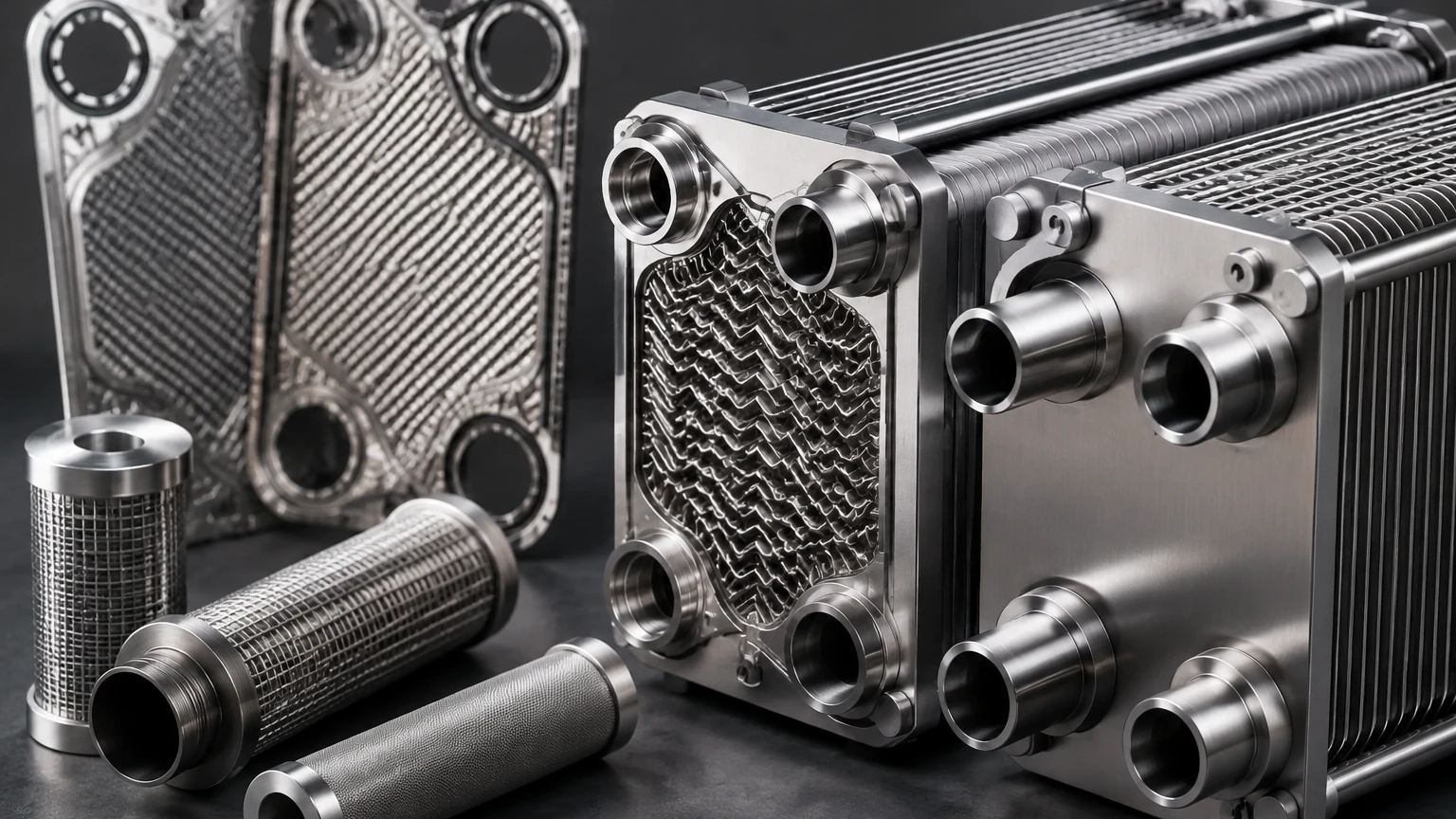
To mitigate this, precision filtration is required at the inlet of the heat exchanger. Custom stainless steel wire mesh filters and filter cartridges are used to remove suspended solids that could otherwise settle in low-velocity areas of the exchanger or clog the narrow channels of plate heat exchangers.
Effective filtration protects the system in several ways:
* Prevention of Erosion-Corrosion: High-velocity particles can physically abrade the passive oxide layer of the stainless steel, leading to rapid localized corrosion.
* Maintaining Flow Rates: Particulate buildup increases pressure drop across the exchanger, forcing pumps to work harder and reducing the overall flow rate, which directly diminishes heat transfer capacity.
* Extending Cleaning Intervals: By capturing contaminants before they enter the heat exchanger, the frequency of manual teardowns and chemical cleanings is greatly reduced.
For those seeking specialized filtration components to integrate with their thermal systems, you can Main Page to review product options and application support tailored to industrial requirements.
Managing Corrosion Risks: Pitting and SCC
While stainless steel is "stainless," it is not invincible. Engineers must confirm several environmental factors before finalizing a material choice for heat exchangers:
Chloride Concentration
Chlorides are the primary enemy of austenitic stainless steel. At elevated temperatures, even moderate chloride levels can cause Stress Corrosion Cracking (SCC). If the operating temperature exceeds 60°C (140°F) in a chloride-rich environment, moving from 316L to a duplex grade is often a necessary engineering decision.
Temperature Fluctuations
Heat exchangers naturally experience thermal cycling. The coefficient of thermal expansion for stainless steel must be accounted for in the design of tube sheets and expansion joints. Repeated expansion and contraction can lead to fatigue at weld points, especially if the material has not been properly stress-relieved.
Oxygen Levels
Stainless steel relies on a thin, chromium-rich oxide layer for protection. This layer requires oxygen to self-heal. In stagnant or low-oxygen environments (such as under a layer of silt or scale), the passive layer can break down, leading to rapid crevice corrosion. This further underscores the importance of high-quality filtration to keep surfaces free of deposits.
Customization and OEM Considerations
In many B2B industrial applications, off-the-shelf solutions are insufficient. Customization of stainless steel components—ranging from the heat exchanger tubes themselves to the internal filtration elements—is often required to meet specific flow dynamics or space constraints.
When sourcing components, engineers should confirm:
* Material Traceability: Ensure that the stainless steel grades are certified (MTRs) to prevent the use of sub-standard alloys that may contain impurities.
* Manufacturing Tolerances: Precision in the diameter and wall thickness of filter components and heat transfer tubes is vital for maintaining predictable pressure drops.
* Surface Finish Requirements: In pharmaceutical or food applications, a specific Ra (Roughness Average) value may be required. Electropolishing is often employed to create a mirror-like finish that resists bacterial growth and facilitates easier cleaning.
Kaifil specializes in providing these types of customized stainless steel filtration solutions, ensuring that the ancillary components of your heat exchange system are as durable and reliable as the primary equipment. Whether it is a custom-sized wire mesh strainer or a high-pressure filter cartridge, the integration of these components is a critical step in system design.
Total Cost of Ownership (TCO)
While the initial capital expenditure (CAPEX) for a stainless steel heat exchanger and its associated filtration system may be higher than alternatives like carbon steel, the Total Cost of Ownership (TCO) is typically much lower. The longevity of stainless steel—often spanning decades with proper maintenance—offsets the initial cost.
Furthermore, the reduction in maintenance labor, the decreased need for chemical corrosion inhibitors, and the energy savings associated with maintaining a clean, high-efficiency heat transfer surface provide a significant Return on Investment (ROI). For purchasing teams, evaluating the "cost per year of service" rather than the "cost per unit" is the most accurate way to justify the selection of high-grade stainless steel for heat exchangers.
Conclusion
Selecting the appropriate grade of stainless steel for heat exchangers is a multifaceted process that requires a deep understanding of metallurgy, fluid chemistry, and thermal dynamics. By pairing the right alloy with robust, precision-engineered filtration, industrial operators can ensure their thermal systems remain efficient and reliable under the most demanding conditions.
As industrial processes become more complex and energy efficiency standards more stringent, the role of high-performance materials and custom filtration components will only continue to grow. Engineers are encouraged to work closely with manufacturers to develop solutions that are precisely tuned to their specific operational parameters, ensuring long-term success in their filtration and heat transfer applications.
