


Water Oil Seperator
In industrial environments, the efficient separation of immiscible liquids is a critical process requirement. Whether managing wastewater discharge, protecting downstream equipment in hydraulic systems, or recovering valuable process fluids, the performance of a water oil seperator is fundamental to operational efficiency and environmental compliance. For engineers and procurement specialists, understanding the technical nuances of separation media and the engineering principles behind these systems is essential for selecting components that ensure long-term reliability.
Industrial oil-water separation is rarely a one-size-fits-all solution. The physical characteristics of the mixture—such as oil droplet size, fluid temperature, viscosity, and the presence of surfactants—dictate the choice of filtration technology. At the heart of these systems are specialized metal filtration components designed to facilitate the coalescence and removal of oil from water or vice versa. As a manufacturer specializing in stainless steel filtration solutions, Kaifil provides the precision components necessary to meet these demanding industrial standards.
Understanding the Mechanics of Oil-Water Separation
The separation of oil and water primarily relies on the difference in specific gravity between the two liquids. Most oils are less dense than water, meaning they will naturally rise to the surface if given sufficient time in a quiescent environment. This process is governed by Stokes' Law, which calculates the settling (or rising) velocity of a droplet through a continuous phase.
However, in high-flow industrial processes, relying solely on gravity is often impractical due to the large tank volumes required. This is where a water oil seperator utilizing mechanical media becomes necessary. There are three primary states of oil in water:
1. Free Oil: Large droplets that rise quickly and are easily separated by gravity.
2. Dispersed Oil: Smaller droplets (typically 10 to 100 microns) that require mechanical assistance to coalesce into larger masses.
3. Emulsified Oil: Microscopic droplets (often less than 10 microns) stabilized by chemical surfactants, requiring specialized treatment or ultra-fine filtration media.
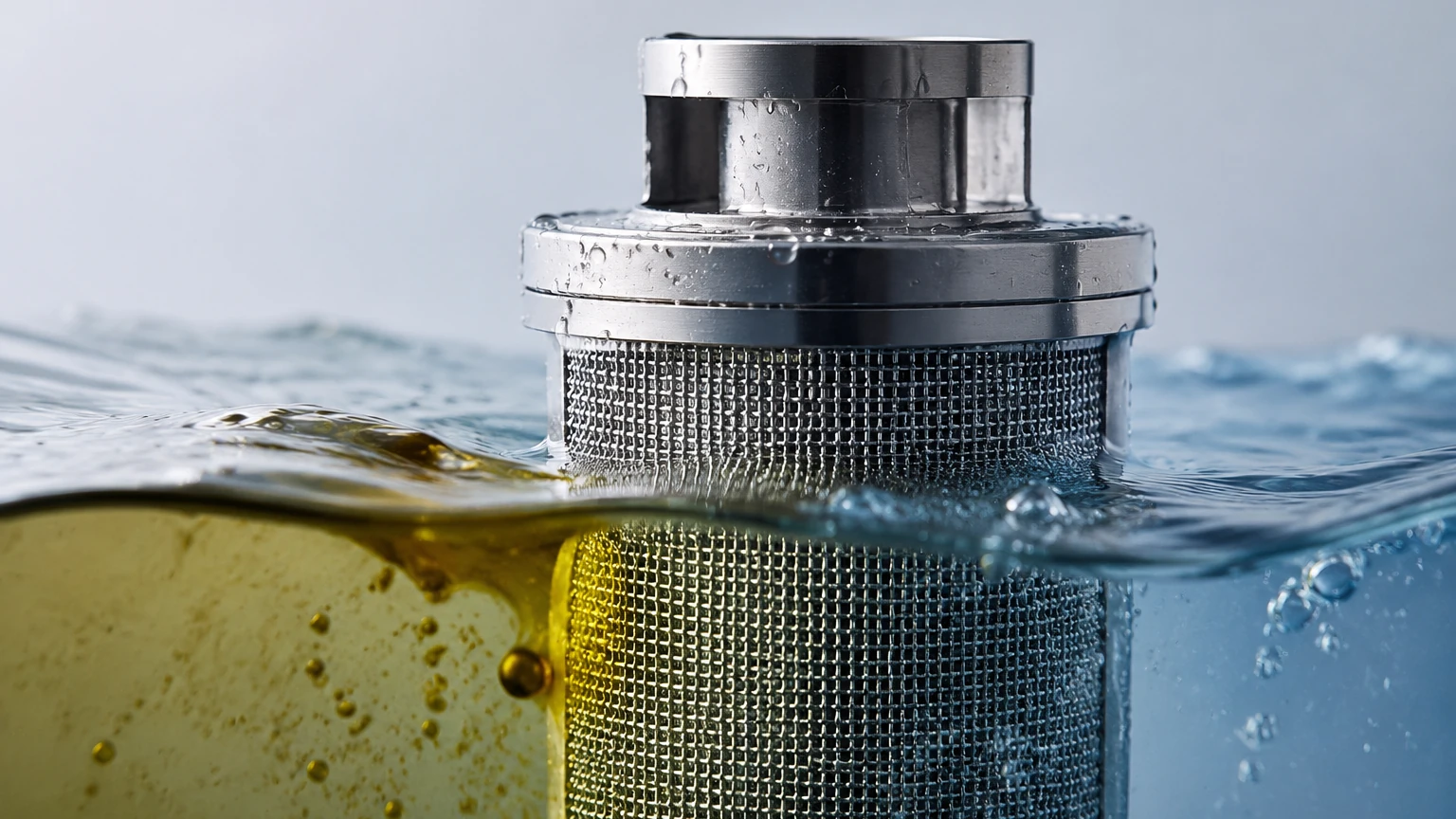
To address dispersed oil, engineers utilize coalescing media. These components provide a large surface area that intercepts small oil droplets. As droplets attach to the media, they merge with others until they reach a size sufficient to overcome the drag of the water flow and rise to the surface. The efficiency of this process depends heavily on the material properties of the filter media, including its surface energy and pore structure.
The Strategic Use of Stainless Steel Filter Media
In the design of a water oil seperator, the choice of material for the coalescing or filtration stage is paramount. While polymer-based media are common in light-duty applications, industrial-grade separation requires the durability and precision of stainless steel. Stainless steel wire mesh and sintered metal components offer several technical advantages:
Corrosion and Chemical Resistance
Industrial fluids often contain aggressive chemicals or operate at pH levels that would degrade standard plastics. Using 304 or 316L stainless steel ensures that the internal components of the separator maintain their structural integrity over years of service, even when exposed to saline water, acidic process streams, or caustic cleaning agents.
Thermal Stability
Many oil-water separation processes occur at elevated temperatures to reduce the viscosity of the oil and improve separation speed. Stainless steel filter cartridges can operate at temperatures far exceeding the limits of synthetic fibers, allowing for consistent performance in steam-assisted or high-temperature chemical processes.
Structural Rigidity and Cleanability
Unlike soft media, stainless steel mesh does not deform under pressure. This maintains a consistent pore size, which is critical for predictable separation efficiency. Furthermore, metal filters are highly cleanable. They can be backwashed, ultrasonically cleaned, or chemically treated to remove fouling, significantly extending the service life of the component compared to disposable alternatives.
Technical Selection Criteria for Industrial Filtration Components
When specifying components for a water oil seperator, engineers must evaluate several variables to ensure the system meets its discharge or purity targets. The following criteria are central to the selection process:
Micron Rating and Pore Distribution
The micron rating of the wire mesh or sintered media determines the smallest droplet size that can be effectively intercepted. For coalescing applications, the media must be tight enough to capture fine droplets but open enough to prevent excessive pressure drop. Precision-woven wire mesh allows for exact control over these parameters.
Surface Tension and Oleophilic/Hydrophobic Properties
The interaction between the liquid and the filter surface is a key driver of separation efficiency. In some designs, the media is treated or selected based on its affinity for oil (oleophilic) or water (hydrophobic). Stainless steel can be mechanically or chemically conditioned to optimize these interactions, encouraging oil droplets to cling and grow on the mesh surface before being released.
Flow Velocity and Residence Time
High flow velocities can shear oil droplets, breaking them into smaller sizes that are harder to capture. It is critical to calculate the effective filtration area to ensure that the flux (flow per unit area) remains within the laminar flow regime, which is conducive to coalescence. Custom-sized filter cartridges allow engineers to maximize the surface area within a fixed housing footprint.
Addressing Operational Risks and Maintenance in Separation Systems
Implementing a water oil seperator involves managing several operational risks that can compromise performance. One of the most common issues is "blinded" media, where solids or biological growth clog the filtration pores. If the influent contains suspended solids in addition to oil, a multi-stage filtration approach is necessary to protect the coalescing media.
Pressure Drop Monitoring
A gradual increase in differential pressure (Delta P) across the separator media is normal as it captures contaminants. However, a sudden spike can indicate fouling or a change in the influent composition. Monitoring Delta P is essential for determining the correct maintenance or cleaning cycle. Because stainless steel components are robust, they can withstand higher pressure differentials than paper or plastic filters before requiring intervention.
Emulsion Breakdown
If a water oil seperator is failing to meet its output specifications, the presence of chemical emulsions is often the culprit. Surfactants lower the interfacial tension between oil and water, preventing droplets from coalescing. In such cases, the filtration media may need to be paired with chemical flocculants or designed with ultra-fine sintered metal to mechanically break the emulsion.
Customization and OEM Integration for Specialized Applications
Standard off-the-shelf filtration components often fail to meet the specific spatial or performance constraints of complex industrial machinery. This is where OEM customization becomes a strategic advantage. For manufacturers of industrial equipment, integrating a custom-designed water oil seperator component can improve the overall footprint and efficiency of the machine.
Kaifil works closely with engineering teams to develop bespoke filtration solutions. This includes:
* Custom Geometric Designs: Manufacturing filter cartridges or mesh screens that fit into non-standard housings or specialized centrifugal separators.
* Layered Media Configurations: Combining different mesh counts or sintered layers to provide both pre-filtration and fine coalescence in a single component.
* Precision Fitting and End Caps: Ensuring that the filter element integrates perfectly with the system's plumbing, preventing bypass—a common failure point where contaminated fluid leaks around the filter media.
By focusing on the specific requirements of the application—whether it is a shipboard bilge water system, a refinery process stream, or a food processing wash-down station—customized metal filters provide a level of reliability that generic parts cannot match.
Procurement Essentials: Information for Technical Decision-Makers
Before finalizing the procurement of components for a water oil seperator, purchasing and engineering teams should confirm several technical data points with their manufacturer. Providing accurate data during the design phase prevents costly retrofits and operational downtime.
1. Fluid Characteristics: What is the specific gravity and viscosity of both the oil and the water at the operating temperature? Are there any known surfactants or solvents present?
2. Contamination Profile: What is the expected concentration of oil in the influent (ppm), and what is the required purity of the effluent?
3. Flow Dynamics: What are the minimum, normal, and maximum flow rates? Is the flow steady or pulsating (which can affect coalescence)?
4. Environmental Constraints: Will the system be exposed to marine environments, extreme temperatures, or high-pressure cleaning cycles?
5. Regulatory Standards: Does the separation performance need to comply with specific environmental regulations (e.g., IMO MEPC for marine applications or local EPA discharge limits)?
By addressing these factors, organizations can ensure that their separation systems are optimized for both performance and total cost of ownership. High-quality stainless steel media may have a higher initial cost than disposable alternatives, but the reduction in maintenance, replacement frequency, and the prevention of downstream damage provide a significant return on investment.
For more detailed technical specifications and to explore our full range of industrial filtration components, visit our Main Page to review product options and application support. Kaifil remains committed to providing the engineering expertise and manufacturing precision required to solve the most challenging industrial filtration and separation tasks.
