


Filtration Mesh for Water Treatment
In industrial water treatment, the selection of filtration media is a critical engineering decision that directly impacts system efficiency, equipment longevity, and operational costs. Filtration mesh for water treatment serves as the primary physical barrier against suspended solids, protecting downstream components such as reverse osmosis (RO) membranes, high-pressure pumps, and sensitive analytical instrumentation. For engineers and procurement specialists, understanding the technical nuances of stainless steel wire mesh—ranging from material metallurgy to weave geometry—is essential for optimizing filtration performance in demanding environments.
Industrial water treatment encompasses a wide spectrum of applications, including municipal supply, cooling tower maintenance, boiler feed water preparation, and wastewater reclamation. Each of these environments presents unique challenges, such as varying pH levels, high chloride concentrations, and fluctuating particle loads. Stainless steel filtration solutions are often preferred over polymer-based media due to their mechanical strength, thermal stability, and ability to be cleaned and reused.
Engineering Considerations for Material Selection
The chemical composition of the water being treated is the foremost factor in determining the appropriate material for a filtration mesh. While stainless steel is generally corrosion-resistant, different grades offer varying levels of protection against specific chemical stressors.
Grade 304 vs. 316L Stainless Steel
Grade 304 stainless steel is the standard choice for general water filtration where the chloride content is low and the environment is relatively non-aggressive. However, in many industrial water treatment scenarios, Grade 316L is the preferred specification. The addition of molybdenum in 316L significantly enhances resistance to pitting and crevice corrosion, particularly in the presence of chlorides. For brackish water or applications involving chemical cleaning agents, 316L provides the necessary durability to prevent premature mesh failure.
Advanced Alloys for Saline Environments
In high-salinity applications, such as seawater desalination or brine processing, even 316L may be susceptible to stress corrosion cracking. In these specialized cases, engineers may specify Duplex stainless steels or high-nickel alloys. These materials maintain structural integrity under extreme electrochemical stress, ensuring that the filtration mesh for water treatment does not become a point of failure in the system.
Filtration Principles and Mesh Characteristics
The performance of a filtration mesh is defined by its ability to remove specific particle sizes while maintaining a manageable pressure drop. This balance is achieved through the manipulation of weave patterns and wire diameters.
Micron Ratings: Absolute vs. Nominal
When selecting a filtration mesh, it is vital to distinguish between absolute and nominal micron ratings. An absolute rating indicates the diameter of the largest spherical particle that can pass through the mesh under laboratory conditions. A nominal rating, conversely, represents a percentage retention (often 60% to 90%) of particles of a certain size. For critical water treatment stages, such as protecting RO membranes from silt and sand, absolute-rated mesh is required to ensure consistent water quality.
Weave Geometries and Their Impact
1. Plain Square Weave: This is the most common weave, featuring a simple over-and-under pattern. It offers high open area and low pressure drop, making it ideal for high-flow pre-filtration and intake screening.
2. Dutch Weave: This pattern uses thicker warp wires and thinner, closely packed weft wires. This creates a tortuous path for the fluid, providing high mechanical strength and precise filtration at finer micron levels. Dutch weave is often used in pressure filters where the mesh must withstand significant differential pressure.
3. Twill Weave: In a twill weave, wires cross over two and under two. This allows for the use of heavier wires for a given mesh count, increasing the durability of the mesh without significantly sacrificing the micron rating.
Applications in Industrial Water Treatment
Filtration mesh for water treatment is integrated into various stages of the water cycle, each requiring specific design parameters to handle the unique debris and flow conditions.
Intake and Raw Water Screening
At the point of entry, large-scale filtration mesh is used to remove macro-impurities such as leaves, twigs, and aquatic life. These screens must be robust enough to handle high flow velocities and potential impact from debris. Stainless steel mesh is favored here for its ability to resist biological fouling and its ease of mechanical cleaning.
Pre-filtration for Membrane Systems
Reverse osmosis and ultrafiltration membranes are highly sensitive to particulate fouling. A stainless steel filter cartridge located upstream can remove fine suspended solids that would otherwise clog the membrane surface. By using a precisely manufactured filtration mesh, operators can extend the intervals between membrane cleanings (CIP) and reduce the overall energy consumption of the high-pressure pumps.
Cooling Tower and Boiler Feed Water
In cooling towers, water is constantly recirculated, leading to the buildup of scale and airborne particulates. Side-stream filtration using stainless steel mesh helps maintain water clarity and prevents the accumulation of sludge in heat exchangers. Similarly, for boiler feed water, removing even trace amounts of solids is essential to prevent scale formation on boiler tubes, which can lead to catastrophic equipment failure.
Customization and Design Parameters
Standard filtration components often fall short in specialized industrial settings. Customization allows engineers to tailor the filtration mesh for water treatment to the exact requirements of the housing and the fluid dynamics of the system.
Pleated vs. Cylindrical Designs
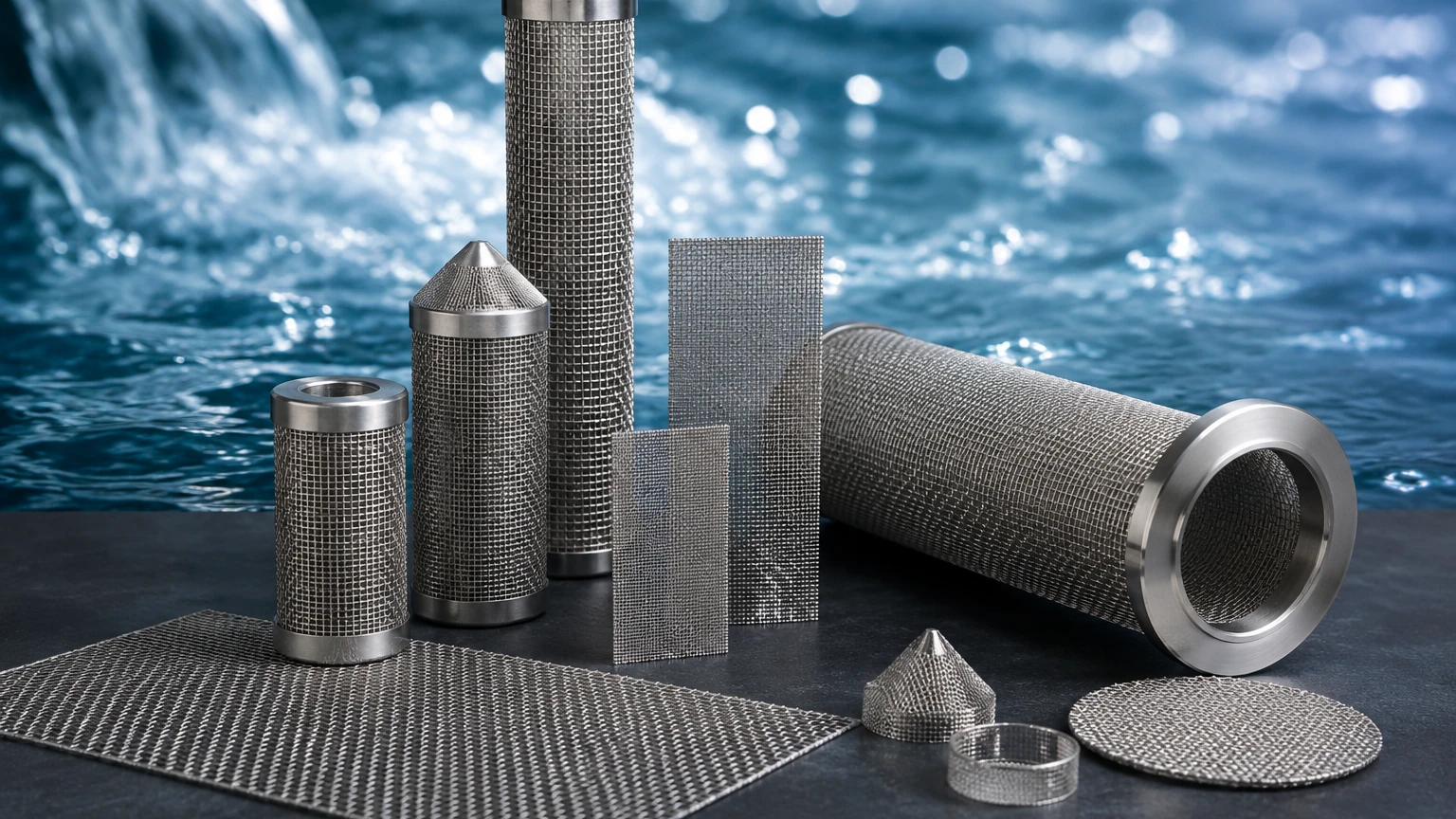
For applications where space is limited but high flow rates are required, pleated filter elements are used. Pleating the stainless steel mesh significantly increases the effective filtration surface area within the same footprint. This reduces the flux (flow per unit area), which in turn lowers the initial pressure drop and increases the dirt-holding capacity of the filter. Cylindrical designs, while having less surface area, are easier to clean and are often used in simpler, low-load applications.
Sintered Mesh for High-Pressure Stability
In environments where the filter is subjected to high pressure or frequent backwashing, a single layer of mesh may lack the necessary rigidity. Sintering—a process of bonding multiple layers of mesh together using heat and pressure—creates a porous metal plate that is incredibly strong. Sintered mesh maintains its pore structure even under extreme mechanical stress, ensuring that the filtration rating remains constant throughout the service life of the component.
Performance Evaluation and Maintenance
The total cost of ownership for a filtration system is heavily influenced by the maintenance requirements and the replacement cycle of the filter elements.
Monitoring Differential Pressure
The primary indicator of filter health is the differential pressure (ΔP) across the mesh. As particles accumulate, the open area decreases, and the pressure drop increases. Systems should be designed with sensors to alert operators when the ΔP reaches a critical threshold. Using high-quality stainless steel mesh allows for higher ΔP limits compared to disposable filters, as the metal can withstand the force without deforming.
Cleaning and Regeneration Methods
One of the greatest advantages of stainless steel filtration mesh for water treatment is its cleanability. Depending on the nature of the contaminants, various methods can be employed:
* Backwashing: Reversing the flow of water to dislodge particles from the mesh surface.
* Ultrasonic Cleaning: Using high-frequency sound waves in a cleaning solution to remove fine particles trapped deep within the weave.
* Chemical Cleaning: Using mild acids or bases to dissolve scale or organic buildup, provided the mesh material is chemically compatible.
Effective cleaning restores the filter to near-original performance, significantly reducing the need for replacement parts and minimizing waste.
Procurement and Total Cost Considerations
When evaluating filtration solutions, purchasing teams must look beyond the initial acquisition cost. While stainless steel mesh filters have a higher upfront price compared to polypropylene or sand filters, their long-term value is often superior. The durability of metal filters means fewer replacements, less downtime, and reduced labor costs associated with filter changes.
Furthermore, the precision of a manufactured mesh ensures a predictable and repeatable filtration process. This reliability is essential for maintaining the quality of the treated water and protecting expensive downstream equipment. For organizations looking to optimize their water treatment infrastructure, partnering with a manufacturer that offers technical support and customization is vital.
To explore specific configurations and technical specifications for industrial filtration components, engineers can Review product options and application support on the Kaifil website. Accessing detailed product data helps in selecting the right mesh count, wire diameter, and alloy for specific water treatment challenges.
Conclusion
Filtration mesh for water treatment is a foundational component of modern industrial processes. By selecting the correct material, weave, and structural design, engineers can ensure efficient removal of contaminants while maintaining system reliability. Whether the goal is protecting sensitive RO membranes or ensuring the clarity of cooling water, stainless steel mesh provides a robust, cleanable, and high-performance solution. As water scarcity and environmental regulations drive the need for more efficient water reclamation, the role of precision-engineered filtration mesh will only continue to grow in importance across the global industrial landscape.
