


Foam Filter
In the landscape of industrial filtration, the foam filter represents a versatile and highly efficient solution for capturing particulate matter across a wide range of fluid and gas applications. Unlike traditional surface filtration media, such as thin membranes or fine wire cloths, foam filters operate primarily through depth filtration. By utilizing a complex, three-dimensional cellular structure, these filters provide a high surface area and a tortuous path for the process fluid, ensuring that contaminants are trapped throughout the thickness of the media rather than just on the surface.
For engineers and procurement professionals, selecting the correct foam filter involves understanding the nuances of material science, pore geometry, and fluid dynamics. Whether the application involves air intake for heavy machinery, pre-filtration in chemical processing, or specialized catalyst support, the choice of foam media significantly impacts the system's overall efficiency, pressure drop, and maintenance intervals. As a professional manufacturer of custom stainless steel filtration solutions, Kaifil provides the technical expertise necessary to navigate these variables, ensuring that filtration components meet the rigorous demands of industrial environments.
Understanding Foam Filter Structures and Porosity
The performance of a foam filter is fundamentally defined by its cellular architecture. Most industrial foam filters are "reticulated," meaning the thin membranes that originally connected the cell struts have been removed through a chemical or thermal process. This results in an open-cell structure that allows fluid to pass through with minimal resistance while maximizing the available surface area for particle impingement.
Pores Per Inch (PPI) and Filtration Grade
The primary metric used to categorize foam filters is Pores Per Inch (PPI). This measurement dictates the coarseness or fineness of the filter media:
* Low PPI (10–30): These are coarse foams with large cells. They are typically used for high-flow applications, such as pre-filtration for HVAC systems or large-scale air intakes, where the goal is to capture large debris without causing a significant pressure drop.
* Medium PPI (45–70): These grades offer a balance between flow rate and efficiency. They are frequently found in hydraulic breathers and industrial equipment where moderate particulate capture is required.
* High PPI (80–100+): Fine-cell foams provide the highest filtration efficiency. These are used in precision applications where smaller particles must be removed, though they require more frequent monitoring due to the increased risk of clogging.
Tortuosity and Depth Filtration
The effectiveness of a foam filter is not solely dependent on the pore size but also on its tortuosity—the complexity of the path a fluid must take to pass through the media. As fluid moves through the interconnected cells, particles are forced to change direction repeatedly. Heavier particles cannot follow these rapid changes in flow and eventually collide with and adhere to the foam struts. This mechanism allows foam filters to achieve high dirt-holding capacities, as the entire volume of the foam acts as a reservoir for captured contaminants.
Material Selection: Polymer vs. Metal Foam Filters
While polymer-based foams are common in light-duty applications, industrial processes often demand materials that can withstand extreme temperatures, corrosive chemicals, and high mechanical stress. Understanding the transition from polyurethane to metal foam is essential for optimizing system longevity.
Polyurethane and Specialty Polymers
Polyurethane foam filters are widely used due to their cost-effectiveness and flexibility. They can be treated with flame retardants or UV stabilizers to suit specific environments. However, they are limited by a relatively low temperature threshold (typically under 100°C) and can degrade when exposed to certain solvents or strong acids. In pharmaceutical or food-grade applications, the risk of polymer shedding or chemical leaching must be carefully evaluated.
Stainless Steel and Metal Foams
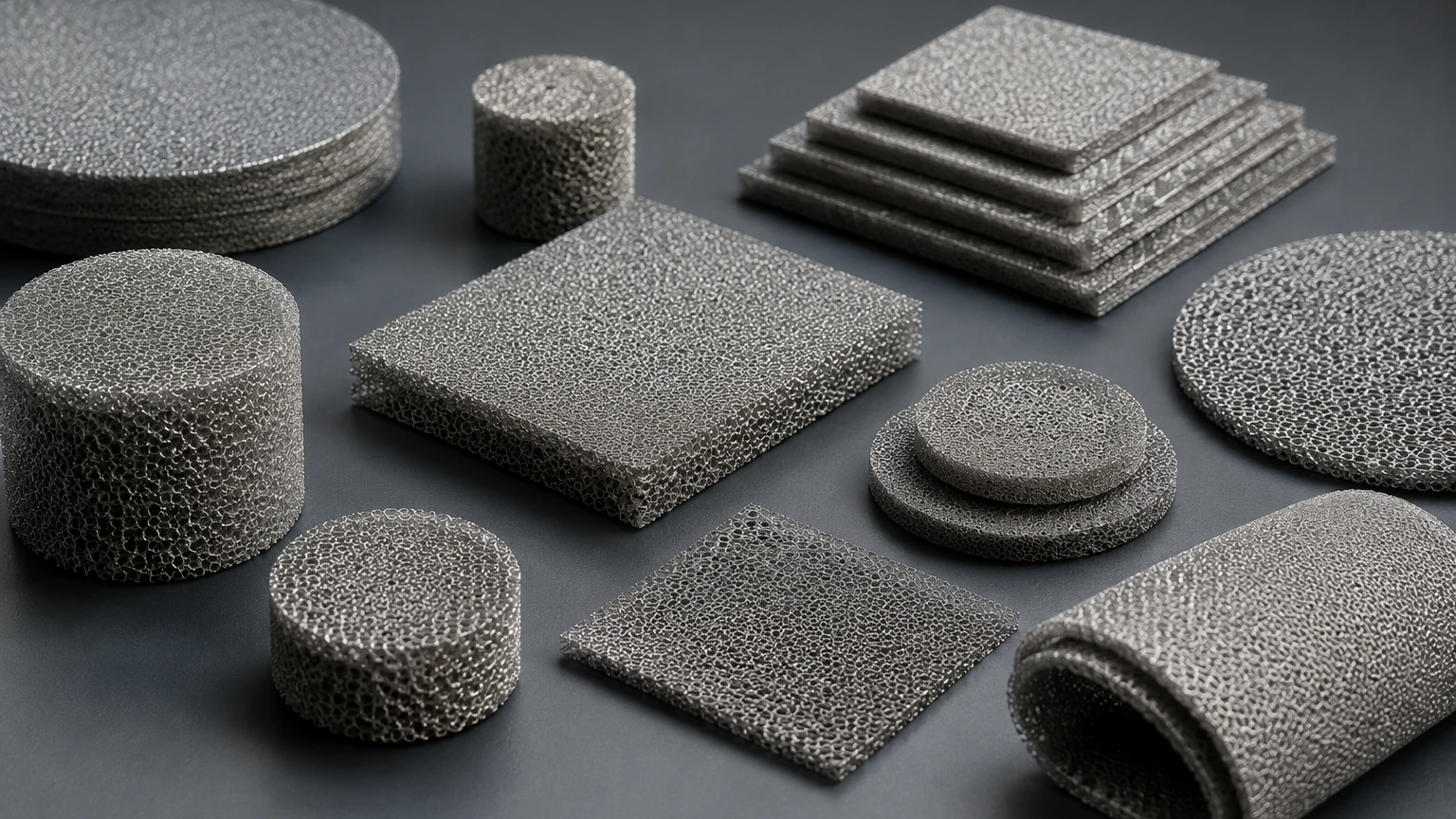
For demanding industrial sectors, such as chemical processing or high-temperature gas filtration, metal foam filters—particularly those made from stainless steel—offer superior performance. These filters are manufactured by depositing metal onto a polymer foam template, which is then removed, leaving a metallic skeleton.
Stainless steel foam filters provide several critical advantages:
* Thermal Resistance: Capable of operating in environments exceeding 500°C, depending on the alloy.
* Chemical Compatibility: Highly resistant to oxidation and a wide array of corrosive agents.
* Mechanical Strength: Unlike polymer foams, metal foams maintain their structural integrity under high-pressure differentials, preventing the media from collapsing or channeling.
* Cleanability: Metal foam filters can often be cleaned through ultrasonic baths, back-pulsing, or chemical cleaning, making them a sustainable choice for long-term operations.
Engineering Considerations for Industrial Applications
When integrating a foam filter into an industrial system, engineers must look beyond simple pore size and consider the holistic impact on the process. To explore specific component designs and technical specifications, professionals can Review product options and application support on the Kaifil Main Page.
Pressure Drop and Flow Rates
One of the most significant advantages of reticulated foam is its high porosity, which can often exceed 95%. This high void volume results in a very low initial pressure drop compared to woven wire mesh or felted media of similar filtration ratings. However, as the filter loads with contaminants, the pressure drop will increase. Engineers must calculate the "terminal pressure drop"—the point at which the filter must be cleaned or replaced to prevent system failure or bypass.
Face Velocity and Residence Time
The velocity at which the fluid enters the foam filter (face velocity) affects filtration efficiency. If the velocity is too high, particles may be forced through the media or "blown off" the struts. Conversely, a lower velocity increases the residence time within the foam, enhancing the probability of particle impingement. Proper sizing of the filter housing is therefore critical to ensure the velocity remains within the optimal range for the chosen PPI grade.
Compatibility with Housing and Seals
A foam filter is only as effective as its installation. In industrial housings, bypass—where fluid flows around the filter rather than through it—is a common failure mode. Foam media must be precisely cut and often compressed slightly within the housing to ensure a tight perimeter seal. In high-pressure applications, the foam may need to be supported by a stainless steel perforated core or outer shroud to prevent deformation.
Key Performance Indicators in Foam Filtration
To evaluate whether a foam filter is performing as intended, technical teams should monitor several key performance indicators (KPIs). These metrics help in establishing a baseline for expected service life and filtration quality.
1. Beta Ratio and Efficiency: While foam filters are often used for nominal filtration, their efficiency can be quantified using the Beta ratio (the ratio of particles upstream vs. downstream). Understanding the specific particle size distribution of the contaminant is vital for selecting the correct PPI.
2. Dirt-Holding Capacity (DHC): This refers to the total mass of contaminants the filter can retain before reaching its terminal pressure drop. A high DHC is desirable to extend the intervals between maintenance cycles.
3. Structural Integrity: In applications involving pulsating flows or high-viscosity fluids, the foam must resist fatigue. For metal foams, this involves checking for any signs of strut fracture or metal shedding that could contaminate the downstream process.
4. Chemical Resistance: Regular inspections should confirm that the filter media is not softening, swelling, or corroding due to the process fluid. This is especially important when dealing with high-purity chemicals or pharmaceutical ingredients.
Customization and Integration with Stainless Steel Systems
Many industrial applications require more than a standard off-the-shelf foam filter. Customization allows for the optimization of the filtration system to meet specific spatial constraints or performance requirements. Kaifil specializes in developing bespoke filtration components that integrate foam media with other structural elements.
Multi-Layer and Composite Filters
In some cases, a single layer of foam may not be sufficient. Engineers often design composite filters that combine different PPI grades. For example, a coarse 20 PPI foam can serve as a pre-filter to capture large debris, followed by a fine 80 PPI foam for final polishing. This "graded density" approach significantly extends the life of the finer media. Furthermore, foam can be combined with stainless steel wire mesh to provide a robust outer support layer or a final absolute filtration barrier.
Custom Shapes and Fittings
Industrial equipment often has unique geometric requirements. Foam filters can be manufactured as cylinders, discs, or complex 3D shapes. For metal foam filters, advanced joining techniques such as TIG welding or vacuum brazing allow the foam to be permanently attached to stainless steel flanges, threaded fittings, or end caps. This ensures a leak-proof assembly that can be easily integrated into existing piping systems.
Maintenance, Cleaning, and Replacement Cycles
The total cost of ownership (TCO) for a filtration system is heavily influenced by the maintenance strategy. While polymer foam filters are often treated as consumables, metal foam filters offer a different economic profile due to their reusability.
Cleaning Protocols for Metal Foam
Unlike disposable cartridges, stainless steel foam filters can be restored to near-original pressure drop levels through professional cleaning. Common methods include:
* Back-flushing: Reversing the flow of clean fluid through the filter to dislodge particles.
* Ultrasonic Cleaning: Using high-frequency sound waves in a cleaning solution to break down stubborn contaminants deep within the cellular structure.
* Chemical Soaking: Utilizing specific solvents or acids to dissolve organic or inorganic buildup without damaging the stainless steel struts.
Determining Replacement Intervals
Even with cleaning, all filters eventually reach the end of their functional life. Replacement should be considered if the pressure drop after cleaning remains significantly higher than the initial "clean" pressure drop, or if visual inspection reveals structural damage. Establishing a rigorous monitoring schedule helps prevent unexpected downtime and ensures that the downstream equipment remains protected.
Selecting the Right Partner for Industrial Filtration
Choosing a foam filter involves a complex interplay of material science and mechanical engineering. It is not merely about finding a mesh that fits a housing, but about ensuring the media can withstand the chemical, thermal, and physical rigors of the application while delivering consistent filtration results.
Kaifil's commitment to quality and precision manufacturing makes us a reliable partner for global industries. By focusing on customized stainless steel solutions, we help engineering and purchasing teams achieve durable and cost-effective filtration performance. Whether you are designing a new system or looking to optimize an existing process, understanding the technical boundaries of foam filtration is the first step toward operational excellence. For detailed technical specifications and to discuss your specific application needs, we invite you to visit our Main Page and consult with our engineering team.
