


100ul Pipette Tips
In the landscape of precision liquid handling, 100ul pipette tips represent a critical mid-range volume standard utilized extensively across pharmaceutical research, clinical diagnostics, and chemical analysis. For engineers and laboratory procurement professionals, selecting the appropriate 100ul pipette tips involves more than simple volume matching; it requires a deep understanding of fluid dynamics, material science, and the filtration technologies that protect both the sample and the pipetting instrument. As industrial processes become increasingly automated, the technical specifications of these consumables must align with the rigorous demands of high-throughput environments.
Understanding the Engineering of 100ul Pipette Tips
The design of 100ul pipette tips is governed by the principles of air displacement pipetting. At this volume, the ratio of the air cushion to the liquid volume is significant enough that any variation in the internal geometry of the tip can lead to measurable inaccuracies. Precision injection molding is required to ensure that every tip maintains a consistent internal diameter and orifice shape.
Geometric Consistency and Orifice Design
The orifice, or the tip's opening, is perhaps the most scrutinized part of the 100ul pipette tips' architecture. A perfectly centered, flash-free orifice ensures that the liquid bead breaks away cleanly during dispensing. In industrial applications where 100ul volumes are used for reagent addition or sample dilution, even a microscopic burr at the tip can cause liquid retention or "wicking" up the outside of the tip, leading to volumetric errors. High-quality tips are manufactured using diamond-polished molds to achieve a surface smoothness that minimizes friction during fluid movement.
Concentricity and Automated Compatibility
For laboratories utilizing robotic liquid handling platforms, the concentricity of 100ul pipette tips is paramount. If a tip is slightly bowed or if the mounting end is not perfectly aligned with the distal end, the automated probe may miss the well center in a 96-well or 384-well plate. Engineers must evaluate the straightness of the tips and the rigidity of the polymer used to ensure they can withstand the mechanical forces of automated ejection and loading without deformation.
The Role of Filtration in Pipette Tip Performance
One of the most vital components in a high-performance 100ul pipette tip is the internal filter or aerosol barrier. These filters serve a dual purpose: protecting the pipette's internal piston from corrosive vapors and cross-contamination, and preventing aerosols from the pipette from entering the sample.
Aerosol Barrier Technology
Most standard 100ul pipette tips utilize porous polyethylene (PE) filters. These are engineered to have a specific pore size—typically ranging from 10 to 30 microns—that allows air to pass freely while blocking droplets and aerosols. In specialized industrial filtration contexts, the principles of depth filtration apply here. The tortuous path within the filter matrix traps contaminants through inertial impaction and diffusion.
While plastic filters are standard for disposable tips, the broader field of industrial filtration often looks toward more robust materials. For instance, in the manufacturing equipment used to produce these tips or in high-pressure liquid handling systems, stainless steel mesh or sintered metal components are often preferred for their durability and precise micron ratings. Professionals looking for advanced filtration components can Review product options and application support to understand how precision metal filters integrate into larger industrial fluid systems.
Hydrophobicity and Contamination Control
The filter must be inherently hydrophobic to prevent liquid from being drawn into the pipette body if over-pipetting occurs. In some advanced 100ul pipette tips, the filters are treated with additives that seal upon contact with liquid, providing a physical fail-safe against equipment contamination. This is particularly important in PCR (Polymerase Chain Reaction) and forensic applications where a single microliter of carryover can invalidate an entire batch of tests.
Material Selection and Chemical Compatibility
The vast majority of 100ul pipette tips are manufactured from medical-grade polypropylene (PP). This material is chosen for its high chemical resistance, thermal stability, and low surface energy. However, not all polypropylene is equal.
Virgin Polypropylene vs. Recycled Resins
In a B2B procurement context, it is essential to verify that tips are made from 100% virgin polypropylene. Recycled resins or lower-grade plastics may contain trace amounts of heavy metals, lubricants, or "leachables" (such as slip agents like oleamide or erucamide). These leachables can interfere with sensitive biological assays or UV-Vis spectroscopy by absorbing light at specific wavelengths. Technical data sheets should be consulted to confirm that the tips are free from DNA, DNase, RNase, and pyrogens.
Low-Retention Surfaces
For samples with high surface tension or those containing detergents (like Tween-20 or Triton X-100), standard polypropylene may still retain a small film of liquid. "Low-retention" 100ul pipette tips are engineered through either a physical modification of the polymer chain or a highly controlled molding process that creates a super-hydrophobic interior surface. This ensures that the entire 100ul volume is dispensed, which is critical for maintaining the Coefficient of Variation (CV) in quantitative analysis.
Technical Specifications for Industrial and Pharmaceutical Applications
When evaluating 100ul pipette tips for industrial-scale use, engineers must look beyond the basic volume label. The performance of a tip is defined by its accuracy (how close the dispensed volume is to the target) and its precision (the repeatability of the dispense).
Accuracy and Precision Metrics
* Systematic Error (Inaccuracy): This is usually expressed as a percentage. For a 100ul volume, a high-quality tip should contribute to an inaccuracy of less than ±1.0%.
* Random Error (Imprecision/CV): This measures the spread of the data. A CV of less than 0.5% is often the benchmark for premium 100ul pipette tips used in validated pharmaceutical methods.
Graduation Marks and Visual Verification
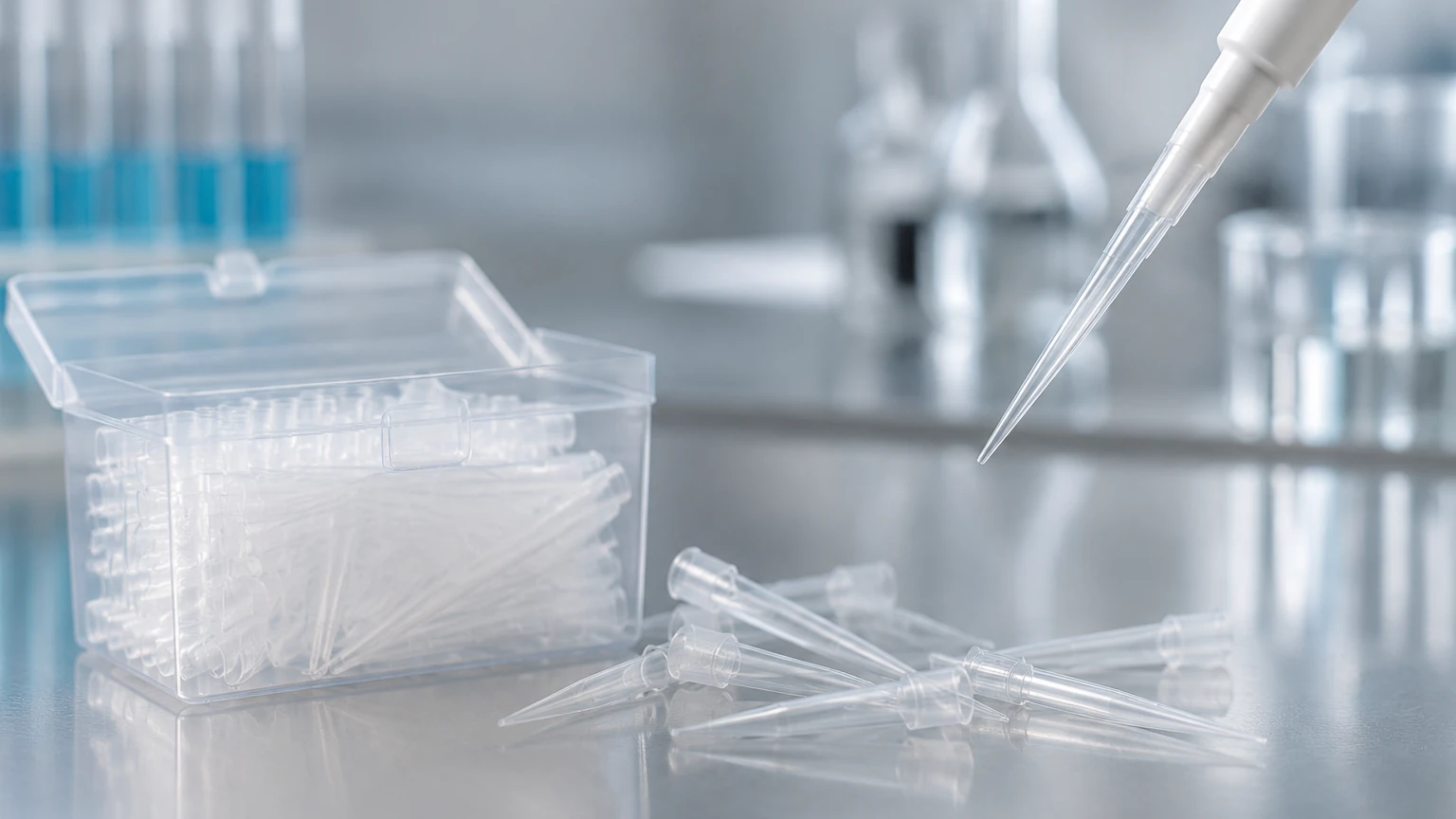
Even in automated environments, visual confirmation remains a secondary safety check. Quality 100ul pipette tips often feature graduation marks at 10ul, 50ul, and 100ul. These marks must be molded into the exterior of the tip rather than printed to avoid the risk of ink contamination. The clarity of the plastic is also a technical requirement; it must be transparent enough to allow the user or an optical sensor to detect the presence of air bubbles or incomplete aspiration.
Quality Control and Manufacturing Standards
The reliability of 100ul pipette tips is a direct result of the manufacturing environment. Because these components are used in sensitive biological and chemical processes, they must be produced under stringent quality management systems.
Cleanroom Production
Tips should be manufactured in ISO Class 8 or Class 7 cleanrooms. This environment controls the concentration of airborne particles and prevents biological contamination during the molding and packaging stages. Automated assembly lines that integrate the filter insertion and racking processes minimize human contact, further reducing the risk of introducing contaminants.
Sterilization Methods
Depending on the application, 100ul pipette tips may be supplied non-sterile, pre-sterilized, or autoclavable.
1. Gamma Irradiation: The most common method for pre-sterilized tips, providing a high Sterility Assurance Level (SAL) of 10^-6.
2. Ethylene Oxide (ETO): Used for materials that might be sensitive to radiation, though less common for standard PP tips.
3. Autoclaving: If tips are to be reused or sterilized on-site, they must be able to withstand 121°C at 15 psi for at least 15 minutes without warping.
Engineers should verify the "flatness" of the tip racks, as heat-induced warping can prevent proper tip pickup by multichannel pipettes or automated arms.
Customization and OEM Solutions for Specialized Lab Equipment
While off-the-shelf 100ul pipette tips satisfy most requirements, specialized industrial equipment often necessitates custom solutions. This is where the intersection of laboratory consumables and industrial engineering becomes most apparent.
Custom Lengths and Bore Sizes
In some applications, such as sampling from deep-well blocks or narrow-neck vials, an extended-length 100ul tip is required. Conversely, for viscous fluids like oils or concentrated syrups, a wide-bore tip may be necessary to reduce shear stress and allow for faster aspiration.
Integration with Advanced Filtration
In complex fluidic systems where 100ul pipette tips are just one part of a larger process, the filtration requirements may extend to the source tanks or the delivery lines. For instance, if the liquid being pipetted contains particulates that could clog the tip's orifice, pre-filtration using stainless steel mesh or custom filter cartridges is necessary. Organizations specializing in these high-durability solutions, such as those found on the Main Page, provide the engineering support needed to integrate laboratory-scale precision with industrial-scale durability.
Selection Criteria for Purchasing Teams
When finalizing a contract for 100ul pipette tips, purchasing teams should confirm several operational factors to ensure long-term value and process stability:
* Compatibility Matrix: Ensure the tips are "universal fit" or specifically validated for the brand of pipettes used in the facility (e.g., Gilson, Eppendorf, Rainin).
* Packaging Options: Evaluate the cost-benefit of bulk tips (bags) versus racked tips versus reload systems. Reload systems reduce plastic waste and storage space, which is an increasingly important factor in corporate sustainability goals.
* Lot Traceability: Every box of 100ul pipette tips should have a lot number that allows the manufacturer to trace the raw material batch, the production date, and the QC test results.
* Total Cost of Ownership: Consider the cost of potential failures. A cheaper, lower-quality tip that causes a single failed 96-well plate assay can result in losses that far exceed the savings on the consumables themselves.
Conclusion
The 100ul pipette tip is a fundamental tool in the modern laboratory, yet its performance depends on a complex interplay of material science, precision engineering, and filtration technology. By focusing on technical specifications such as orifice concentricity, filter pore size, and resin purity, engineers and technical professionals can optimize their liquid handling workflows for maximum accuracy and minimal downtime. Whether through standard polypropylene tips or integrated industrial filtration systems, maintaining the integrity of the 100ul volume is essential for the success of critical B2B applications in science and industry.
