


Industrial Strainer Basket
In industrial fluid handling systems, the protection of downstream equipment—such as pumps, valves, flow meters, and heat exchangers—is a critical operational priority. The industrial strainer basket serves as the primary mechanical barrier against particulate contamination, scale, and debris. Unlike disposable filter elements, these baskets are typically designed for durability, high flow capacity, and reusability. Selecting the correct basket requires a technical understanding of fluid dynamics, material science, and the specific mechanical stresses of the application environment.
As a specialized manufacturer, Kaifil provides high-precision stainless steel filtration solutions tailored to these demanding requirements. For engineers and procurement teams, evaluating an industrial strainer basket involves more than just matching pipe sizes; it requires a deep dive into mesh geometry, structural integrity, and chemical compatibility to ensure long-term system reliability.
Understanding the Function of Industrial Strainer Baskets
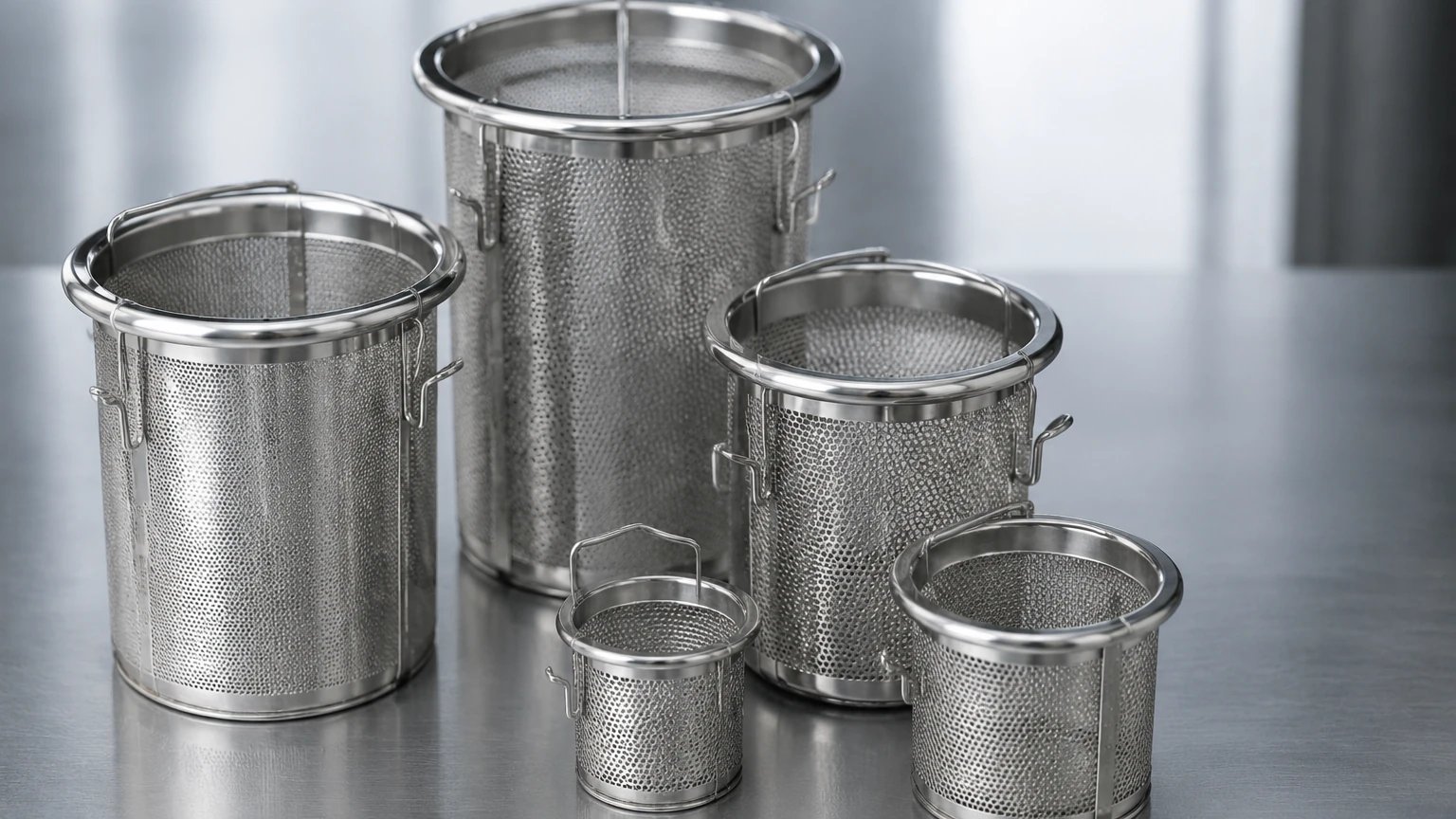
An industrial strainer basket is the internal component of a basket strainer housing (either simplex or duplex). Its primary function is to remove solids from a liquid or gas stream. While the terms "filter" and "strainer" are often used interchangeably, in an industrial context, straining typically refers to the removal of larger particles (usually 40 microns and above) using a perforated or mesh-lined metal basket.
The fluid enters the strainer housing and is directed into the center of the basket. As the fluid passes through the basket walls, the contaminants are trapped inside the basket, allowing the clean fluid to exit through the outlet. Because the debris is collected within the basket, maintenance is simplified; the operator can remove the basket, clean it, and reinstall it without significant downtime. This cleanable nature makes the industrial strainer basket a cost-effective solution for systems with high solids loading.
Key Engineering Specifications: Micron Rating and Open Area
When specifying an industrial strainer basket, two of the most critical factors are the filtration fineness (micron rating) and the open area ratio. These parameters directly influence the efficiency of the system and the frequency of maintenance cycles.
Micron Rating and Mesh Count
The micron rating defines the size of the smallest particle the basket is designed to retain. For coarse straining, perforated metal with hole diameters ranging from 1/32" to 1/2" is common. For finer applications, a stainless steel wire mesh is layered inside or over a perforated support cylinder.
Engineers must balance the need for fine filtration with the risk of rapid clogging. A mesh that is too fine for the application will lead to frequent pressure spikes and excessive cleaning requirements. Conversely, a mesh that is too coarse may allow harmful debris to pass through, potentially damaging sensitive downstream components.
The Open Area Ratio
The "Open Area" refers to the total area of the holes or mesh openings relative to the total surface area of the basket material. In high-performance industrial designs, the goal is to achieve an open area ratio of at least 6:1 or 8:1 relative to the cross-sectional area of the inlet pipe. A higher open area ratio ensures a lower initial pressure drop and provides more space for debris accumulation before the flow is significantly restricted. This is a vital consideration for maintaining system flow rates and reducing the load on pumps.
Material Considerations for Durability and Chemical Resistance
The choice of material for an industrial strainer basket is dictated by the chemical composition of the process fluid, the operating temperature, and the potential for mechanical wear. Stainless steel is the industry standard due to its versatile performance characteristics.
* Grade 304 Stainless Steel: This is the most common material used for general-purpose industrial applications. It offers excellent strength and good corrosion resistance for water, oils, and mild chemicals.
* Grade 316/316L Stainless Steel: For more aggressive environments, such as those involving chlorides, acids, or pharmaceutical processing, Grade 316 is preferred. The addition of molybdenum enhances its resistance to pitting and crevice corrosion. The "L" (low carbon) version is often specified for welded components to prevent sensitization and intergranular corrosion in the heat-affected zones.
* Specialty Alloys: In extreme cases involving highly corrosive sea water or concentrated chemicals, materials like Monel, Hastelloy, or Duplex stainless steel may be required.
Beyond chemical resistance, the material must withstand the physical pressure of the fluid flow. In high-viscosity applications or systems with high-pressure surges, the basket must be reinforced with heavier gauge perforated metal or external support ribs to prevent structural collapse.
Custom Design Options for Specialized Industrial Applications
Standard off-the-shelf strainer baskets may not meet the unique requirements of every industrial process. Customization is often necessary to optimize performance and fitment within existing housings. Kaifil specializes in developing tailored filtration components that address these specific engineering challenges.
Structural Configurations
Baskets can be designed with various bottom styles, including flat, rounded (dish), or slanted. Slanted baskets are often used in offset strainer housings to facilitate better flow patterns. Additionally, the top flange of the basket must be precision-engineered to ensure a tight seal against the housing seat, preventing "bypass" where contaminated fluid leaks around the basket rather than passing through it.
Pleated Designs
For applications requiring a significantly larger surface area within a compact housing, pleated industrial strainer baskets are an effective solution. By pleating the wire mesh, the available filtration surface area can be increased by 200% to 400% compared to a standard cylindrical basket. This results in a much lower flux rate (flow per unit area), which extends the time between cleaning cycles and improves the retention of deformable particles.
Handle and Lifting Mechanisms
In large-scale industrial operations, the ease of maintenance is a safety and efficiency concern. Custom baskets can be fitted with heavy-duty bail handles, slant handles, or overhead lifting lugs to facilitate removal using hoists or specialized tools, especially when the basket is heavy with collected debris.
Evaluating Performance: Flow Rate and Pressure Drop (ΔP)
From an engineering perspective, the performance of an industrial strainer basket is primarily measured by its pressure drop (ΔP). The pressure drop is the difference in pressure between the inlet and the outlet of the strainer.
As the basket captures debris, the available open area decreases, causing the velocity of the fluid through the remaining openings to increase. According to Bernoulli's principle, this increase in velocity leads to a rise in differential pressure.
Calculating Clean Pressure Drop
Before installation, engineers must calculate the "clean pressure drop" based on the fluid's viscosity, specific gravity, and flow rate. High-viscosity fluids (like heavy oils or resins) will experience a much higher pressure drop than water through the same mesh size. If the initial pressure drop is too high, it leaves very little margin for debris accumulation before the system reaches its maximum allowable differential pressure.
Structural Integrity and Collapse Pressure
Every industrial strainer basket has a maximum differential pressure rating. If the basket becomes completely blinded by debris and the pump continues to operate, the pressure can exceed the structural strength of the metal, leading to basket deformation or total collapse. To mitigate this risk, heavy-duty baskets are often engineered with internal or external support cages made from thick perforated plate or longitudinal bars.
Maintenance Protocols and Service Life Optimization
The longevity of an industrial strainer basket depends heavily on proper maintenance and cleaning procedures. Unlike disposable filters, a high-quality stainless steel basket can last for years if handled correctly.
Cleaning Methods
* Manual Cleaning: For coarse debris, a simple wash with a high-pressure hose or a soft brush may suffice. However, care must be taken not to damage the fine wire mesh.
* Ultrasonic Cleaning: For baskets used in fine filtration or those capturing sticky/resinous materials, ultrasonic cleaning is the most effective method. It uses high-frequency sound waves to create cavitation bubbles that dislodge microscopic particles from deep within the mesh pores.
* Chemical Cleaning: In industries like food processing or chemical manufacturing, baskets may require soaking in caustic or acidic solutions to remove organic buildup or scale. This requires the basket material to be fully compatible with the cleaning agents.
Inspection for Fatigue
Regular inspection is vital. Technicians should look for signs of wire fatigue, broken welds, or thinning of the metal due to erosion. In high-velocity systems, the constant vibration and impact of particles can cause work hardening and eventual cracking of the mesh. Early detection of these issues prevents the catastrophic failure of the basket and the subsequent contamination of the downstream process.
Conclusion: Selecting the Right Partner for Filtration Solutions
Choosing the right industrial strainer basket is a balance of technical specification and operational reality. By focusing on material quality, open area ratios, and structural reinforcement, facilities can significantly reduce maintenance costs and protect their capital equipment.
As a professional manufacturer, Kaifil understands the complexities of industrial filtration. Whether you require a standard replacement or a fully customized design for a unique chemical process, our engineering-led approach ensures that every component meets the highest standards of durability and precision. For more information on our manufacturing capabilities and to explore our full range of stainless steel filtration products, please visit our Main Page.
When evaluating your next filtration project, consider the total cost of ownership. A well-engineered industrial strainer basket not only performs better in the short term but also provides the reliability needed to keep your critical industrial processes running smoothly for the long haul.
