


Plate Type Evaporator
In the landscape of industrial thermal processing, the plate type evaporator stands as a critical component for concentration, desalination, and solvent recovery. These systems are prized for their high heat transfer coefficients and compact footprints compared to traditional shell-and-tube designs. However, the efficiency of a plate type evaporator is inextricably linked to the purity of the process fluids. For engineers and facility managers, understanding the synergy between evaporation mechanics and precision filtration is essential for maintaining system uptime and product quality.
As a specialist in stainless steel filtration solutions, Kaifil provides the technical components necessary to protect these sophisticated thermal systems. This guide explores the engineering principles of plate type evaporators, the risks associated with fluid impurities, and the selection criteria for filtration components that ensure long-term operational success.
The Mechanics of Plate Type Evaporators
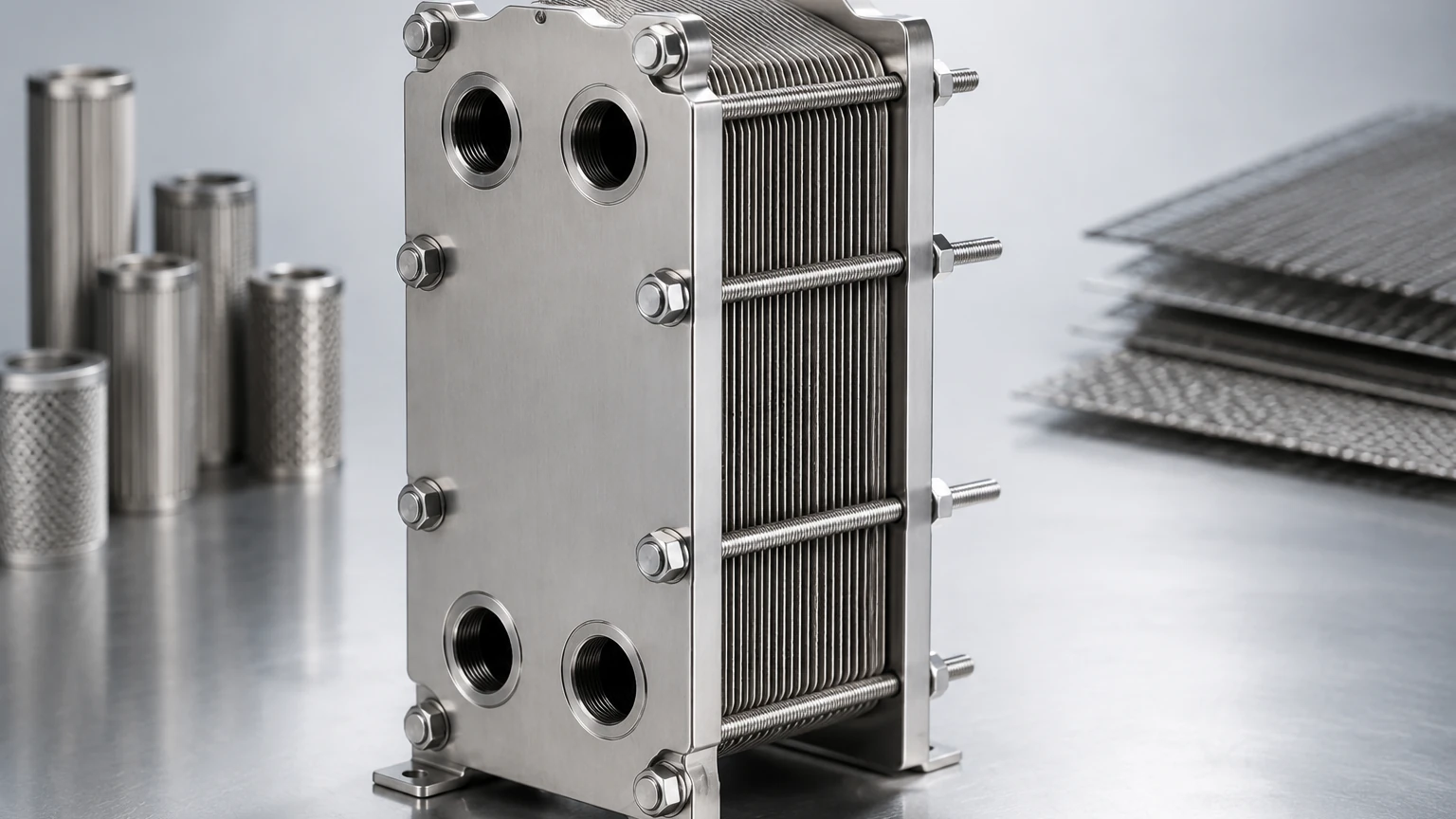
A plate type evaporator operates on the principle of thin-film evaporation. The system consists of a series of corrugated metal plates—typically made from stainless steel or titanium—pressed together to create narrow channels. Heating media (usually steam) and the product liquid flow through alternating channels, allowing for rapid heat exchange.
Heat Transfer Efficiency
The corrugations on the plates serve a dual purpose: they increase the surface area available for heat transfer and induce turbulence even at low flow velocities. This turbulence disrupts the boundary layer, leading to heat transfer rates that are often three to five times higher than those found in tubular evaporators. High efficiency allows for a smaller temperature approach, which is critical when processing heat-sensitive materials in the food, beverage, and pharmaceutical sectors.
Rising Film vs. Falling Film Designs
Plate type evaporators are generally categorized into two configurations:
1. Rising Film: The liquid enters at the bottom and boils as it rises. The vapor generated pushes the liquid against the plate walls in a thin film. This is suitable for low-viscosity liquids.
2. Falling Film: The liquid is distributed at the top and flows downward under gravity. This design is preferred for heat-sensitive products because it allows for very low pressure drops and short residence times.
Regardless of the configuration, the narrow gaps between the plates—often only a few millimeters wide—make the system highly sensitive to suspended solids and particulates.
The Critical Role of Filtration in Evaporation Systems
The primary challenge in operating a plate type evaporator is fouling. Fouling occurs when particulates, crystals, or organic matter accumulate on the heat transfer surfaces. Because the channels are narrow, even minor accumulation can lead to significant pressure drops and a sharp decline in thermal efficiency.
Protecting the Heat Transfer Surface
Upstream filtration is the first line of defense. By implementing high-precision stainless steel wire mesh filters, operators can remove suspended solids before they enter the evaporator. This prevents the mechanical blockage of the plate channels and reduces the frequency of manual cleaning cycles. For many industrial applications, a multi-stage filtration approach is recommended, starting with coarse strainers and moving to fine stainless steel filter cartridges.
Vapor-Liquid Separation
After the evaporation process, the resulting vapor must be separated from the concentrated liquid. In many systems, entrained droplets of the concentrate can be carried over into the vapor stream, leading to product loss and contamination of the condensate. Kaifil’s precision metal filter components are often utilized in demister pads or separator units to capture these fine droplets, ensuring high-purity vapor discharge.
Engineering Considerations for Filter Selection
When selecting filtration components for a system utilizing a plate type evaporator, engineers must evaluate several technical parameters to ensure compatibility and performance.
Material Compatibility
Given that many evaporation processes involve corrosive chemicals or high temperatures, material selection is paramount. Stainless steel 316L is the industry standard for its excellent resistance to pitting and crevice corrosion. In food-grade applications, the surface finish of the filter media must also meet sanitary standards to prevent bacterial growth. Kaifil focuses on high-grade alloys to ensure that filtration components can withstand the aggressive environments often found in chemical processing and wastewater treatment.
Micron Rating and Flow Rates
The micron rating of the filter must be balanced against the allowable pressure drop. A filter that is too fine will clog rapidly, requiring frequent maintenance, while a filter that is too coarse will allow particulates to pass through and foul the evaporator plates. Engineers should typically look for a filtration accuracy that is at least 5 to 10 times smaller than the narrowest gap in the evaporator plate assembly.
Pressure and Temperature Resilience
Evaporation often occurs under vacuum or high pressure. Filtration housings and elements must be engineered to maintain structural integrity under these fluctuating conditions. Sintered wire mesh and reinforced stainless steel cartridges are ideal for these applications as they do not migrate or bypass under pressure surges.
Maintenance and Total Cost of Ownership
The total cost of owning a plate type evaporator is not just the initial capital expenditure; it includes the ongoing costs of energy, cleaning chemicals, and downtime. Effective filtration directly impacts these variables.
Cleaning-in-Place (CIP) Integration
Modern evaporation skids are designed for CIP. Filtration systems should be equally compatible. Stainless steel filters are advantageous here because they can be cleaned with the same caustic or acidic solutions used for the evaporator plates. Unlike disposable polymer filters, permanent stainless steel elements can be backwashed or ultrasonically cleaned, significantly reducing the waste stream and long-term replacement costs.
Monitoring Performance
Engineers should confirm the presence of differential pressure gauges across all filtration stages. A sudden increase in differential pressure indicates that the filter is doing its job by capturing contaminants, but it also signals that a cleaning cycle is imminent. By tracking these trends, maintenance teams can move from reactive to predictive maintenance, scheduling cleanings during planned shutdowns rather than during peak production.
Customization for Specialized Applications
No two industrial processes are identical. A plate type evaporator used for seawater desalination faces different challenges than one used for concentrating fruit juice. Customization is often required to optimize the filtration system for specific fluid dynamics.
At Kaifil, we work closely with OEM manufacturers and system integrators to develop bespoke filtration components. Whether it is a unique housing geometry to fit within a compact skid or a specific mesh weave to handle high-viscosity fluids, customization ensures that the filtration solution complements the evaporator’s design rather than hindering it.
For more information on how precision metal filtration can enhance your thermal processing systems, you can Review product options and application support on our Main Page.
Common Risks and Mitigation Strategies
Failure to implement adequate filtration in a plate type evaporator system leads to several well-documented risks:
* Thermal Degradation: Fouling acts as an insulator. To maintain the required evaporation rate, operators may be forced to increase the heating media temperature, which can cause thermal degradation of the product (e.g., scorching of sugar-based liquids).
* Erosion-Corrosion: Particulates moving at high velocities through narrow channels can cause localized erosion of the plates, eventually leading to cross-contamination between the product and the heating media.
* Increased Pumping Costs: As channels become restricted, the pump must work harder to maintain flow, leading to increased electrical consumption and premature pump failure.
By ensuring that the feed stream is properly conditioned through high-quality filtration, these risks are significantly mitigated, preserving the integrity of the heat exchanger plates and extending the overall lifespan of the equipment.
Conclusion: Selecting a Reliable Partner
The integration of a plate type evaporator into an industrial process is a significant investment. Ensuring its efficiency requires a holistic view of the system, where filtration is seen not as an accessory, but as a core protective element. When evaluating filtration suppliers, engineers should look for manufacturers who understand the nuances of industrial filtration, from material science to fluid dynamics.
Kaifil’s expertise in custom stainless steel filtration solutions provides the reliability needed for demanding industrial environments. By focusing on durability, precision, and ease of maintenance, we help our clients achieve optimized performance in their evaporation and concentration processes. Before finalizing your next evaporator installation, confirm that your filtration strategy is robust enough to handle the realities of your process fluid. For technical specifications and engineering support, visit the Kaifil Main Page at https://www.kaifil.com/.
