


Filter for Seawater
In industrial and marine engineering, selecting an effective filter for seawater is a critical decision that impacts the longevity of downstream equipment, the efficiency of heat transfer, and the overall reliability of the system. Seawater presents a unique set of challenges—ranging from high salinity and corrosive chemical profiles to the presence of diverse biological organisms and abrasive suspended solids. Unlike freshwater applications, a filter for seawater must be engineered to withstand constant electrochemical attack while maintaining precise filtration accuracy.
For engineers and procurement professionals, understanding the technical nuances of material compatibility, structural integrity, and filtration mechanisms is essential. This guide examines the engineering considerations required to specify a high-performance filter for seawater, ensuring that the chosen solution meets the rigorous demands of desalination, offshore oil and gas, ballast water treatment, and industrial cooling systems. For a comprehensive look at available configurations and technical support, professionals often refer to the Main Page of specialized manufacturers like Kaifil to align their requirements with advanced manufacturing capabilities.
Challenges of Seawater Filtration
Seawater is arguably one of the most complex fluids to process in an industrial environment. Its composition is not uniform; it varies by depth, temperature, and proximity to coastal runoff. The primary challenges associated with a filter for seawater include:
1. Corrosion and Pitting
The high chloride concentration in seawater (typically around 19,000 mg/L) promotes localized corrosion. For stainless steel filters, the most common threats are pitting and crevice corrosion. Pitting occurs when the protective passive layer of the metal breaks down in a small area, leading to rapid, deep penetration. Crevice corrosion occurs in stagnant areas, such as under gaskets or within the tight weaves of a wire mesh, where oxygen levels are depleted.
2. Biofouling
Seawater is rich in biological life, including bacteria, algae, larvae, and larger organisms like barnacles and mussels. These organisms can colonize the surface of a filter for seawater, creating a biological film that increases pressure drop ($\\Delta P$) and restricts flow. Macro-fouling can lead to complete blockage of the filter element if not managed through proper material selection or backwashing cycles.
3. Suspended Solids and Abrasives
Coastal seawater often contains high levels of sand, silt, and organic debris. These particles can be highly abrasive, leading to mechanical wear on the filter media. In high-velocity systems, the constant impact of these particles can erode the protective oxide layer of the metal, accelerating corrosion—a phenomenon known as erosion-corrosion.
Material Science: Selecting Alloys for Corrosive Environments
The choice of material is the single most important factor in the design of a filter for seawater. Standard 304 stainless steel is generally unsuitable due to its low resistance to chloride-induced pitting. Engineers must look toward higher-alloyed materials to ensure a reasonable service life.
316L Stainless Steel
While 316L is a significant upgrade over 304 due to the addition of molybdenum, it is often considered the "minimum" standard for seawater. It performs well in cold, flowing seawater but may struggle in warm, stagnant conditions where the risk of pitting is highest. For critical applications, 316L is often used for temporary or low-temperature filtration needs.
Duplex and Super Duplex Stainless Steels
Duplex stainless steels, such as Grade 2205, offer a mixed microstructure of austenite and ferrite. This provides higher strength and significantly better resistance to stress corrosion cracking and pitting than 316L. For even more aggressive environments, Super Duplex (Grade 2507) is preferred. These materials have a high Pitting Resistance Equivalent Number (PREN), calculated as:
$PREN = \%Cr + 3.3(\%Mo + 0.5\%W) + 16\%N$
A filter for seawater manufactured from Super Duplex typically has a PREN greater than 40, making it highly resistant to the harsh marine environment.
Specialized Alloys
In extreme cases, such as high-temperature seawater processing or deep-sea applications, materials like Titanium, Monel 400, or Hastelloy may be required. These alloys provide near-immunity to chloride attack but come at a significantly higher capital cost. Engineers must balance the initial investment against the total cost of ownership (TCO) and the expected lifespan of the system.
Engineering Design and Filtration Mechanisms
The structural design of a filter for seawater must accommodate high flow rates while maintaining structural stability under pressure. There are several common types of filter media used in these applications:
Sintered Wire Mesh
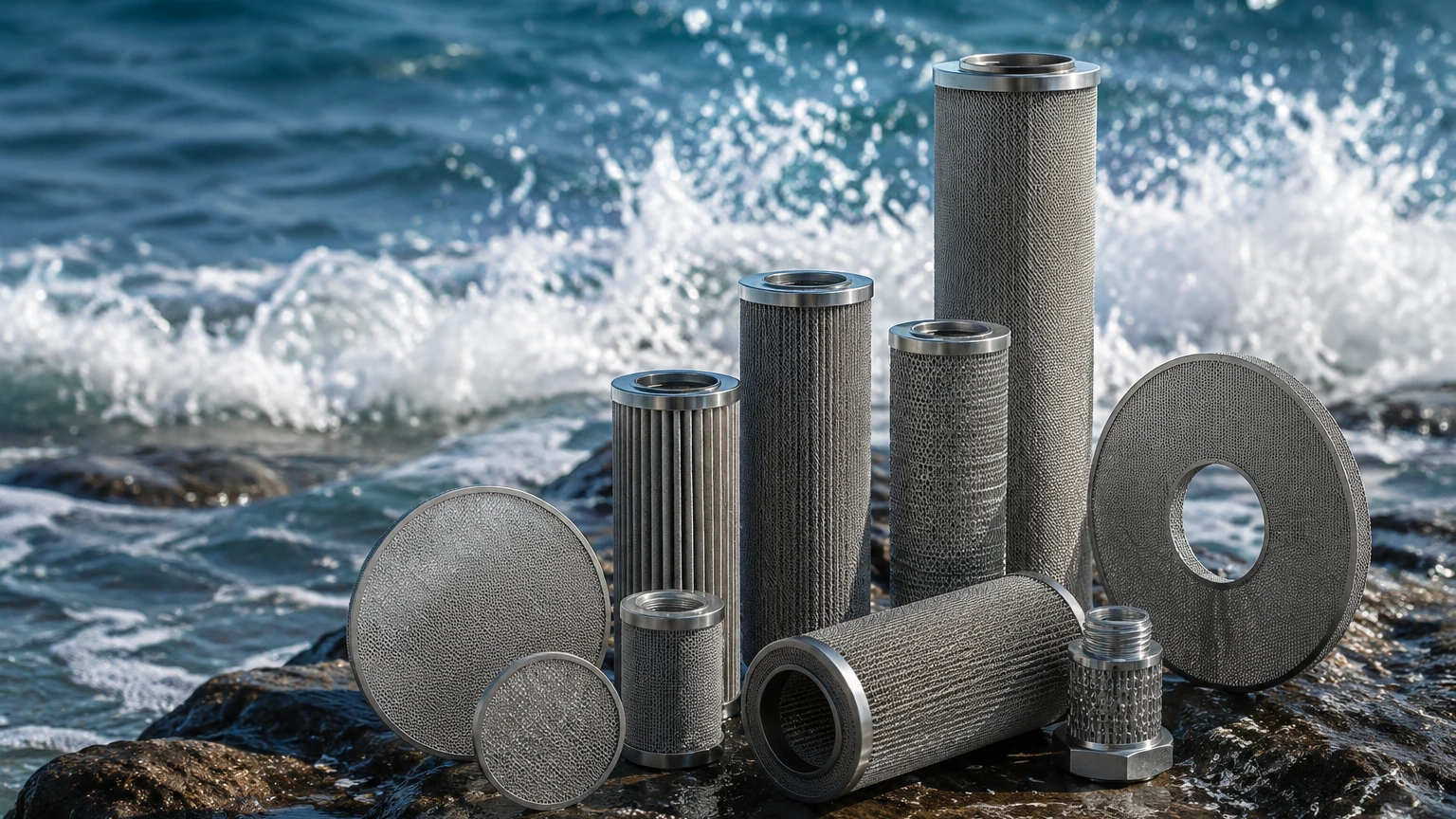
Sintered wire mesh is a preferred choice for precision seawater filtration. It consists of multiple layers of stainless steel wire mesh that are bonded together through a high-temperature sintering process. This creates a porous metal plate that is mechanically strong, heat-resistant, and capable of maintaining a consistent micron rating. The multi-layer structure allows for a combination of a fine filtration layer protected by coarser support layers, ensuring the filter does not deform under high differential pressure.
Wedge Wire Screens
Wedge wire, or V-wire, filters are excellent for coarse seawater filtration (primary screening). The V-shaped profile of the wire prevents clogging and makes the filter exceptionally easy to clean via backwashing. This design is commonly used in intake systems to protect pumps and downstream fine filters from large debris and marine life.
Perforated Metal and Expanded Metal
These are often used as the outermost support structure for a filter for seawater. They provide the mechanical cage that holds the finer mesh in place, ensuring the assembly can withstand the hydraulic forces of the system. For more details on how these components are integrated into custom designs, technical teams can consult the Main Page for engineering specifications.
Performance Evaluation and Operational Parameters
When specifying a filter for seawater, engineers must evaluate several performance metrics to ensure the system operates within its design limits.
Micron Rating: Absolute vs. Nominal
In seawater applications, the distinction between absolute and nominal ratings is vital. A nominal rating indicates the ability of the filter to retain a certain percentage of particles of a specific size. An absolute rating, however, guarantees that no particle larger than the specified micron size will pass through. For sensitive downstream equipment like reverse osmosis (RO) membranes, absolute filtration is often required to prevent fouling.
Clean Pressure Drop ($\\Delta P$)
The initial pressure drop across a clean filter for seawater should be minimized to reduce energy consumption and provide a longer operating window before cleaning is required. Factors affecting $\\Delta P$ include the open area of the filter media, the fluid velocity, and the viscosity of the fluid (which changes with seawater temperature).
Dirt Holding Capacity
This refers to the amount of contaminant a filter can retain before the pressure drop reaches a terminal level. In seawater with high seasonal turbidity (e.g., during algae blooms), a filter with a high dirt-holding capacity is essential to prevent frequent system shutdowns for cleaning.
Maintenance, Cleaning, and Replacement Cycles
The longevity of a filter for seawater depends heavily on the maintenance regime. Unlike disposable cartridges, stainless steel and metal alloy filters are designed to be cleaned and reused, providing a more sustainable and cost-effective solution over time.
Backwashing and Back-pulsing
Automated backwashing systems use a portion of the filtered fluid (or an external clean source) to flush contaminants off the surface of the filter in the reverse direction. This is highly effective for surface-loading media like wedge wire or single-layer mesh. For a filter for seawater, backwashing helps manage biofouling by preventing organisms from establishing a permanent foothold on the media.
Ultrasonic and Chemical Cleaning
Over time, fine particles or biological films may become deeply embedded in the mesh. In these cases, the filter element may need to be removed for ultrasonic cleaning or chemical soaking. Acid cleaning (passivation) can also help restore the protective oxide layer on stainless steel components, extending their service life in corrosive environments.
Monitoring Replacement Cycles
While metal filters are durable, they are not infinite. Fatigue from pressure cycling and gradual erosion-corrosion will eventually necessitate replacement. Engineers should monitor the time it takes for the filter to reach its terminal $\\Delta P$ after each cleaning cycle. A shortening of this interval often indicates that the media is becoming permanently blinded or structurally compromised.
Customization and Specification for Industrial Applications
No two seawater applications are identical. A filter for seawater used in a coastal power plant will have different requirements than one used on a deep-water oil rig. Customization is often necessary to ensure the filter housing, connections, and internal elements fit the specific spatial and hydraulic constraints of the project.
Key Information for Customization
When contacting a manufacturer like Kaifil, engineers should be prepared to provide the following data:
* Flow Rate: Minimum, normal, and maximum flow rates.
* Operating Pressure and Temperature: Including potential surges.
* Target Micron Rating: Based on the sensitivity of downstream components.
* Water Chemistry: Salinity levels, pH, and the presence of H2S or other corrosive gases.
* Contaminant Profile: The nature of the solids (organic vs. inorganic, abrasive vs. soft).
By providing these details, manufacturers can recommend the ideal alloy and structural design to maximize performance. For those beginning the selection process, the Main Page serves as a vital resource for understanding the range of custom filtration solutions available for demanding marine and industrial environments.
Conclusion
Specifying a filter for seawater requires a deep understanding of both fluid dynamics and material science. The harsh nature of the marine environment leaves little room for error; choosing the wrong material or an inadequate structural design can lead to rapid equipment failure and costly downtime. By focusing on high-grade alloys like Super Duplex, utilizing robust structures like sintered wire mesh, and implementing effective maintenance strategies, industrial operators can achieve reliable, long-term filtration performance. Whether for protecting RO membranes or ensuring the efficiency of cooling towers, a well-engineered filter for seawater is a fundamental component of modern maritime and coastal infrastructure.
