


Beer Filtration
In the industrial brewing sector, beer filtration is a critical separation process that determines the final product's clarity, biological stability, and shelf life. While the brewing process relies on complex biochemical reactions, the final presentation and commercial viability of the beer often depend on the efficiency of the filtration system. For engineers and production managers, selecting the right filtration media involves balancing throughput, filtration accuracy, and operational costs.
Modern breweries have transitioned from traditional, high-waste filtration methods toward more sustainable and precise technologies. Stainless steel filtration solutions, such as those manufactured by Kaifil, play a pivotal role in this evolution. By utilizing precision-engineered wire mesh and sintered metal cartridges, breweries can achieve consistent results while minimizing product loss and environmental impact.
The Objectives of Industrial Beer Filtration
Beer filtration is not a single-step operation but a series of separation stages designed to remove specific particulates. The primary objectives include:
1. Clarification: The removal of yeast cells and large particles remaining after fermentation and maturation. This stage is essential for producing "bright" beer.
2. Colloidal Stability: Reducing the concentration of haze-forming proteins and polyphenols. Without proper filtration, these elements can precipitate over time, especially when the beer is chilled, resulting in "chill haze."
3. Microbiological Stability: The removal of spoilage organisms, such as wild yeast and bacteria (e.g., *Lactobacillus*), to ensure the beer remains safe and flavorful throughout its intended shelf life.
4. Polishing: A final stage that provides the brilliant sparkle expected in many commercial lager and ale styles.
From an engineering perspective, the challenge lies in removing these unwanted elements without stripping away the essential proteins and esters that contribute to the beer’s mouthfeel, head retention, and flavor profile. This requires a nuanced approach to micron ratings and flow dynamics.
Stainless Steel Filter Media in Brewing Applications
Stainless steel has become the material of choice for industrial beer filtration due to its mechanical strength, chemical resistance, and longevity. Unlike disposable depth filters or polymer membranes, stainless steel components offer a permanent or semi-permanent solution that can withstand the rigorous cleaning cycles common in food and beverage production.
Wire Mesh Filters
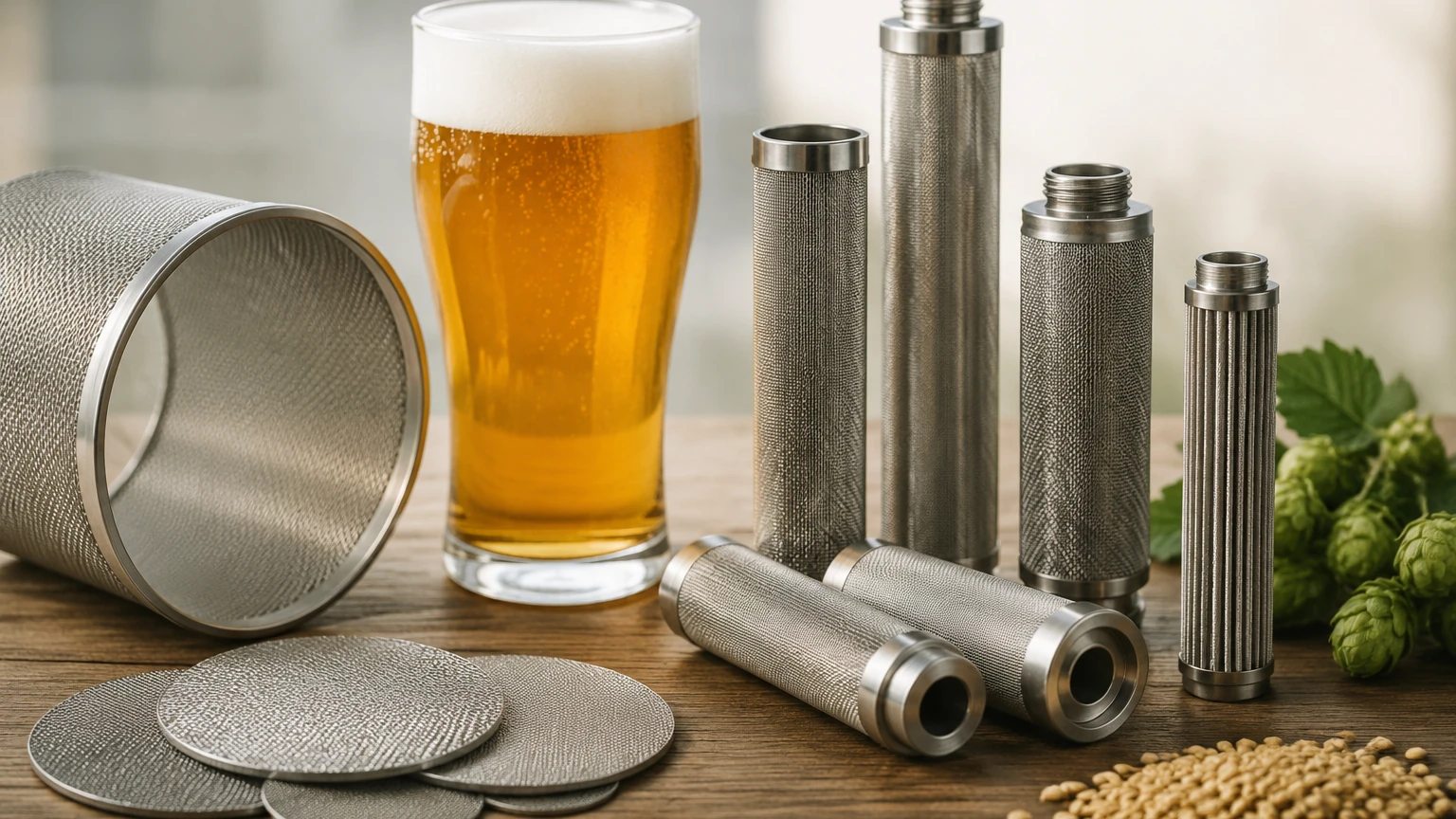
Precision wire mesh is often used in the early stages of filtration. It is particularly effective as a "trap filter" following diatomaceous earth (DE) or centrifuge stages. The mesh acts as a safety barrier, ensuring that no filter aids or large yeast clumps pass into the bright beer tanks. Kaifil specializes in custom wire mesh configurations, including Plain Dutch Weave and Twilled Dutch Weave, which provide high mechanical strength and precise aperture control.
Sintered Metal Cartridges
For applications requiring higher pressure resistance and finer filtration, sintered stainless steel cartridges are utilized. These components are created by fusing multiple layers of wire mesh or metal fibers through a thermal process, resulting in a porous structure that is incredibly durable. These are often used in steam filtration or for gas carbonation, where fine bubble dispersion is required.
Stages of the Beer Filtration Process
To optimize the process, breweries typically employ a multi-stage filtration strategy. Each stage serves a specific purpose and protects the downstream equipment from premature fouling.
Primary Filtration (Rough Filtration)
At this stage, the goal is to remove the bulk of the yeast and suspended solids. This is often achieved using centrifuges or DE filters. However, to protect the integrity of the downstream polishing filters, stainless steel trap filters are essential. These filters are designed to handle high flow rates with minimal pressure drop.
Secondary Filtration (Polishing)
Polishing filtration targets smaller particles and colloidal precursors. At this stage, the filtration accuracy usually ranges from 1 to 5 microns. Stainless steel cartridges used here must provide a high surface area to ensure long run times between cleaning cycles. The use of pleated stainless steel mesh is common here, as it maximizes the filtration area within a standard cartridge footprint.
Final/Sterile Filtration (Cold Stabilization)
Before packaging, many breweries perform a final filtration to ensure microbiological stability. This stage often uses membrane filters with ratings as low as 0.45 microns. While the membranes themselves are often polymer-based, the housings and pre-filters are almost exclusively stainless steel to allow for steam sterilization (SIP) and chemical cleaning (CIP).
Engineering Considerations for Filter Selection
When specifying filtration components for a brewery, engineers must evaluate several technical parameters to ensure system compatibility and performance.
Micron Rating: Absolute vs. Nominal
It is vital to distinguish between nominal and absolute micron ratings. A nominal rating refers to the ability of the filter to retain a percentage of particles of a certain size, whereas an absolute rating indicates that 99.9% or more of particles above that size will be captured. For critical stages like yeast removal, absolute-rated stainless steel mesh is preferred to prevent "bleed-through."
Pressure Drop (Delta P)
Every filter introduces a resistance to flow, known as pressure drop. As the filter accumulates debris, the pressure drop increases. Engineers must select a filter that provides the required accuracy while maintaining a low initial pressure drop to conserve pump energy and prevent mechanical stress on the filter media.
Material Compatibility
Brewery environments are demanding. Filtration components must be resistant to both the acidic nature of beer (pH 3.8–4.5) and the aggressive caustic and acid cleaners used during CIP. AISI 316L stainless steel is the industry standard due to its superior resistance to pitting and corrosion compared to 304 stainless steel.
Flow Velocity and Turbulence
High flow velocities can cause shear stress, which may break apart yeast cells or protein flocs, making them harder to filter. Properly sized filter housings and cartridges ensure that the fluid velocity remains within an optimal range, typically below 2-3 meters per second for most brewing applications.
Customization and OEM Solutions in Brewery Filtration
No two breweries are identical. Differences in piping layouts, vessel sizes, and production volumes necessitate customized filtration solutions. OEM manufacturers like Kaifil provide the flexibility needed to integrate filtration components into existing systems seamlessly.
Customization options often include:
* End Cap Configurations: Adapting cartridges to fit various housing styles (e.g., Code 7, 222, or 226 O-rings).
* Bespoke Dimensions: Manufacturing filter elements to specific lengths and diameters to match legacy equipment.
* Reinforced Structures: Adding internal support cores or external cages for filters subject to high-pressure back-washing or hydraulic shocks.
By working with a manufacturer that understands these technical nuances, engineering teams can reduce the need for expensive system overhauls and instead focus on optimizing specific filtration points. You can Review product options and application support on our Main Page to see how these custom solutions are implemented.
Maintenance, Cleaning (CIP), and Operational Longevity
One of the primary advantages of stainless steel filtration media is the ability to be cleaned and reused. This significantly reduces the total cost of ownership (TCO) compared to disposable cartridges. However, the longevity of these filters depends on proper maintenance protocols.
Cleaning-In-Place (CIP)
Stainless steel filters are designed to be cleaned without removal from the housing. A typical CIP cycle for a beer filter may involve:
1. Warm Water Rinse: To remove loose organic matter.
2. Caustic Wash (Sodium Hydroxide): To dissolve proteins and organic build-up.
3. Acid Rinse (Phosphoric or Nitric Acid): To remove mineral scale and neutralize the caustic.
4. Sanitization: Using hot water, steam, or peracetic acid (PAA).
Back-washing
In certain applications, automated back-washing can extend the time between deep cleaning cycles. By reversing the flow of filtered beer or water, accumulated solids are lifted from the surface of the mesh and flushed to drain. This is particularly effective with robust wire mesh designs.
Economic and Environmental Impact
The shift toward permanent stainless steel filtration is driven by both economic and environmental factors. While the initial capital expenditure (CAPEX) for stainless steel cartridges is higher than for disposable depth filters, the operational expenditure (OPEX) is significantly lower.
From an environmental standpoint, reducing the volume of spent filter cartridges sent to landfills aligns with the sustainability goals of modern breweries. Furthermore, the durability of stainless steel means fewer resources are consumed in the manufacturing and transport of replacement parts over the life of the brewery.
Conclusion
Beer filtration is a sophisticated engineering discipline that requires a deep understanding of fluid dynamics, material science, and microbiology. By selecting high-quality stainless steel filtration components, breweries can achieve the clarity and stability their customers demand while maintaining operational efficiency. Whether it is a standard trap filter or a custom-designed OEM component, the right filtration solution is a cornerstone of quality brewing. For more information on technical specifications and customized designs, visit our Main Page.
