


Sintered Metal Plate
In the field of industrial filtration and fluid dynamics, the sintered metal plate represents a pinnacle of engineering achievement, combining the mechanical strength of solid metal with the controlled porosity required for high-precision separation. These components are essential in environments where traditional polymer-based or ceramic filters fail due to extreme temperatures, high pressure, or chemically aggressive media. Understanding the technical nuances of sintered metal plates—from their manufacturing process to their operational maintenance—is critical for engineers and procurement teams looking to optimize system performance and reduce the total cost of ownership.
Understanding the Manufacturing Process of Sintered Metal Plates
The production of a sintered metal plate is a sophisticated metallurgical process known as diffusion bonding. Unlike traditional welding or the use of adhesive binders, sintering relies on atomic diffusion to join metal particles or wire mesh layers at their contact points. This is achieved by placing the material in a high-temperature vacuum or controlled-atmosphere furnace at temperatures just below the melting point of the base metal.
Under these conditions, the metal atoms migrate across the boundaries of the individual wires or powder grains, creating a monolithic structure. Because no secondary bonding agents are used, the resulting sintered metal plate maintains the full chemical resistance and mechanical properties of the parent alloy. For industries such as pharmaceutical manufacturing or food processing, this lack of binders is crucial as it eliminates the risk of media migration or chemical leaching into the process stream.
Structural Composition and Layer Configuration
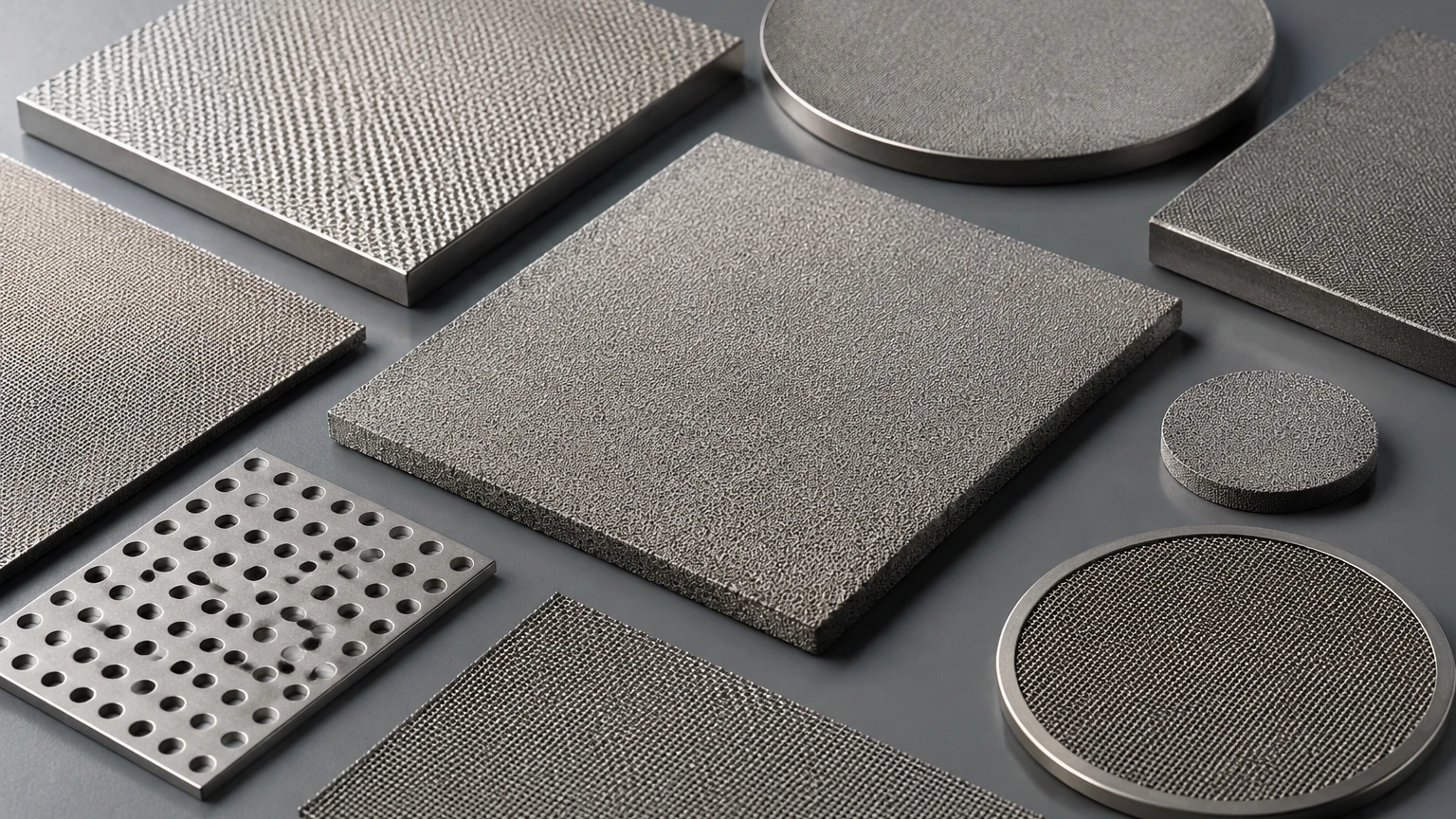
A sintered metal plate can be manufactured using either metal powders or multiple layers of woven wire mesh. The choice between these two depends largely on the specific filtration requirements and mechanical loads of the application.
Sintered Wire Mesh Plates
Sintered wire mesh plates are typically constructed from multiple layers of stainless steel mesh. A standard five-layer configuration includes:
1. Protective Layer: A coarse mesh that protects the finer internal layers from mechanical damage.
2. Filter Layer: The precision-woven mesh that determines the micron rating and filtration efficiency.
3. Dispersion Layer: Provides a buffer to ensure uniform flow distribution across the filter media.
4. Support Layers (Two Layers): Coarse, heavy-duty mesh layers that provide the structural rigidity necessary to withstand high differential pressures.
Sintered Metal Powder Plates
These are formed by compacting metal powder into a mold and then sintering it. These plates offer a more tortuous path for the fluid, making them excellent for depth filtration. They are often used in applications requiring extremely fine filtration or gas sparging, where the uniform distribution of microscopic bubbles is required.
Technical Specifications and Performance Metrics
When evaluating a sintered metal plate for industrial use, several engineering metrics must be considered to ensure the component meets the application's demands.
Filtration Accuracy (Micron Rating)
Filtration accuracy is defined as the ability of the plate to remove particles of a specific size. This is categorized into "nominal" and "absolute" ratings. An absolute rating indicates that 99.9% of particles at that micron size will be retained, a critical factor for sterile filtration in the pharmaceutical sector. Sintered metal plates can achieve filtration ratings ranging from 0.5 microns to over 200 microns.
Permeability and Pressure Drop
Permeability refers to the ease with which a fluid passes through the porous structure. It is inversely proportional to the pressure drop ($ΔP$). Engineers must balance the need for fine filtration with the energy costs associated with pushing fluid through the plate. A high-quality sintered metal plate is designed to maximize the open area while maintaining structural integrity, thereby minimizing the initial pressure drop.
Mechanical Strength
One of the primary advantages of a sintered metal plate is its ability to remain dimensionally stable under high-pressure differentials. Unlike fabric or paper filters, these plates do not deform or "unload" captured contaminants when subjected to pressure surges. This makes them ideal for hydraulic systems and high-pressure gas filtration.
Material Selection for Harsh Environments
The longevity of a sintered metal plate is heavily dependent on the alloy selected. While stainless steel is the most common material, other alloys are utilized for specific environmental challenges.
* Stainless Steel 316L: The industry standard for most chemical and food-grade applications. The "L" denotes low carbon content, which improves weldability and resistance to intergranular corrosion.
* Stainless Steel 304: Suitable for less demanding applications where cost-effectiveness is a priority and chemical exposure is minimal.
* Hastelloy C-276: Used in highly acidic or chloride-rich environments where standard stainless steels would suffer from pitting or stress corrosion cracking.
* Monel and Inconel: Reserved for high-temperature applications (up to 1000°C) or specialized chemical processing involving hydrofluoric acid or alkaline media.
For more information on material compatibility and customized filtration components, technical professionals are encouraged to review the product options and application support available on our Main Page.
Industrial Applications and Operational Advantages
Sintered metal plates are utilized across a diverse range of sectors due to their versatility and durability.
Chemical and Petrochemical Processing
In these industries, filters must withstand corrosive fluids and high temperatures. Sintered metal plates are used for catalyst recovery, polymer filtration, and gas-solid separation. Their ability to be cleaned and reused significantly reduces the waste stream compared to disposable filter elements.
Food and Beverage Industry
Strict hygiene standards require materials that are easy to sterilize. Sintered plates are used in steam filtration, carbonation processes, and the removal of yeast or sediment in brewing and winemaking. Their robust nature allows for Clean-in-Place (CIP) procedures using aggressive caustic or acidic cleaners.
Pharmaceutical and Biotechnology
Precision is paramount in pharmaceutical manufacturing. Sintered plates provide the absolute filtration necessary for solvent purification and the recovery of active pharmaceutical ingredients (APIs). The smooth surface finish of the sintered mesh prevents particle entrapment, making the cleaning validation process more reliable.
Maintenance, Cleaning, and Longevity
One of the most significant advantages of a sintered metal plate over disposable media is its cleanability. Because the structure is rigid and the pores are fixed, these plates can be restored to near-original performance levels through several cleaning methods:
1. Backwashing and Backpulsing: Reversing the flow of fluid or gas to dislodge accumulated cake from the surface of the plate. This is often done in-situ.
2. Ultrasonic Cleaning: Using high-frequency sound waves in a cleaning solvent to remove fine particles trapped deep within the porous structure.
3. Chemical Cleaning: Using surfactants, acids, or alkalis to dissolve organic or inorganic deposits. Because the plates are made of high-grade alloys, they can withstand aggressive chemical baths that would destroy other filter types.
4. Thermal Cleaning (Burn-off): In applications like polymer filtration, plates can be heated in a controlled furnace to oxidize and remove organic contaminants.
The ability to clean and reuse a sintered metal plate results in a lower total cost of ownership, despite the higher initial investment compared to disposable filters. In many industrial settings, a well-maintained sintered plate can last for several years of continuous operation.
Engineering Considerations for Custom Procurement
When sourcing a sintered metal plate, engineers should provide detailed process parameters to the manufacturer to ensure the component is fit for purpose. Key information includes:
* Fluid Characteristics: Viscosity, density, and chemical composition.
* Operating Conditions: Normal and maximum operating temperatures, as well as the maximum allowable pressure drop.
* Contaminant Profile: The nature of the solids being removed (deformable vs. hard particles) and the expected solids loading.
* Dimensional Requirements: Precise measurements for thickness, diameter, or custom shapes, as well as requirements for edge sealing or integrated gaskets.
As a professional manufacturer, Kaifil specializes in providing customized filtration solutions that address these specific engineering challenges. By working closely with technical teams, we ensure that every sintered metal plate is optimized for the intended flow rate and filtration efficiency, providing a reliable barrier that protects downstream equipment and ensures product purity.
Conclusion
The sintered metal plate is an indispensable component in modern industrial filtration. Its unique combination of permeability, mechanical strength, and chemical resistance allows it to perform in the most demanding environments. By selecting the appropriate material, layer configuration, and micron rating, engineers can achieve precise separation results while benefiting from the long-term durability and cleanability of metal media. For those seeking to optimize their filtration systems, focusing on the technical specifications and maintenance protocols of these plates is the first step toward achieving operational excellence.
