


Cyclone Particle Separator
In industrial fluid and gas processing, the management of particulate matter is a critical factor in maintaining equipment longevity and process efficiency. A cyclone particle separator serves as a primary mechanical separation device, utilizing centrifugal force to remove solids from a medium without the need for moving parts or consumable filter media. For engineers designing complex filtration systems, understanding the integration of cyclone separators with secondary stages—such as stainless steel wire mesh filters and precision cartridges—is essential for optimizing the total cost of ownership and system reliability.
As a manufacturer of high-performance stainless steel filtration solutions, Kaifil recognizes that the cyclone particle separator is often the first line of defense in a multi-stage filtration architecture. By removing the bulk of heavy or abrasive particles, these units protect downstream precision components, ensuring that fine filtration stages can operate at peak efficiency for longer durations.
Understanding the Mechanics of a Cyclone Particle Separator
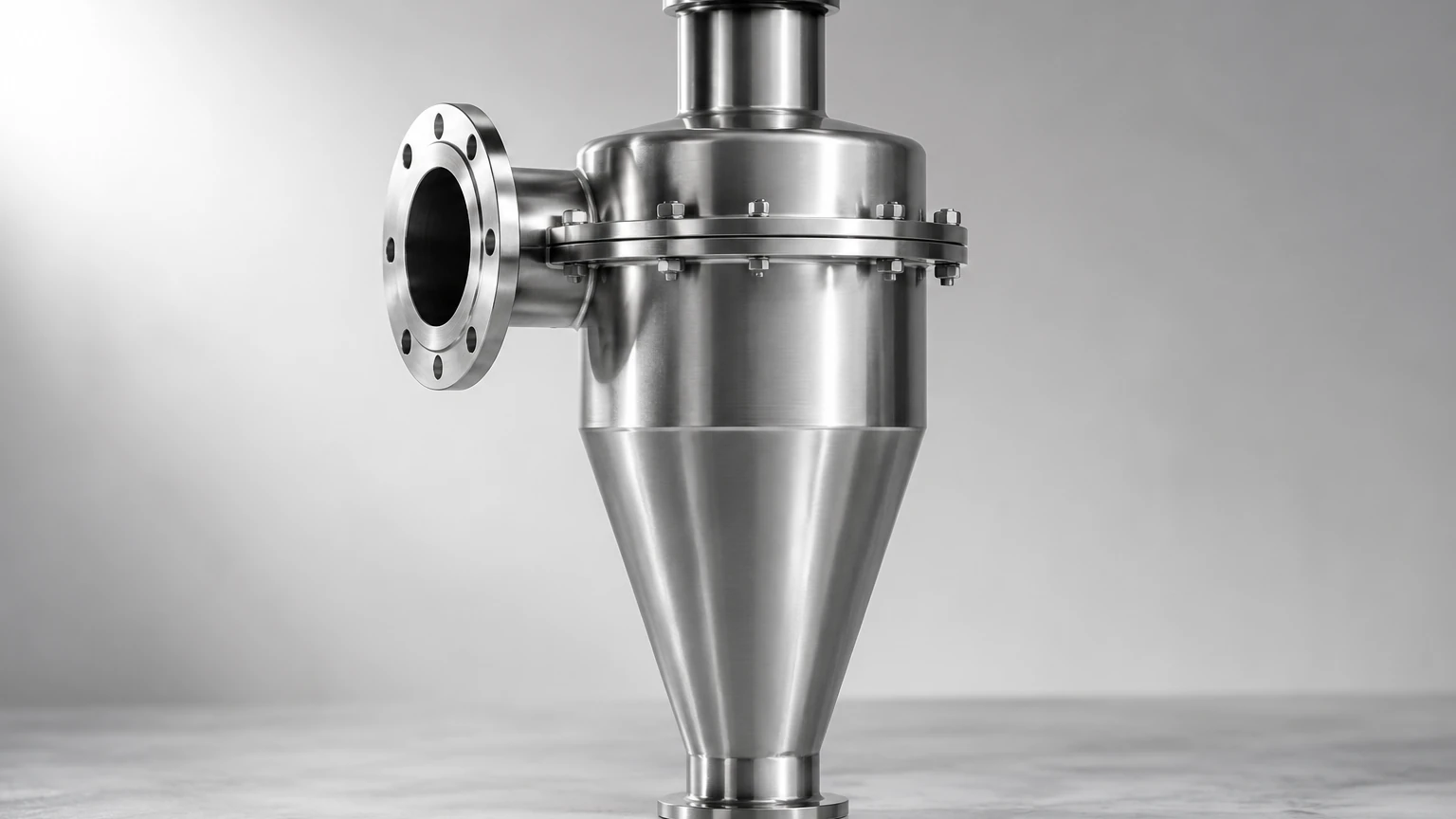
The operation of a cyclone particle separator is rooted in the principles of inertia and centrifugal force. When a fluid or gas stream enters the cylindrical chamber of the separator tangentially, it is forced into a high-velocity spiral or "vortex." This rotational motion creates a centrifugal force that acts on the particles suspended in the stream.
Because solid particles typically have a higher density than the carrying medium (liquid or gas), they are flung outward toward the wall of the separator. Once the particles strike the wall, they lose kinetic energy and fall downward through the conical section of the device, eventually collecting in a discharge hopper or underflow outlet. The cleaned medium then reverses direction, forming an inner vortex that exits through the top of the unit via a vortex finder.
Key Performance Metrics
When evaluating a cyclone particle separator, engineers focus on several technical parameters:
* Cut Point (d50): This represents the particle size at which the separator is 50% efficient. Particles larger than the d50 are likely to be captured, while smaller particles may remain in the stream.
* Pressure Drop ($Δ$P): The energy loss across the separator. A higher pressure drop often indicates higher separation efficiency but requires more pumping or fan power.
* Flow Rate Capacity: The volume of fluid the unit can process while maintaining the required centrifugal velocity.
The Role of Pre-Filtration in Industrial Systems
A cyclone particle separator is rarely used as a standalone solution in applications requiring high-purity outputs. Instead, it serves as a pre-filter. In industries such as chemical processing, food and beverage, and hydraulic systems, the presence of large, abrasive particles can cause premature blinding or physical damage to fine filtration media.
By implementing a cyclone separator upstream, the majority of the "heavy lifting" is completed before the fluid reaches precision stainless steel filter cartridges. This staged approach offers several advantages:
1. Extended Service Life: Reducing the particulate load on secondary filters significantly extends the interval between cleaning or replacement cycles.
2. Reduced Operational Costs: Since cyclones do not use consumable media, the cost per ton of removed solids is exceptionally low.
3. Protection of Sensitive Equipment: In hydraulic and water treatment applications, removing sand, scale, and metal chips prevents erosion of pumps, valves, and nozzles.
For more information on the secondary filtration stages that complement these systems, you can visit the Main Page to review product options and application support.
Engineering Evaluation Criteria for Separator Selection
Selecting the right cyclone particle separator requires a deep dive into the specific characteristics of the process stream. Engineers must move beyond generic sizing and consider the following technical factors:
Particle Size Distribution (PSD)
A cyclone's efficiency is highly dependent on the size and density of the particles. If the PSD indicates a high concentration of sub-10-micron particles, a standard cyclone may not be sufficient as a final stage. In such cases, the cyclone should be paired with a high-precision stainless steel wire mesh filter capable of capturing the remaining fines.
Fluid Viscosity and Density
In liquid-solid separation (hydrocyclones), the viscosity of the carrying fluid plays a major role. High-viscosity fluids resist the centrifugal movement of particles, effectively increasing the cut point and reducing efficiency. Temperature fluctuations must also be considered, as they directly impact fluid viscosity.
Material Compatibility
Industrial environments often involve corrosive chemicals or high temperatures. While many separators are available in carbon steel or plastics, demanding B2B applications typically require stainless steel construction. Using 304 or 316L stainless steel ensures resistance to oxidation and chemical attack, which is vital for maintaining the internal geometry of the cyclone. Any erosion or corrosion of the internal walls can disrupt the vortex flow, leading to a sharp decline in separation performance.
Common Operational Risks and Mitigation
While cyclone particle separators are valued for their simplicity, they are not immune to operational challenges. Engineers should be aware of the following risks:
Internal Erosion
Because the separator relies on high-velocity contact between particles and the chamber walls, erosion is a constant threat, especially when handling abrasive materials like sand or metal shavings. To mitigate this, high-grade stainless steel or specialized internal coatings are recommended. Regular wall-thickness inspections are necessary for units operating in high-load environments.
Air/Fluid Leakage at the Discharge
The discharge point (underflow) must be properly sealed, often using a rotary valve or an airtight collection tank. If air or fluid leaks into the bottom of the cyclone, it can disrupt the vortex and cause captured particles to be re-entrained into the clean stream, effectively bypassing the separation process.
Turndown Limitations
Cyclones are designed for specific flow ranges. If the flow rate drops significantly below the design point, the centrifugal velocity decreases, and separation efficiency plummets. Systems with highly variable flow rates may require multiple smaller cyclones in a manifold (multicyclones) that can be brought online or offline as needed.
Customization and Application-Specific Design
No two industrial processes are identical, and "off-the-shelf" separators often fail to meet the rigorous demands of specialized sectors. Customization is frequently required in the following areas:
* Food and Beverage: Separators must feature sanitary finishes, such as polished 316L stainless steel, and be designed for Clean-in-Place (CIP) compatibility to prevent bacterial growth.
* Pharmaceuticals: Precision manufacturing is required to ensure no crevices exist where product could accumulate and cross-contaminate batches.
* Chemical Processing: Custom alloy selections may be necessary to withstand aggressive solvents or acidic environments that would degrade standard materials.
Kaifil specializes in these types of customized metal filtration components, ensuring that the transition from the primary cyclone separator to the final stainless steel filter cartridge is seamless and engineered for the specific chemical and thermal profile of the application.
Technical Specification Checklist for Procurement
Before finalizing the design or purchase of a cyclone particle separator and its associated downstream filters, purchasing teams and engineers should confirm the following data points with their manufacturer:
1. Target Particle Size: What is the minimum particle size that must be removed by the cyclone, and what is the allowable carry-over for the secondary filter?
2. Operating Pressure and Temperature: Will the housing material and seals withstand the peak process conditions?
3. Solids Loading: What is the concentration of solids (ppm or mg/L)? High loading may require automated discharge systems.
4. Space Constraints: Does the vertical height required for a cyclone fit within the existing facility footprint?
5. Integration Requirements: Are the inlet and outlet flanges compatible with existing piping? Are there specific requirements for the secondary filtration stage (e.g., pleated mesh vs. sintered metal)?
Conclusion
The cyclone particle separator remains a cornerstone of industrial filtration due to its reliability and low maintenance requirements. However, its effectiveness is maximized only when it is integrated into a well-engineered system that accounts for the nuances of particle dynamics and material science. By utilizing a cyclone for bulk separation and high-quality stainless steel components for precision polishing, industrial operators can achieve superior fluid purity and protect their most valuable equipment.
For technical professionals seeking to optimize their filtration processes, selecting a partner with expertise in both the mechanics of separation and the manufacturing of precision metal filters is key. Explore the full range of custom filtration solutions and engineering support by visiting the Main Page today.
