


Air Motor Silencer
In the landscape of industrial automation and pneumatic power, the management of exhaust noise is not merely a matter of comfort but a critical requirement for operational safety, regulatory compliance, and mechanical efficiency. An air motor silencer, frequently referred to in engineering specifications as a pneumatic muffler, serves as the primary interface between a high-pressure pneumatic system and the ambient atmosphere. Its role is to dissipate the energy of exhausting compressed air while minimizing the negative impact on the motor's performance. For technical professionals and procurement teams, understanding the nuances of silencer design, material science, and fluid dynamics is essential for maintaining a productive work environment.
As a leading manufacturer of precision stainless steel filtration and metal components, Kaifil provides engineered solutions that address the specific challenges of industrial filtration and noise attenuation. Our expertise in wire mesh and sintered metal technologies allows us to support demanding applications across the chemical, pharmaceutical, and food processing sectors. To explore our comprehensive range of filtration products and technical services, please visit our Main Page.
The Mechanics of Noise Generation in Pneumatic Systems
To effectively select or design an air motor silencer, one must first understand the physics of the noise it is intended to suppress. When an air motor exhausts, the compressed air undergoes a rapid transition from a high-pressure internal environment to a low-pressure external environment. This transition results in several phenomena that contribute to high-decibel noise levels:
1. Turbulent Flow: As air exits the exhaust port at high velocities—often reaching sonic speeds—it creates a shear layer against the stationary ambient air. This turbulence generates high-frequency sound waves, often characterized as a sharp "bark" or "hiss."
2. Rapid Expansion: The sudden drop in pressure causes the air to expand volumetrically at an explosive rate. This expansion creates pressure fluctuations in the surrounding air, which are perceived as noise.
3. Vibration and Resonance: The mechanical movement within the motor itself, combined with the pulsing nature of the exhaust flow (especially in piston-type air motors), can cause the exhaust piping and the motor housing to resonate, adding to the overall acoustic profile.
Uncontrolled exhaust noise from a single air motor can easily exceed 100 dB(A). For context, OSHA (Occupational Safety and Health Administration) and similar global bodies mandate hearing protection or engineering controls for environments where noise levels exceed 85 dB(A) over an eight-hour shift. Implementing a high-quality air motor silencer is typically the most effective engineering control available, often reducing noise levels by 20 dB to 40 dB.
Engineering Principles: Balancing Attenuation and Backpressure
The most significant technical challenge in specifying an air motor silencer is the inherent trade-off between noise reduction and backpressure. Every silencer acts as a restriction in the exhaust path. When the exhaust flow is restricted, pressure builds up behind the silencer, creating "backpressure" that acts against the motor's internal moving parts.
Impact on Motor Performance
High backpressure directly reduces the pressure differential across the air motor. Since the torque and power output of a pneumatic motor are proportional to this pressure differential, an improperly sized silencer will lead to:
* Reduced RPM: The motor will spin slower than its rated speed under a given load.
* Torque Loss: The motor may fail to start under load or may stall more easily.
* Increased Air Consumption: To compensate for the loss of power, operators may increase the inlet pressure, leading to higher energy costs and accelerated wear on the motor seals.
The Flow Coefficient (Cv)
Engineers use the Flow Coefficient (Cv) to quantify a silencer's ability to allow air to pass. A higher Cv value indicates lower resistance. When selecting an air motor silencer, it is a best practice to choose a component with a Cv rating that matches or exceeds the exhaust flow requirements of the motor at its maximum operating speed. This ensures that the silencer does not become a bottleneck in the system.
Material Selection for Industrial Environments
In industrial B2B contexts, the environment in which the air motor silencer operates dictates the material requirements. While standard brass or plastic mufflers may suffice for clean, indoor laboratory settings, they often fail in heavy industrial applications.
Stainless Steel (304 and 316L)
For industries such as chemical processing, marine environments, and food production, stainless steel is the preferred material. Kaifil specializes in the fabrication of 304 and 316L stainless steel components, which offer several distinct advantages:
* Corrosion Resistance: 316L stainless steel contains molybdenum, providing superior resistance to chlorides and acidic wash-down chemicals used in food and pharmaceutical facilities.
* Thermal Resilience: Pneumatic exhaust can be extremely cold due to the Joule-Thomson effect (expansion cooling), or the motor itself may be located in a high-heat zone. Stainless steel maintains its structural integrity across a much wider temperature range than polymers.
* Mechanical Strength: In high-vibration environments or areas where equipment is subject to physical impact, stainless steel silencers are far less likely to crack or shear at the threads compared to plastic or sintered bronze alternatives.
Cleanliness and Sterilization
In the pharmaceutical and biotech sectors, the ability to sterilize equipment is paramount. Stainless steel silencers can be subjected to autoclaving or CIP (Clean-In-Place) processes without degrading. Furthermore, unlike sintered bronze, which can shed microscopic metallic particles over time, high-quality stainless steel wire mesh is highly stable and resistant to media migration.
Comparison of Silencing Media: Sintered Metal vs. Wire Mesh
The internal "media" of the air motor silencer is what actually performs the work of noise attenuation. The two most common types of metal media are sintered metal and multi-layer wire mesh.
Sintered Metal Media
Sintered metal silencers are created by pressing metal powders (typically bronze or stainless steel) into a mold and heating them until the particles bond. This creates a porous, rigid structure with a very tortuous path for the air.
* Pros: Exceptional noise reduction due to the high surface area and complex internal geometry.
* Cons: Higher risk of clogging. The small, irregular pores can easily trap oil aerosols and particulates from the compressed air line, leading to a rapid increase in backpressure.
Multi-Layer Wire Mesh Media
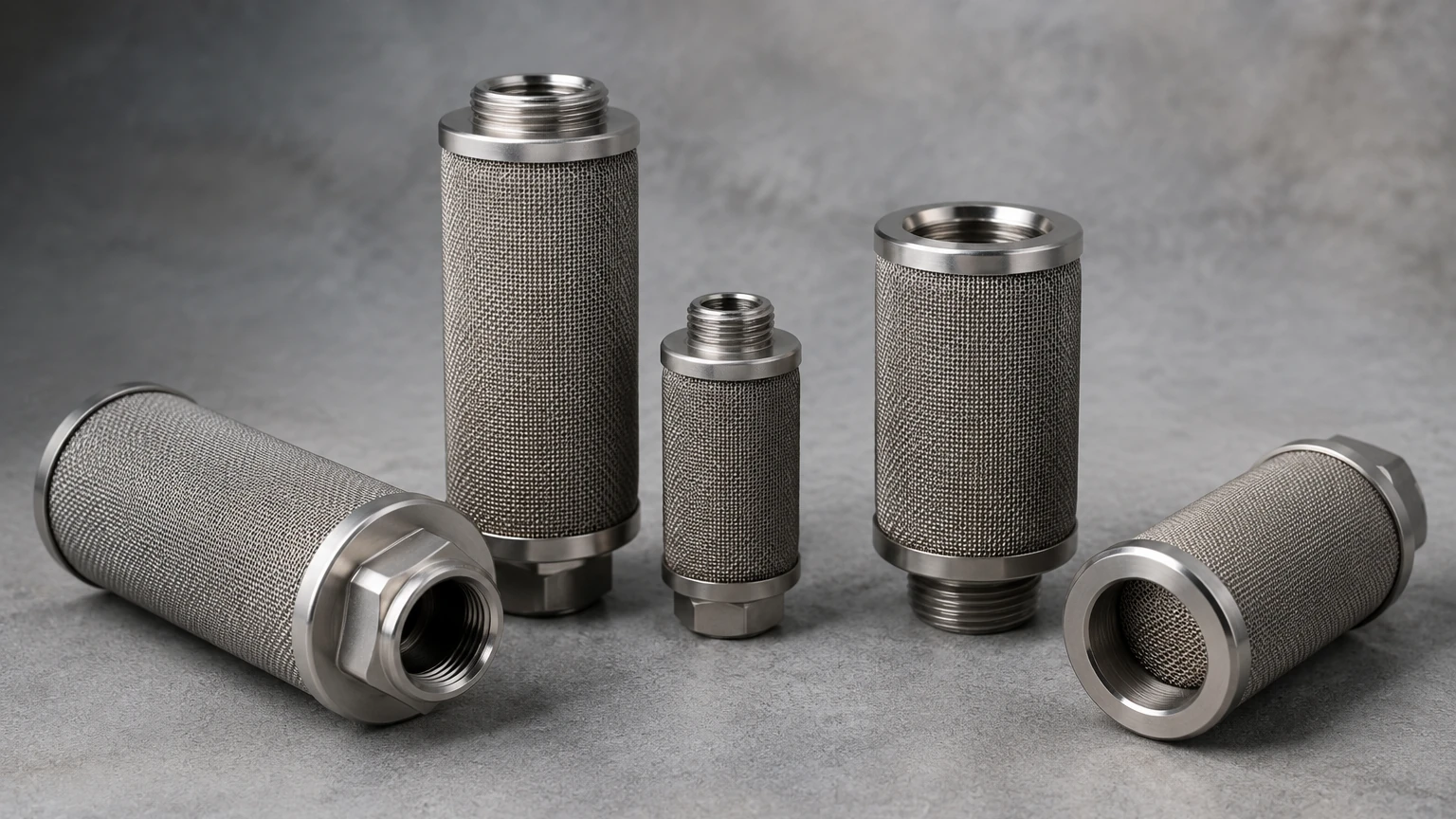
Kaifil’s precision wire mesh silencers utilize layers of woven stainless steel mesh that are often sintered together to form a robust, porous element.
* Pros: Excellent flow-to-surface-area ratio. The structured nature of the mesh allows for more predictable flow patterns and a higher "void volume" than sintered powders. This makes them significantly more resistant to clogging from oil mist or moisture.
* Cons: Slightly less acoustic attenuation than thick-walled sintered metal, though usually more than sufficient for industrial noise compliance.
For most high-cycle industrial air motors, wire mesh is the superior choice because it maintains the motor's performance for longer periods between maintenance cycles.
Critical Selection Factors for Engineering and Procurement
When specifying an air motor silencer, the following technical parameters must be confirmed to ensure a successful integration:
1. Thread Type and Size: Common standards include NPT (National Pipe Thread) for North American markets and G-thread (BSPP) for European and international markets. Using an adapter can introduce leak points, so selecting the correct native thread is preferred.
2. Micron Rating: This refers to the size of the pores in the silencing media. A lower micron rating provides better filtration (trapping oil mist) but increases backpressure. For most air motor exhaust applications, a rating between 40 and 100 microns is standard.
3. Maximum Pressure Rating: Although the silencer is on the exhaust side, it must be rated to handle the full system pressure in the event of a motor failure or a downstream blockage.
4. Dimensions and Clearance: In compact machinery, the physical size of the silencer is a constraint. Engineers must ensure there is adequate clearance for the silencer to be installed and for air to escape freely from its entire surface area.
5. Environmental Exposure: Will the silencer be exposed to outdoor elements, salt spray, or aggressive cleaning agents? This will determine whether 304 or 316L stainless steel is required.
Maintenance and Total Cost of Ownership (TCO)
A common mistake in pneumatic system management is treating the air motor silencer as a "fit and forget" component. Over time, all silencers will accumulate contaminants from the compressed air supply, such as compressor oil, water-oil emulsions, and pipe scale.
Identifying a Clogged Silencer
Maintenance teams should monitor for the following symptoms:
* A noticeable decrease in the air motor's operating speed.
* A change in the "pitch" of the exhaust noise.
* Increased heat generation at the motor housing.
* Visible oil saturation on the exterior of the silencer.
Cleaning and Reuse
One of the primary B2B advantages of stainless steel silencers over plastic versions is their reusability. While plastic mufflers are disposable, stainless steel wire mesh and sintered elements can often be cleaned using ultrasonic baths, solvent degreasers, or back-flushing with high-pressure air. This significantly reduces the Total Cost of Ownership (TCO) by extending the service life of the component and reducing waste.
Custom OEM Solutions and Integration
For manufacturers of specialized industrial equipment, standard off-the-shelf silencers may not provide the optimal balance of performance and aesthetics. Custom-engineered silencers allow for the integration of noise control directly into the machine's design.
Kaifil works as a technical partner for OEMs to develop bespoke air motor silencer solutions. This includes:
* Custom Threading and Manifolding: Designing silencers that can be manifolded together to handle multiple exhaust ports simultaneously.
* Specific Geometry: Creating low-profile or elongated silencers to fit within narrow machine envelopes.
* Adjustable Exhaust: Some custom silencers feature an adjustable needle valve or shroud that allows technicians to fine-tune the backpressure, effectively acting as a speed control for the air motor.
By collaborating with a manufacturer that understands both the filtration and the mechanical requirements of the application, OEMs can ensure their equipment operates at peak efficiency while remaining well within noise safety limits.
Conclusion
The selection of an air motor silencer is a fundamental engineering decision that impacts the safety, performance, and reliability of pneumatic systems. By moving beyond generic components and opting for high-quality materials like stainless steel, and by carefully considering the balance between noise attenuation and flow capacity, industrial operators can protect their personnel and their equipment simultaneously.
At Kaifil, we are committed to providing the technical expertise and manufacturing precision required to solve complex industrial filtration and silencing challenges. Whether you require a standard replacement or a custom-engineered component for a new machine design, our team is ready to assist. For more detailed product specifications and to see how our solutions can be integrated into your workflow, please visit our Main Page.
