


Waste Water Treatment Solution
In the modern industrial landscape, the management of aqueous discharge has evolved from a simple regulatory obligation into a complex engineering challenge. A robust waste water treatment solution is essential for maintaining operational continuity, protecting expensive downstream equipment, and meeting increasingly stringent environmental standards. Whether the application involves chemical processing, food and beverage production, or heavy manufacturing, the primary objective remains the same: the efficient and reliable removal of contaminants from process water.
Industrial wastewater is rarely a simple mixture. It often contains a diverse array of suspended solids, organic compounds, chemical precipitates, and abrasive particles. Consequently, a one-size-fits-all approach is insufficient. Engineers must design a waste water treatment solution that accounts for specific flow rates, particle size distributions, and chemical compatibilities. Stainless steel filtration components, such as those found on our Main Page, offer the mechanical integrity and chemical resistance necessary to handle these demanding conditions over long service life cycles.
The Engineering Fundamentals of Industrial Wastewater Filtration
At its core, a waste water treatment solution relies on the physical separation of solids from liquids. This process is governed by several critical factors, including the nature of the suspended solids and the hydraulic characteristics of the system. Understanding these fundamentals is the first step in selecting the right filtration media.
Particle Size Distribution and Retention
One of the most important considerations is the particle size distribution (PSD) of the contaminants. A waste water treatment solution must be capable of capturing particles at a specific micron rating without becoming prematurely blinded. In many industrial settings, wastewater contains a high concentration of "fines"—particles smaller than 10 microns—which can quickly clog standard filters. Engineers often employ a multi-stage approach, using coarse wire mesh filters for primary removal and finer sintered metal or pleated cartridges for secondary polishing.
Total Suspended Solids (TSS) and Loading
The volume of solids, often measured as Total Suspended Solids (TSS), dictates the required surface area of the filter. High TSS levels require a waste water treatment solution with a high dirt-holding capacity. If the filter surface area is too small, the pressure drop will rise rapidly, leading to frequent maintenance cycles and potential system downtime. By utilizing pleated stainless steel elements, engineers can significantly increase the effective filtration area within a compact housing, thereby managing higher solids loading more effectively.
Material Science: Why Stainless Steel is Central to the Solution
The choice of material for filtration components is a defining factor in the longevity and reliability of any waste water treatment solution. While polymer-based filters are common in light-duty applications, industrial environments often demand the superior properties of stainless steel.
Corrosion Resistance in Aggressive Environments
Industrial wastewater can be highly corrosive, containing acids, alkalis, or high concentrations of chlorides. Grade 304 stainless steel is suitable for many general-purpose water treatment applications. However, for more aggressive environments—such as those found in chemical plants or coastal facilities—Grade 316L stainless steel is the preferred choice. The addition of molybdenum in 316L provides enhanced resistance to pitting and crevice corrosion, ensuring that the filter media maintains its structural integrity even when exposed to harsh chemicals for extended periods.
Thermal Stability and Mechanical Strength
Unlike synthetic fibers, stainless steel does not degrade when exposed to high temperatures. This makes it an ideal component for a waste water treatment solution involving steam cleaning, hot process water, or thermal sterilization. Furthermore, the mechanical strength of metal mesh allows it to withstand high differential pressures. In systems where pressure surges are common, stainless steel filters provide a level of security that disposable cartridges cannot match, preventing media migration and downstream contamination.
Designing a Waste Water Treatment Solution for High-Flow Applications
High-flow industrial processes require filtration systems that can handle massive volumes of water without sacrificing efficiency. Designing a waste water treatment solution for these applications involves a careful balance of flow velocity, pressure drop, and filter geometry.
Optimizing Pressure Drop (ΔP)
The pressure drop across a filter is a critical metric for energy efficiency. A well-engineered waste water treatment solution aims to keep the initial ΔP as low as possible. This is achieved by selecting a wire mesh weave that offers a high percentage of open area while still meeting the required micron rating. Plain weave and twilled weave patterns are often used for high-flow applications, providing a stable pore structure with minimal resistance to fluid flow.
Pleated vs. Cylindrical Elements
For applications with restricted space but high flow requirements, pleated stainless steel filter cartridges are often the optimal choice. By pleating the wire mesh, the surface area can be increased by a factor of three to five compared to a standard cylindrical element. This design choice in a waste water treatment solution not only extends the time between cleaning cycles but also reduces the flux rate (flow per unit area), which can improve the retention efficiency of the filter media.
Application-Specific Filtration Strategies
Different industries face unique challenges when implementing a waste water treatment solution. A tailored approach is necessary to address the specific contaminants and operational requirements of each sector.
* Food and Beverage Industry: In this sector, wastewater often contains organic solids, fats, and proteins. The filtration components must be compatible with Clean-in-Place (CIP) systems and withstand frequent sanitization. Stainless steel filters are ideal here because they are non-leaching and can be thoroughly cleaned using hot water and caustic agents.
* Pharmaceutical and Biotech: These industries require extreme precision. A waste water treatment solution for pharmaceutical discharge must ensure that even trace amounts of active ingredients or biological matter are captured. Sintered metal fiber felt is often used in these applications to provide absolute filtration ratings at very fine micron levels.
* Chemical and Petrochemical: The primary challenge here is chemical compatibility. Filters must handle solvents, hydrocarbons, and varying pH levels. A waste water treatment solution utilizing 316L or specialty alloys like Hastelloy ensures that the filtration system does not become a point of failure in the process chain.
* Power Generation and Cooling Towers: Cooling water and boiler blowdown often contain scale, rust, and silt. High-strength wire mesh strainers are used to protect heat exchangers and pumps from abrasive damage, ensuring the long-term efficiency of the power plant's water circuit.
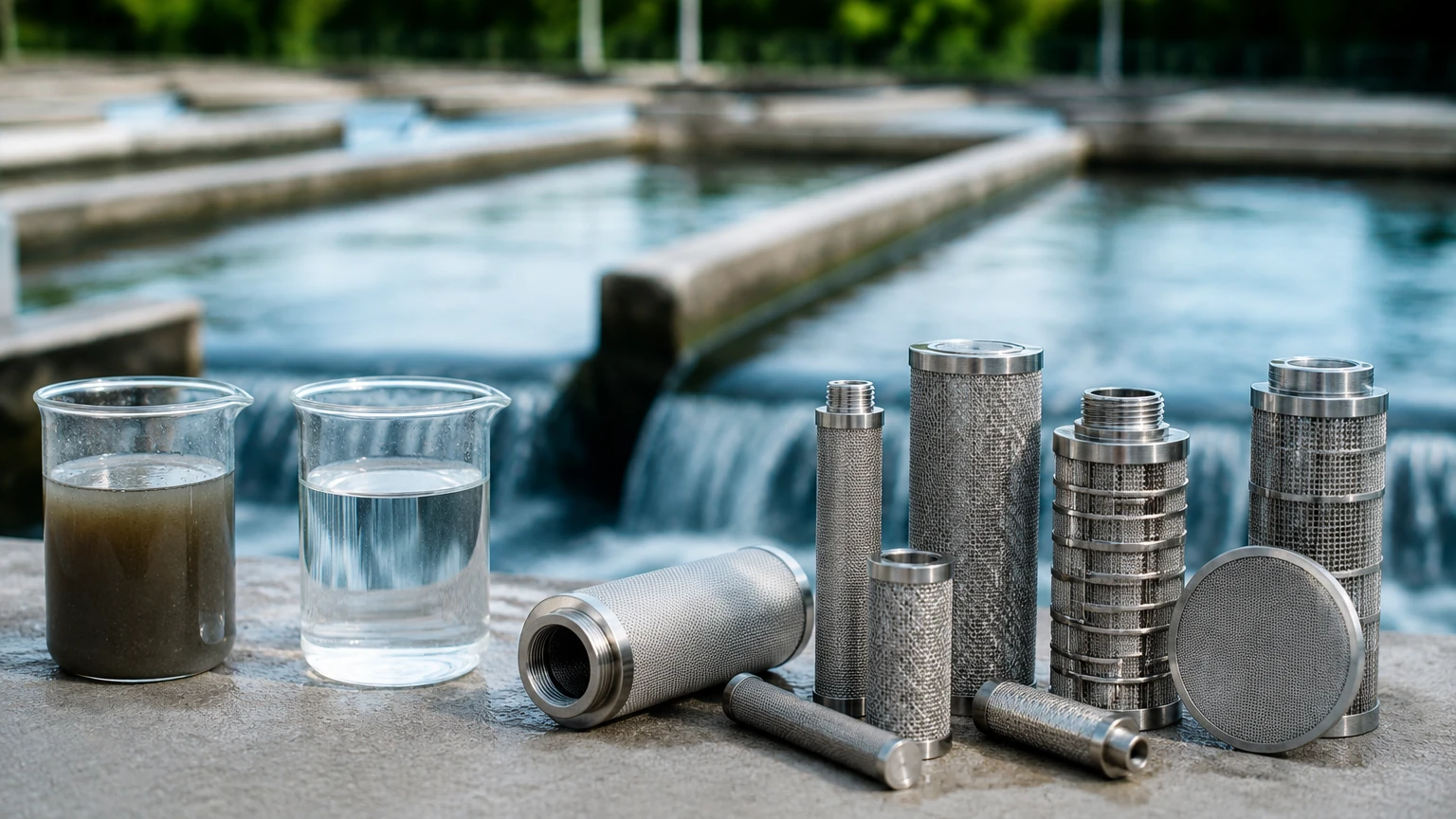
Operational Efficiency: Cleaning, Maintenance, and Total Cost of Ownership
One of the most compelling arguments for using stainless steel components in a waste water treatment solution is the impact on the total cost of ownership (TCO). While the initial purchase price of a stainless steel filter is higher than that of a disposable unit, the long-term savings are substantial.
The Advantage of Cleanability
Disposable filters represent a continuous operational expense and generate significant solid waste. In contrast, stainless steel filters are designed to be cleaned and reused. In a modern waste water treatment solution, cleaning can be achieved through several methods:
1. Backwashing: Many automated systems use a portion of the filtered water to back-flush the filter media, removing accumulated solids without interrupting the flow.
2. Ultrasonic Cleaning: For deep-seated contaminants, filters can be removed and placed in an ultrasonic bath. The high-frequency waves create cavitation bubbles that dislodge particles from the intricate weave of the mesh.
3. Chemical Soaking: If the filter is fouled with mineral scale or organic biofilms, it can be soaked in appropriate cleaning solutions to restore its original flow characteristics.
Sustainability and Waste Reduction
By choosing a reusable waste water treatment solution, industrial facilities can significantly reduce their environmental footprint. The elimination of thousands of disposable plastic or paper cartridges per year reduces landfill waste and the carbon emissions associated with the manufacturing and transport of replacement filters. This makes stainless steel filtration an essential component of any corporate sustainability strategy.
Customization and OEM Integration for Specialized Systems
Every industrial facility has unique constraints, from the physical layout of the piping to the specific hydraulic parameters of the pumps. A truly effective waste water treatment solution often requires customized filtration components that are built to exact specifications.
Tailored Mechanical Interfaces
Customization involves more than just the filter media. It includes the engineering of end caps, gaskets, and support structures. Whether a system requires a specific threaded connection, a flange mount, or a specialized O-ring material like Viton or EPDM, the filtration component must integrate seamlessly into the existing infrastructure. This level of detail ensures a leak-free operation and prevents the bypass of unfiltered water.
Collaborative Engineering
When developing a waste water treatment solution, engineers often work closely with manufacturers to prototype and test different filter configurations. This might involve testing different wire diameters to optimize mechanical strength or experimenting with multi-layered sintered mesh to achieve a specific flow-to-retention ratio. This collaborative approach ensures that the final product is perfectly tuned to the nuances of the application.
Conclusion: Implementing a Resilient Waste Water Treatment Solution
The selection of filtration technology is a pivotal decision in the design of any industrial waste water treatment solution. By prioritizing high-quality materials like stainless steel and focusing on engineered designs that maximize surface area and cleanability, facilities can achieve a balance of performance and cost-effectiveness.
Engineers and procurement teams should evaluate their filtration needs based on the long-term reliability and the total lifecycle costs of the components. A robust waste water treatment solution not only ensures compliance with environmental regulations but also serves as a critical safeguard for the entire industrial process. For those looking to upgrade their current systems or design new installations, exploring the technical capabilities and customization options available on our Main Page provides the foundation for a more efficient and sustainable water management strategy.
