


Demister
In industrial process engineering, the separation of liquid droplets from gas or vapor streams is a critical operation for protecting downstream equipment, reducing product loss, and ensuring environmental compliance. A demister, often referred to as a mist eliminator, is a specialized filtration component designed to remove entrained liquid particles that are too small to settle by gravity alone. These components are essential in a wide array of applications, including distillation columns, scrubbers, evaporators, and knock-out drums.
For engineers and procurement teams, selecting the correct demister involves a deep understanding of fluid dynamics, material science, and the specific mechanical requirements of the process vessel. This guide provides a technical overview of demister technology, focusing on engineering considerations, performance metrics, and selection criteria for industrial environments.
The Mechanics of Mist Elimination
The primary function of a demister is to facilitate the coalescence of fine liquid droplets into larger masses that can be drained away from the gas flow. This process typically relies on three physical mechanisms: inertial impaction, direct interception, and Brownian diffusion.
Inertial Impaction
Inertial impaction is the dominant mechanism for droplets larger than 5 to 10 microns. As the gas stream travels through the tortuous path created by the knitted wire mesh or vane structure, the gas can easily negotiate the turns. However, the liquid droplets, possessing higher momentum due to their mass, cannot change direction as quickly. They collide with the surface of the wire or plate, where they adhere and begin to accumulate.
Direct Interception
Direct interception occurs when a droplet follows a gas streamline but comes close enough to the surface of the filtration media to touch it. This is particularly relevant for mid-sized droplets that are influenced by the flow but still have enough physical volume to be captured by the proximity of the mesh fibers.
Brownian Diffusion
For extremely fine sub-micron mists, Brownian diffusion becomes the primary capture mechanism. These tiny particles move erratically due to collisions with gas molecules. This random movement increases the probability that the particles will eventually strike the surface of the demister media. While wire mesh demisters are highly effective for larger droplets, high-efficiency sub-micron separation often requires specialized high-density fiber beds or multi-stage systems.
Engineering Considerations for Wire Mesh Demisters
Wire mesh demisters are the most common type used in industrial applications due to their high surface area and relatively low cost. They consist of a knitted mesh pad, often supported by grids to maintain structural integrity under the pressure of the gas flow.
Mesh Density and Surface Area
The performance of a demister is largely determined by its specific surface area (the total area of the wire per unit volume) and the void volume (the percentage of open space within the pad). A higher mesh density increases the probability of droplet impaction but also increases the pressure drop across the unit. Engineers must balance these factors to achieve the desired separation efficiency without exceeding the system's energy constraints.
Wire Diameter
The diameter of the wire used in the knit affects both the efficiency and the structural life of the demister. Thinner wires provide more surface area for a given weight of material, which can improve the capture of smaller droplets. However, thinner wires are also more susceptible to corrosion and mechanical wear. In many industrial settings, a standard wire diameter of 0.28mm is used, though variations are common depending on the specific chemical environment.
Pad Thickness
Standard demister pads are typically 100mm to 150mm thick. Increasing the thickness can improve separation efficiency by providing a longer residence time and more opportunities for impaction. However, after a certain point, the marginal gain in efficiency is offset by the increased pressure drop and material cost.
Material Selection and Chemical Compatibility
Because demisters are often exposed to aggressive chemical environments and high temperatures, material selection is paramount to ensuring a long service life. Stainless steel is the industry standard due to its balance of mechanical strength and corrosion resistance.
* SS304/SS304L: Suitable for general-purpose applications where corrosion is minimal. It is frequently used in food and beverage or water treatment sectors.
* SS316/SS316L: Offers superior resistance to chlorides and organic acids. This is the preferred choice for many chemical processing and pharmaceutical applications.
* High-Nickel Alloys: For highly corrosive environments involving sulfuric acid, phosphoric acid, or high-temperature gases, materials like Monel, Inconel, or Hastelloy may be required.
* Specialty Plastics: In applications where metal is unsuitable, such as highly acidic scrubbers at lower temperatures, polypropylene (PP) or PTFE (Teflon) mesh may be utilized.
When evaluating materials, it is important to consider the potential for localized corrosion, such as pitting or stress corrosion cracking, which can lead to premature failure of the fine wire mesh.
Performance Evaluation: The Souders-Brown Equation
The sizing of a demister is primarily governed by the gas velocity. If the velocity is too low, droplets may follow the gas stream through the mesh without impacting the wires. If the velocity is too high, the gas flow will strip the accumulated liquid off the wires and re-entrain it into the exit stream—a phenomenon known as "flooding" or "re-entrainment."
The design velocity ($v$) is typically calculated using the Souders-Brown equation:
$$v = K \sqrt{\frac{\rho_l – ρ_g}{ρ_g}}$$
Where:
* $v$ = Maximum allowable gas velocity (m/s)
* $K$ = Design factor (typically ranging from 0.07 to 0.11 m/s for mesh demisters)
* $ρ_l$ = Density of the liquid
* $ρ_g$ = Density of the gas
The $K$-factor is adjusted based on operating pressure, liquid surface tension, and the specific geometry of the demister. For example, at higher operating pressures, the $K$-factor is usually reduced to account for the decreased surface tension and increased gas density, which make separation more difficult.
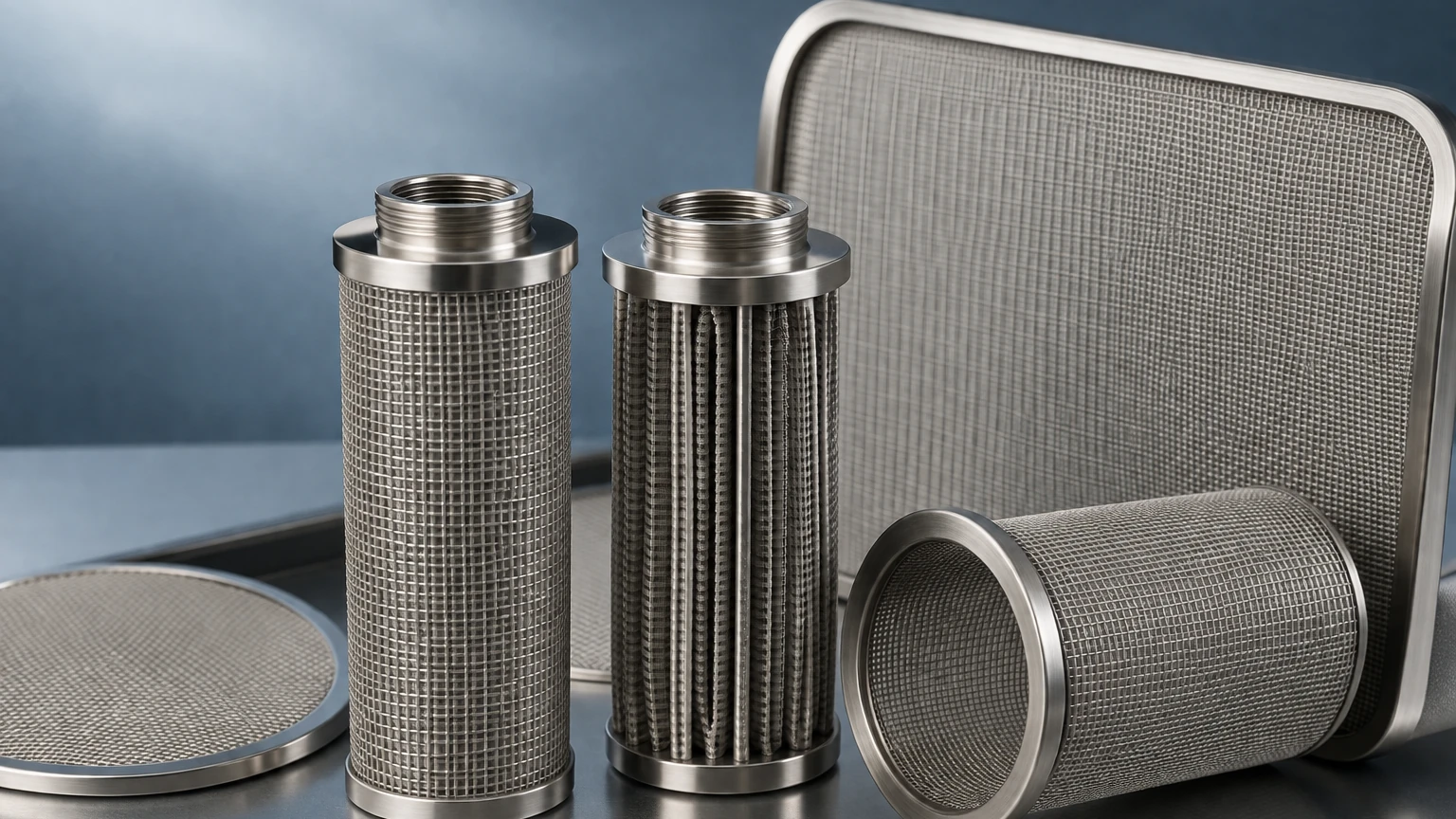
Customization and Integration
No two industrial processes are identical, which is why customization is a core requirement for demister procurement. For engineers looking to optimize their systems, several design variables can be adjusted:
1. Sectional Design: For installation through small manways in large vessels, demister pads are often manufactured in sections. These sections are numbered and designed to fit together precisely within the vessel's support ring.
2. Support Grids: The mesh pad must be held firmly to prevent shifting or bypass. Support grids (top and bottom) are typically constructed from flat bars and round rods, welded to provide a rigid frame. These can be bolted or clamped to the vessel's internal supports.
3. Vane-Mesh Combinations: In high-load applications, a two-stage system may be used. A vane-type separator (which handles high liquid volumes) is followed by a wire mesh demister (which captures the remaining fine mist). This configuration extends the life of the mesh and ensures high purity of the exit gas.
To explore specific configurations and technical support for your application, you can visit the Main Page for detailed product options and engineering assistance.
Maintenance and Operational Longevity
While demisters are generally low-maintenance components, their performance can degrade over time due to fouling, scaling, or mechanical damage. Monitoring the pressure drop ($ΔP$) across the demister is the most effective way to track its condition. A sudden increase in $ΔP$ usually indicates plugging by solids or high liquid loading, while a decrease may suggest that the mesh has been eroded or bypassed.
Cleaning Procedures
In processes where solids are present, demisters may require periodic cleaning. Depending on the nature of the contaminant, this can be achieved through:
* In-situ Spraying: Installing spray nozzles above the demister to wash away accumulated solids during operation or during scheduled shutdowns.
* Ultrasonic Cleaning: For removable pads, ultrasonic baths can effectively remove fine particulate matter trapped deep within the knitted structure.
* Chemical Soaking: Using compatible solvents or acids to dissolve scale and deposits.
Replacement Cycles
The replacement cycle for a demister depends heavily on the corrosivity of the process and the presence of abrasives. In clean, non-corrosive environments, a stainless steel demister can last for several years. However, in aggressive chemical service, it is common practice to inspect the mesh during every major turnaround and replace it if there is evidence of wire thinning or structural sagging.
Total Cost of Ownership (TCO)
When purchasing a demister, the initial acquisition cost is only one part of the equation. Engineers should also consider the following factors that contribute to the total cost of ownership:
* Energy Consumption: A demister with an unnecessarily high pressure drop will increase the load on compressors or fans, leading to higher utility costs over the life of the equipment.
* Product Recovery: In many processes, the liquid being captured is a valuable product. A more efficient demister can pay for itself quickly by reducing product loss.
* Downstream Protection: High-quality mist elimination prevents liquid carryover into compressors, turbines, or catalysts, which can prevent catastrophic equipment failure and expensive unplanned downtime.
By focusing on high-quality materials and precise engineering, facilities can ensure that their filtration systems provide reliable performance in demanding industrial environments. For further technical specifications and to Review product options and application support, consulting with a specialized manufacturer is recommended to ensure the selected demister meets the exact requirements of the process.
