


Breathers and Vents
In industrial fluid systems, the management of air exchange is a critical factor in maintaining equipment longevity and process purity. Breathers and vents serve as the primary interface between the internal environment of a reservoir or tank and the surrounding atmosphere. While their primary function is to equalize pressure, their role as a filtration barrier is what ultimately determines the cleanliness of the system. For engineers and maintenance professionals, selecting the correct breather or vent involves a complex balance of flow capacity, filtration efficiency, and material compatibility.
As a manufacturer specializing in stainless steel filtration solutions, Kaifil provides precision-engineered components designed to meet the rigorous demands of industrial applications. Understanding the technical nuances of breathers and vents is essential for optimizing system performance and reducing the total cost of ownership.
The Role of Breathers and Vents in Industrial Systems
Industrial reservoirs, gearboxes, and storage tanks are dynamic environments. As fluid levels rise and fall during operation—due to pump cycles or thermal expansion and contraction—the volume of air within the headspace must change accordingly. This process is known as "breathing."
Without adequate venting, a system can experience significant pressure differentials. A vacuum created by a falling fluid level can cause tank walls to collapse or seals to fail, while excessive pressure from rising levels or heating can lead to leaks and structural damage. Breathers and vents allow for the free flow of air to equalize this pressure.
However, the air being drawn into the system is rarely clean. It often contains particulate matter, moisture, and chemical vapors. If left unfiltered, these contaminants enter the fluid, leading to accelerated wear on hydraulic components, oil oxidation, and product contamination in food or pharmaceutical processes. High-quality breathers and vents act as the first line of defense, ensuring that only clean, dry air enters the system.
Engineering Considerations for Air Exchange Filtration
When designing or specifying a filtration system for air exchange, engineers must look beyond simple airflow. The effectiveness of a breather is defined by its ability to capture particles of a specific size while maintaining a low pressure drop.
Micron Ratings in Air vs. Liquid
It is important to note that filtration behavior differs between air and liquid media. Particles in air are often subject to different capture mechanisms, such as Brownian motion and inertial impaction, which can influence the effective micron rating of a mesh or sintered element. For industrial breathers, a common target is the removal of particles 3 microns and larger, which are typically the most damaging to precision hydraulic tolerances.
Flow Rate and Differential Pressure
The most common mistake in breather selection is undersizing the unit. A breather must be able to handle the maximum anticipated air exchange rate. This is usually determined by the maximum pump flow rate or the fastest rate of thermal contraction. If the breather is too small, it creates a high differential pressure (delta P), which forces air through the seals or causes the breather element to bypass, defeating the purpose of the filter.
Material Selection: Why Stainless Steel Mesh and Sintered Components?
While plastic and disposable desiccant breathers are common in light-duty applications, heavy industrial environments require more robust materials. Kaifil focuses on stainless steel filtration media because of its inherent advantages in demanding settings.
Durability and Mechanical Strength
In sectors like chemical processing or mining, breathers are exposed to physical impacts, high vibrations, and extreme temperatures. Stainless steel wire mesh and sintered metal components offer structural integrity that polymers cannot match. They do not become brittle over time and can withstand high-pressure pulses without rupturing.
Chemical and Thermal Resistance
Many industrial processes involve corrosive vapors or high-temperature fluids. 304 or 316L stainless steel provides excellent resistance to a wide range of chemicals, preventing the filter media from degrading and shedding fibers into the system. Furthermore, stainless steel breathers can operate in environments exceeding 200°C, where standard plastic housings would fail.
Cleanability and Sustainability
Unlike disposable filters, stainless steel breathers and vents are often cleanable. Through ultrasonic cleaning or backflushing, the accumulated particulate can be removed, restoring the element to its original performance levels. This reduces waste and lowers long-term procurement costs, aligning with modern industrial sustainability goals.
Comparing Different Types of Industrial Breathers
There is no one-size-fits-all solution for venting. The design of the breather must match the specific risks of the application.
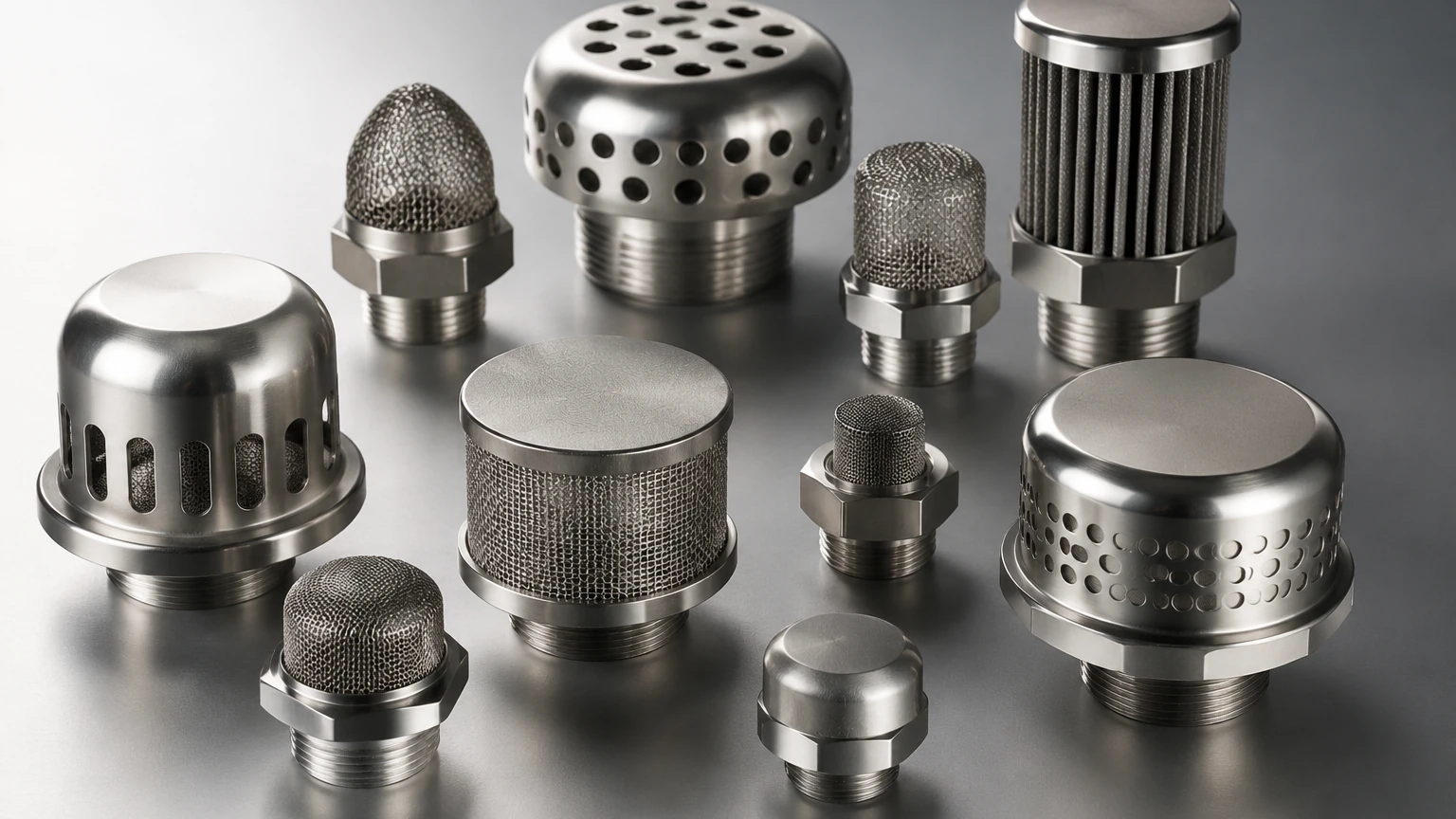
1. Wire Mesh Breathers: These utilize multiple layers of stainless steel wire cloth. They are ideal for high-flow applications where the primary concern is large particulate and debris. They offer very low pressure drop and are extremely easy to maintain.
2. Sintered Metal Vents: Created by fusing metal powders or fibers, sintered elements provide a tortuous path for air, offering high filtration precision. They are excellent for fine particulate control and can be engineered with specific porosities to manage air diffusion.
3. Pleated Element Breathers: By pleating the stainless steel mesh, the surface area is significantly increased. This allows for higher dirt-holding capacity and longer service intervals without increasing the overall footprint of the breather.
4. Vacuum Relief Vents: These are specialized components designed to remain closed until a specific vacuum threshold is reached. They are critical for protecting thin-walled tanks from atmospheric pressure during rapid discharge.
Key Performance Metrics and Selection Criteria
To ensure the selected breather or vent meets the operational requirements, purchasing and engineering teams should confirm the following technical specifications:
* Maximum Airflow Capacity: Measured in Standard Cubic Feet per Minute (SCFM) or Liters per Minute (LPM). This should exceed the maximum fluid displacement rate by a safety margin of at least 20%.
* Filtration Efficiency: The Beta ratio or micron rating. For critical systems, a high-efficiency (absolute rated) element may be required to maintain ISO 4406 cleanliness codes.
* Connection Type: Breathers are available with NPT, BSPP, or flanged connections. Ensuring a leak-proof interface is vital for preventing bypass.
* Environmental Conditions: Consider if the breather will be exposed to salt spray, heavy dust (such as in cement plants), or wash-down procedures in food processing. Specialized caps or shields may be necessary to prevent direct water ingress.
Maintenance, Durability, and Total Cost of Ownership
While the initial cost of a high-performance stainless steel breather may be higher than a disposable alternative, the total cost of ownership (TCO) is often significantly lower. A durable breather protects the much more expensive internal components of the system—such as pumps, valves, and the fluid itself.
Maintenance schedules should be based on the environmental dust load. In many cases, visual inspection of the differential pressure or a scheduled cleaning cycle is sufficient. Because stainless steel components do not degrade, they can remain in service for years, whereas disposable breathers must be replaced every 3 to 6 months, leading to higher labor and inventory costs.
Customization and OEM Integration
Every industrial system has unique constraints. Standard off-the-shelf breathers may not fit the available space or meet specific filtration requirements. Kaifil specializes in providing customized filtration solutions that address these challenges. From custom thread sizes and specialized housing shapes to multi-stage filtration media, OEM integration allows for a breather design that is perfectly matched to the equipment's lifecycle.
Customization also extends to the filtration media itself. Depending on the application, we can combine different mesh counts or sintering densities to achieve a specific balance between airflow and particle retention. This level of engineering ensures that the breather is not an afterthought, but a high-performance component of the overall system design.
Conclusion
Breathers and vents are essential components for the protection and efficient operation of industrial fluid systems. By preventing pressure imbalances and blocking the entry of harmful contaminants, they safeguard equipment and ensure process consistency. When selecting these components, engineers must prioritize material durability, accurate flow ratings, and long-term maintainability. Stainless steel solutions offer the reliability needed for the world's most demanding industrial environments.
For more information on our range of custom stainless steel filtration components and to explore how our engineering expertise can support your specific application, please visit our Main Page to review product options and application support.
