


V-bank Air Filters
In industrial environments where air quality directly impacts both process integrity and equipment longevity, the selection of filtration hardware is a critical engineering decision. V-bank air filters, often referred to as header-style or high-surface-area filters, represent a significant advancement in air handling technology. By leveraging a specific geometric configuration, these filters address the common conflict between high-efficiency particulate capture and the energy costs associated with air resistance.
For engineers and facility managers, understanding the technical nuances of V-bank air filters—ranging from their aerodynamic design to material compatibility—is essential for optimizing HVAC systems and industrial exhaust streams. As a specialist in custom filtration solutions, Kaifil provides the technical expertise necessary to integrate these high-performance components into demanding industrial frameworks.
The Engineering Principle of V-bank Geometry
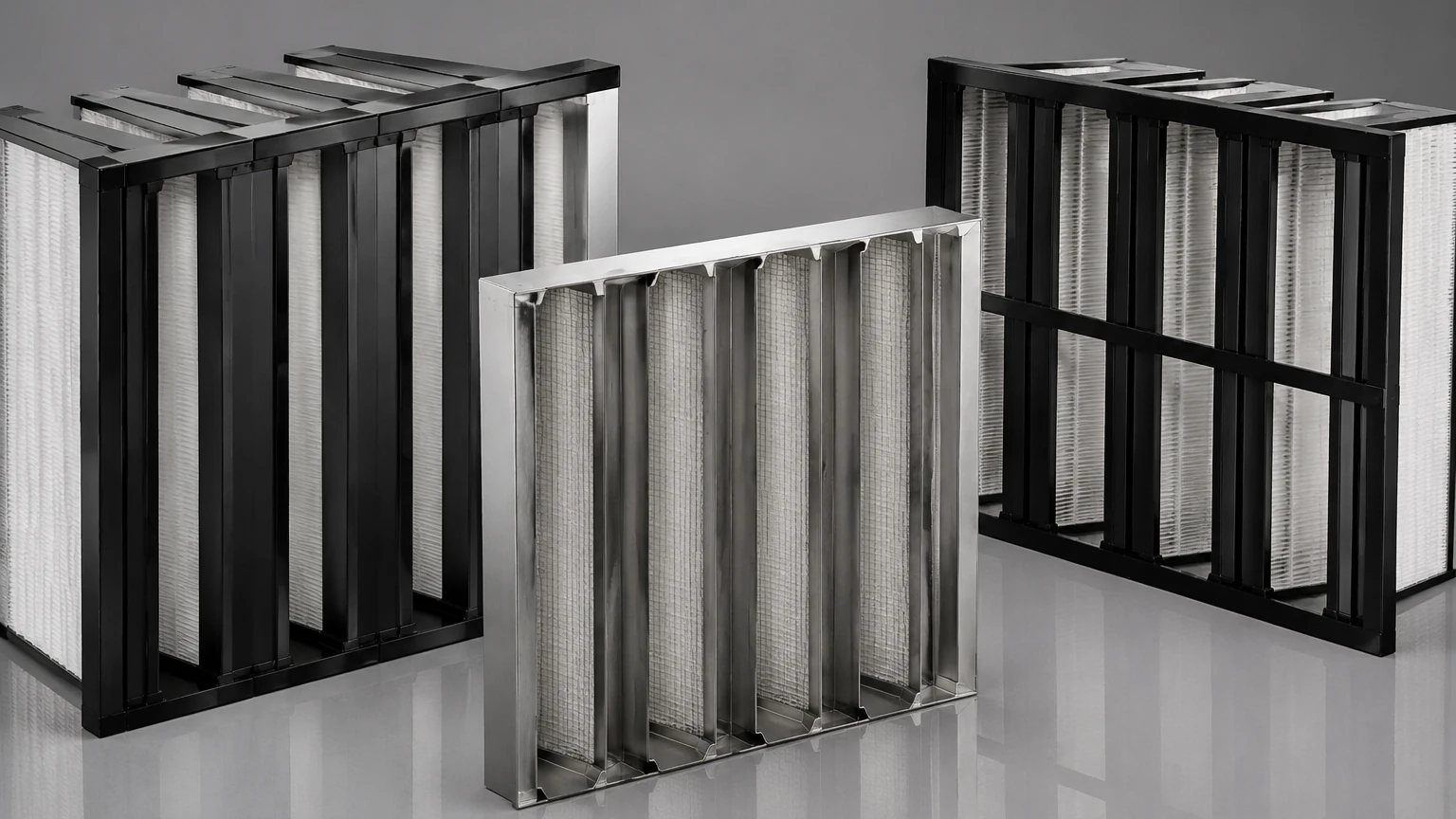
The defining characteristic of a V-bank air filter is its "V" shaped arrangement of pleated media packs. Unlike standard flat-panel or box filters, which utilize a single plane of filtration media, V-bank filters typically incorporate multiple mini-pleat packs (usually 2, 3, or 4 "V" shapes) within a rigid frame.
Surface Area and Airflow Velocity
This configuration exponentially increases the effective surface area of the filter without increasing its face dimensions. In filtration physics, the relationship between surface area and velocity is inverse: for a given volume of air (CFM), increasing the media surface area reduces the face velocity at which air passes through the material.
Lower face velocity results in several technical advantages:
1. Reduced Pressure Drop: The resistance to airflow (static pressure) is significantly lower, which reduces the energy load on fans and blowers.
2. Increased Residence Time: Slower airflow through the media allows for more effective capture of sub-micron particles through diffusion and interception.
3. Higher Dust Holding Capacity (DHC): With more physical space to trap particulates, the filter can operate longer before reaching its terminal pressure drop.
Technical Specifications and Performance Metrics
When evaluating V-bank air filters for industrial use, several performance metrics must be scrutinized to ensure the component meets the specific needs of the application.
Filtration Efficiency (MERV and HEPA)
V-bank filters are typically available in high-efficiency ranges, generally from MERV 11 to MERV 16, and into the HEPA (High-Efficiency Particulate Air) categories. For critical environments, such as pharmaceutical cleanrooms or semiconductor fabrication, V-bank HEPA filters are utilized to achieve efficiencies of 99.97% or higher for particles at 0.3 microns.
Pressure Drop and Energy Consumption
The initial resistance of a V-bank filter is often 30% to 50% lower than a standard pleated filter of the same efficiency rating. In a large-scale industrial HVAC system, this reduction translates into substantial kilowatt-hour savings over the filter's lifespan. Engineers should request the "Initial Resistance vs. Airflow" curve from the manufacturer to calculate the specific energy impact on their system.
Frame and Media Materials
The choice of materials is dictated by the operating environment:
* Filter Media: Most modern V-bank filters use synthetic micro-glass or high-durability synthetic fibers. These materials are moisture-resistant and designed to maintain pleat spacing even under high-velocity airflow.
* Frame Construction: While plastic (ABS) frames are common for standard HVAC, industrial applications often require galvanized steel or stainless steel frames. Stainless steel is particularly vital in food processing, pharmaceutical, and chemical environments where corrosion resistance and the ability to withstand rigorous cleaning protocols are required. For specialized requirements, reviewing technical options on the Main Page can help engineers identify the correct material grade for their housing and support structures.
Industrial Applications and Environmental Suitability
V-bank air filters are not universal solutions; they are engineered for high-volume, high-efficiency requirements. Their application is most prevalent in sectors where downtime is costly and air purity is non-negotiable.
Pharmaceutical and Biotech
In these industries, maintaining sterile air is a regulatory requirement. V-bank filters are used as pre-filters for terminal HEPA units or as primary filters in less critical zones. Their ability to handle high airflow while maintaining a compact footprint allows for more efficient air handling unit (AHU) designs.
Gas Turbines and Power Generation
Gas turbines require massive volumes of clean air to prevent blade erosion and fouling. V-bank filters are the industry standard for turbine intake systems because they can handle the extreme CFM requirements while providing the high-level filtration needed to protect multi-million dollar equipment.
Food and Beverage Processing
Contamination control is essential in food production. V-bank filters with antimicrobial media or specialized stainless steel frames are used to remove airborne pathogens and dust from processing areas, ensuring product safety and compliance with health standards.
Selection Criteria: A Guide for Purchasing Teams
Selecting the right V-bank filter involves more than matching dimensions. Purchasing teams and engineers should confirm the following technical details before procurement:
1. Nominal vs. Actual Dimensions: Ensure the filter fits the existing holding frames. Standard sizes are often 24"x24"x12", but actual dimensions may vary by a fraction of an inch depending on the manufacturer.
2. Face Velocity Rating: Most V-bank filters are rated for 500 FPM (Feet Per Minute), but high-capacity models can handle up to 750 FPM. Overloading a filter beyond its rated velocity will lead to premature failure and potential media blow-through.
3. Temperature and Humidity Limits: Standard filters are often rated up to 150°F (65°C). If the application involves high-heat exhaust or steam sterilization, specialized high-temperature media and metal frames (such as stainless steel) must be specified.
4. Gasket and Seal Integrity: To prevent bypass—where unfiltered air leaks around the filter—the quality of the gasket (typically EPDM or polyurethane) is paramount. In high-vibration environments, a seamless poured-in-place gasket is preferred.
Maintenance, Replacement Cycles, and Total Cost of Ownership (TCO)
While the initial purchase price of a V-bank air filter is higher than a standard panel or bag filter, the Total Cost of Ownership is often lower due to extended service life and energy savings.
Monitoring Pressure Drop
Industrial systems should be equipped with differential pressure gauges (such as Magnehelic gauges). The filter should be replaced when it reaches its "Final Resistance," which is typically twice the initial resistance or as specified by the system designer. Operating a filter beyond this point risks collapsing the media packs and significantly increasing energy costs.
The Impact of Pre-filtration
To maximize the life of expensive V-bank filters, it is common practice to use lower-cost G4 or MERV 8 pre-filters. These capture larger dust particles, allowing the V-bank filter to focus on the fine particulate matter it was designed to stop. This staged approach can extend the life of a V-bank filter by 50% or more.
Customization and Integration with Kaifil Solutions
In many industrial scenarios, off-the-shelf filtration products do not meet the specific spatial or chemical requirements of a process. This is where customization becomes a strategic advantage. At Kaifil, we specialize in the manufacturing of precision metal filtration components that often serve as the structural backbone or the final stage in complex air and liquid filtration systems.
Whether you require custom stainless steel frames to house V-bank media in a corrosive chemical plant, or specialized wire mesh pre-filters to protect high-efficiency banks from heavy particulate loads, our engineering team works to provide solutions that align with your specific performance targets. Our focus on durability and filtration accuracy ensures that your systems operate at peak efficiency with minimal maintenance intervention.
For engineers seeking to optimize their filtration systems or those requiring custom-engineered components for unique industrial applications, we invite you to review product options and application support on our Main Page. By combining the high-capacity benefits of V-bank technology with the robust construction of custom metal filtration components, industrial facilities can achieve a superior balance of performance and reliability.
