


Metal Screen Filter
In industrial processing, the efficiency of a filtration system often dictates the quality of the final product and the longevity of downstream equipment. A metal screen filter serves as a critical component in these systems, providing a robust, reusable, and precise method for separating solids from liquids or gases. Unlike disposable polymer filters, metal screen filters are engineered to withstand extreme temperatures, high pressures, and corrosive chemical environments, making them the preferred choice for heavy-duty industrial applications.
Kaifil, a professional manufacturer specializing in custom stainless steel filtration solutions, provides high-performance components designed to meet the rigorous demands of modern engineering. Understanding the technical nuances of metal screen filter design, material selection, and performance characteristics is essential for engineers and purchasing teams tasked with optimizing industrial processes.
Understanding Metal Screen Filter Construction and Weave Types
The performance of a metal screen filter is primarily determined by its construction method and the specific weave pattern used in the wire mesh. Industrial filters are typically fabricated from woven wire cloth, which offers a predictable and stable pore structure. The choice of weave affects not only the filtration accuracy but also the mechanical strength and flow resistance of the screen.
Plain Weave and Twill Weave
Plain weave is the most common construction, where each warp wire crosses over and under each shute wire. This provides a high degree of transparency and a consistent opening size, ideal for basic straining and high-flow applications. Twill weave, where wires cross over two and under two, allows for the use of heavier wires in a given mesh count, providing increased strength for high-pressure environments.
Dutch Weave Variations
For applications requiring finer filtration, Dutch weaves (Plain Dutch and Twill Dutch) are employed. These weaves feature a higher density of wires in one direction, creating a "tortuous path" for particles. This construction results in a much finer micron rating and superior mechanical stability, allowing the metal screen filter to capture smaller contaminants while maintaining structural integrity under backpressure.
Sintered Metal Screens
In environments where extreme mechanical stress or high-velocity flows are present, multiple layers of wire mesh may be sintered together. Sintering involves bonding the contact points of the wires through a high-temperature vacuum process without melting the metal. This creates a composite material that combines the fine filtration of thin mesh with the structural support of heavy mesh, ensuring the filter does not deform or experience "media migration" during operation.
Material Engineering: Selecting the Right Alloy
The durability of a metal screen filter is largely dependent on its material composition. While various metals can be used, stainless steel remains the industry standard due to its balance of cost, strength, and chemical resistance. At Kaifil, material selection is treated as a foundational engineering step to ensure compatibility with the process fluid.
Stainless Steel 304 and 316L
Stainless steel 304 is the general-purpose choice, offering excellent strength and basic corrosion resistance suitable for many food and beverage or industrial water applications. However, for more demanding environments, 316L stainless steel is preferred. The addition of molybdenum in 316L significantly improves resistance to pitting and crevice corrosion, particularly in chloride-rich environments or acidic chemical processing.
Specialty Alloys for Extreme Conditions
For applications involving highly aggressive chemicals or extreme temperatures (exceeding 500°C), specialty alloys such as Monel, Inconel, or Hastelloy may be required. These materials provide exceptional stability where standard stainless steels might fail due to oxidation or rapid chemical degradation. When selecting a metal screen filter, engineers must confirm the exact chemical composition and temperature range of the operating environment to prevent premature failure.
Performance Metrics: Micron Rating and Flow Dynamics
When evaluating a metal screen filter, two primary performance metrics must be considered: filtration accuracy (micron rating) and flow capacity (pressure drop). Balancing these factors is critical to achieving efficient filtration without compromising system throughput.
Absolute vs. Nominal Filtration
It is important to distinguish between absolute and nominal micron ratings. A nominal rating refers to the ability of the filter to retain a major percentage of particles of a certain size (e.g., 90% of 20-micron particles). An absolute rating, common in precision metal screen filters, indicates the largest opening in the mesh, guaranteeing that no particle larger than the specified size can pass through. For critical pharmaceutical or hydraulic applications, absolute ratings are often required to protect sensitive components.
Open Area and Pressure Drop
The "open area" of a screen is the percentage of the total area that is unoccupied by wire. A higher open area generally leads to a lower initial pressure drop and higher flow rates. However, increasing the open area often requires using thinner wires, which can reduce the filter's burst strength. Engineers must calculate the expected differential pressure across the metal screen filter to ensure that the system's pumps can maintain the required flow as the filter begins to load with contaminants.
For detailed technical data on flow rates and pressure drop calculations for specific mesh types, professionals can refer to the Kaifil Main Page to review product options and application support.
Customization Options for OEM Integration
Industrial filtration systems rarely utilize "off-the-shelf" solutions. Most applications require a metal screen filter that is customized to fit specific housing dimensions, flow patterns, or structural requirements. Customization involves more than just changing the size; it includes the engineering of the entire filter assembly.
Geometric Configurations
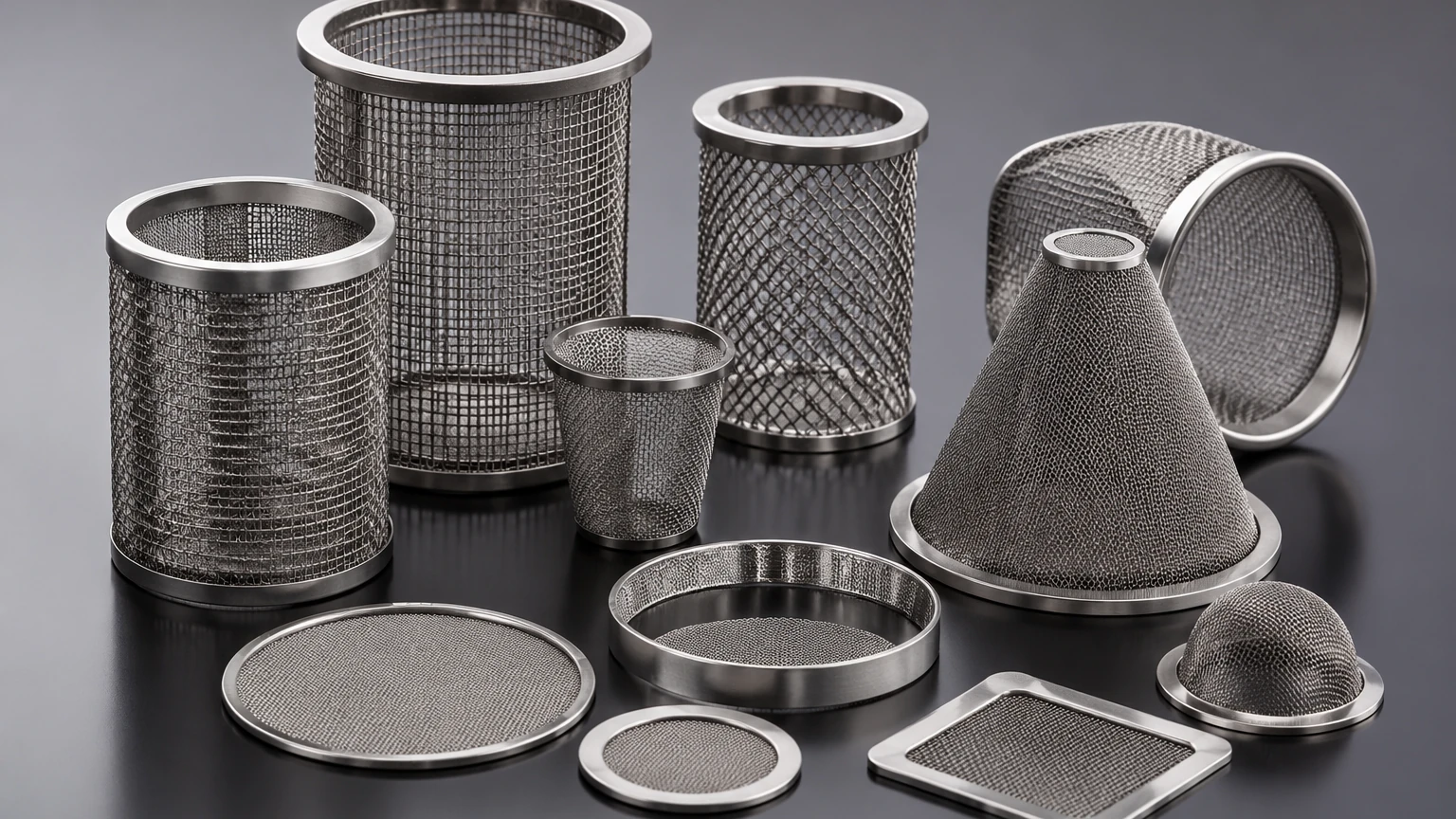
Metal screen filters can be fabricated into a variety of shapes, including cylindrical cartridges, flat discs, conical strainers, and pleated elements. Pleating is a common technique used to increase the effective filtration surface area within a compact footprint. By pleating the metal screen, the dirt-holding capacity is significantly increased, leading to longer service intervals and lower pressure drops.
Reinforcement and Support
In high-pressure applications, the fine filtration mesh is often supported by a perforated metal core or an outer shroud. This reinforcement prevents the mesh from collapsing or bursting under the weight of accumulated solids or sudden pressure spikes. Custom end caps, such as threaded fittings, flanges, or O-ring seals, are also integrated to ensure a bypass-free installation within the filter housing.
Industry-Specific Applications of Metal Screen Filters
The versatility of the metal screen filter makes it indispensable across a wide range of sectors. Each industry presents unique challenges that dictate the design of the filtration component.
* Chemical Processing: Filters must resist a broad spectrum of pH levels and temperatures. Stainless steel filters are used to remove catalysts, protect spray nozzles, and ensure the purity of intermediate chemical products.
* Food and Beverage: Hygiene is the priority. Metal screens used in this sector must be made from FDA-compliant materials and designed for easy cleaning (CIP/SIP) to prevent bacterial growth. They are commonly used in juice filtration, syrup processing, and dairy production.
* Pharmaceuticals: This industry requires high-precision filtration with strict adherence to material traceability. Metal screen filters are used in solvent recovery, active pharmaceutical ingredient (API) filtration, and sterile air venting.
* Hydraulics and Oil & Gas: High-pressure stability is essential. Metal screen filters protect sensitive valves and actuators from particulate wear, ensuring the reliability of heavy machinery and offshore drilling equipment.
Maintenance, Cleaning, and Total Cost of Ownership
One of the most significant advantages of a metal screen filter over disposable media is its cleanability. While the initial acquisition cost of a stainless steel filter is higher than that of a plastic or paper alternative, the total cost of ownership (TCO) is often much lower due to the extended service life and reduced waste.
Cleaning Methods
Depending on the nature of the contaminants, metal screen filters can be cleaned using several methods:
1. Backwashing: Reversing the flow of the fluid to dislodge particles from the surface of the screen.
2. Ultrasonic Cleaning: Using high-frequency sound waves in a cleaning solution to remove fine particles trapped deep within the mesh pores.
3. Chemical Cleaning: Using compatible solvents or acids to dissolve organic or inorganic scaling.
4. Burn-off/Pyrolysis: For polymer or organic buildup, the filter can be heated in a controlled environment to carbonize and remove the contaminants.
Determining Replacement Cycles
Although metal screens are durable, they are not infinite. Factors such as mechanical fatigue from repeated pressure cycling, erosion from abrasive particles, or gradual blinding that cannot be reversed by cleaning will eventually necessitate replacement. Monitoring the differential pressure (ΔP) is the most effective way to determine when a filter needs cleaning or replacement. A consistent increase in the baseline pressure after cleaning is a primary indicator that the filter media is reaching the end of its functional life.
Technical Evaluation: What Engineers Should Confirm Before Purchase
To ensure the successful implementation of a metal screen filter, procurement and engineering teams should confirm several key data points with the manufacturer. Providing accurate process information allows for the development of a solution that balances performance with cost-effectiveness.
Before finalizing a specification, consider the following:
* Fluid Characteristics: What is the viscosity, density, and chemical composition of the fluid? Are there any volatile components?
* Contaminant Profile: What is the expected particle size distribution? Are the solids hard, soft, or fibrous?
* Operating Parameters: What are the normal and maximum operating pressures and temperatures? What is the required flow rate?
* Installation Constraints: What are the physical dimensions of the housing? What type of seal or connection is required to prevent bypass?
* Compliance Requirements: Does the filter need to meet specific industry standards, such as PED, ASME, or FDA regulations?
By addressing these factors, engineers can select a metal screen filter that provides reliable, long-term performance in even the most demanding industrial environments. As a dedicated manufacturer, Kaifil supports these technical evaluations with deep expertise in material science and filtration engineering, ensuring that every custom component is optimized for its specific application.
