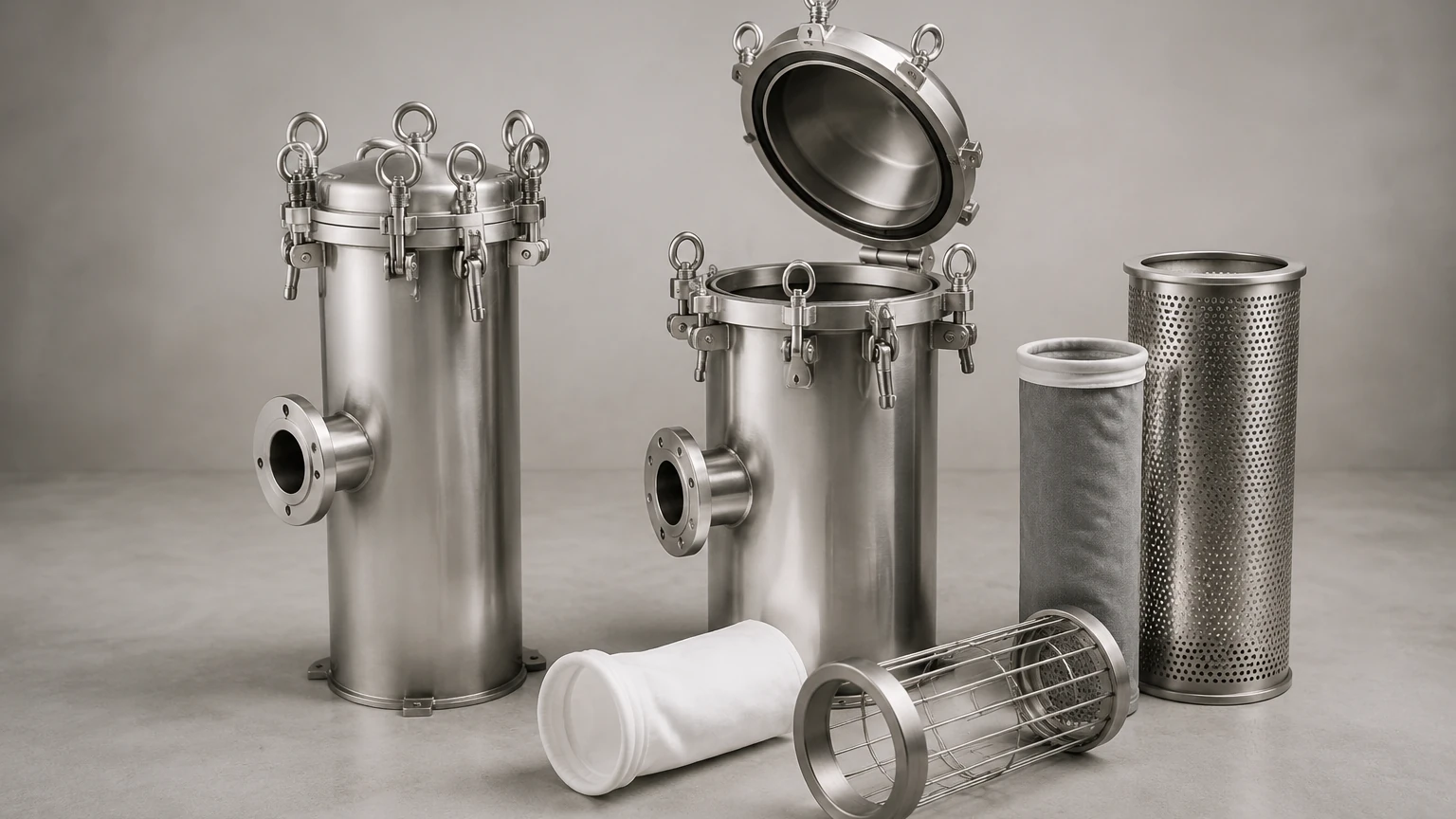
Industrial Bag Filter Housing
In the landscape of industrial liquid processing, the industrial bag filter housing serves as a critical pressure vessel designed to facilitate high-volume filtration with minimal downtime. For engineers and procurement specialists, selecting the correct housing is not merely a matter of matching pipe sizes; it involves a deep understanding of fluid dynamics, material compatibility, and the mechanical integrity required to withstand fluctuating operational pressures. As a professional manufacturer of custom stainless steel filtration solutions, Kaifil emphasizes that the performance of a filtration system is heavily dependent on the synergy between the housing design and the internal support components.
Engineering Fundamentals of Industrial Bag Filter Housings
An industrial bag filter housing is essentially a closed system where unfiltered liquid enters through an inlet, passes through a reinforced filter bag supported by a metal basket, and exits through an outlet. The primary objective is the removal of solid contaminants from a liquid stream.
Material selection is the first technical hurdle. Most industrial applications demand stainless steel due to its corrosion resistance and structural longevity. SS304 is often the standard for water treatment and general industrial use, providing excellent durability and cost-effectiveness. However, in chemical processing or pharmaceutical environments, SS316L is frequently mandated. The higher molybdenum content in SS316L offers superior resistance to chlorides and acidic environments, preventing pitting and stress corrosion cracking over long service cycles.
Beyond material grade, the pressure rating of the vessel must be verified against the system’s maximum operating pressure, including potential surges. Most standard housings are designed to meet specific pressure thresholds (such as 100 or 150 PSI), but specialized applications may require ASME-coded vessels to ensure compliance with safety regulations in high-pressure environments.
Key Evaluation Criteria for System Selection
When evaluating an industrial bag filter housing, technical teams must look beyond the external shell. The efficiency of the filtration process is dictated by several variables:
1. Flow Rate and Viscosity: The housing must be sized to handle the maximum flow rate (GPM or m³/h) without creating an excessive initial pressure drop. High-viscosity fluids, such as oils or resins, require larger housings or multi-bag configurations to maintain throughput while keeping the velocity through the filter media low enough to prevent particle breakthrough.
2. Micron Rating and Loading Capacity: While the bag determines the micron rating, the housing must accommodate the physical volume of the solids being removed. If the contaminant load is high, a single-bag housing will require frequent changes, leading to increased labor costs and process interruptions. In such cases, multi-bag housings are the preferred engineering solution.
3. Temperature Limits: The seals and gaskets (O-rings) within the housing must be compatible with the process temperature. While the stainless steel body can withstand high heat, standard Buna-N or EPDM seals may fail in high-temperature applications, necessitating the use of Viton or PTFE-encapsulated seals.
For more detailed technical specifications on filtration components, engineers can visit the Main Page to review product options and application support.
Design Configurations: Top-Entry vs. Side-Entry
The internal geometry of the industrial bag filter housing significantly impacts the ease of maintenance and the risk of fluid bypass. There are two primary configurations used in the industry:
* Side-Entry Housings: These are often the most common and economical. The fluid enters through the side of the head and travels over the top of the bag. While effective, they often require a heavy-duty hold-down device to ensure the bag remains seated. If not properly designed, there is a minor risk of "unfiltered bypass" if the bag shifts during a pressure surge.
* Top-Entry Housings: In a top-entry design, the fluid enters through the very top of the housing, directly into the center of the filter bag. This design allows for a 360-degree sealing surface. The pressure of the incoming fluid actually helps to seat the bag more firmly against the internal basket, virtually eliminating the risk of bypass. For high-purity applications in the food and beverage or pharmaceutical sectors, top-entry is often the preferred engineering choice.
The Role of Precision Internal Support Baskets
A bag filter is only as strong as the basket that supports it. Without a rigid internal structure, the differential pressure would cause the filter bag to burst or deform, leading to catastrophic system failure. This is where precision manufacturing becomes vital.
Industrial baskets are typically constructed from perforated stainless steel or heavy-duty wire mesh. The open area of the basket must be maximized to ensure it does not contribute significantly to the pressure drop, yet it must be structurally sound enough to support the weight of a fully loaded filter bag. Customization in basket design allows for the use of different mesh linings to provide secondary filtration or to accommodate non-standard bag sizes. At Kaifil, the focus is on providing these high-performance metal components that ensure the longevity of the entire filtration assembly.
Mitigating Operational Risks and Managing Maintenance
The most common risk in operating an industrial bag filter housing is neglecting the differential pressure ($ΔP$). As the filter bag collects debris, the resistance to flow increases. If the $ΔP$ exceeds the manufacturer’s recommended limit (typically 15-20 PSI), the bag may rupture, or the housing itself could be subjected to unnecessary mechanical stress.
To mitigate these risks, housings should be equipped with differential pressure gauges. Modern industrial setups often include automated sensors that trigger an alarm or bypass valve when the pressure threshold is reached.
Another risk is chemical incompatibility with the housing seals. Even if the stainless steel shell is resistant to the process fluid, a compromised O-ring can lead to external leaks or internal bypass. It is essential to perform a chemical compatibility check for all wetted parts, including the housing, the support basket, and the sealing gaskets.
Customization and OEM Solutions
Standard off-the-shelf housings do not always meet the unique requirements of complex industrial systems. Customization options often include:
* Surface Finishes: For sanitary applications, the internal and external surfaces of the housing may require electropolishing to achieve a specific Ra (Roughness Average) value, preventing bacterial growth and making the vessel easier to clean.
* Connection Types: While NPT threads or standard flanges are common, some systems require specialized sanitary tri-clamp fittings or custom DIN/ANSI flanges to integrate into existing piping.
* Multi-Chamber Designs: For continuous flow requirements, duplex filter systems allow one housing to be serviced while the other remains in operation, ensuring zero downtime.
By working with a specialized manufacturer, engineering teams can specify these details during the design phase, ensuring that the industrial bag filter housing is perfectly matched to the operational environment.
Total Cost of Ownership (TCO) Considerations
When purchasing filtration equipment, the initial capital expenditure is only one part of the equation. The Total Cost of Ownership includes:
1. Consumable Costs: How often will the bags need replacement? A poorly sized housing that causes bags to clog prematurely will drive up operational costs.
2. Labor and Downtime: How easy is it to open the housing? Quick-opening covers (such as V-clamp or swing-bolt closures) can significantly reduce the time required for bag changes compared to standard bolted covers.
3. Energy Consumption: A housing with a high inherent pressure drop forces pumps to work harder, increasing energy usage over the life of the system.
4. Durability: A high-quality stainless steel housing from a reputable manufacturer like Kaifil may have a higher upfront cost but will resist corrosion and mechanical fatigue for decades, whereas lower-quality alternatives may require replacement within a few years.
Conclusion: Technical Confirmation Checklist
Before finalizing the procurement of an industrial bag filter housing, engineers should confirm the following technical details:
* Fluid Properties: Confirm viscosity, temperature, and chemical pH.
* Flow Requirements: Ensure the housing size matches the peak flow rate with a low clean pressure drop.
* Material Certification: Request Mill Test Reports (MTRs) to verify the grade of stainless steel.
* Seal Compatibility: Match the O-ring material to the chemical and thermal profile of the process.
* Support Structure: Verify that the internal basket is constructed for the specific bag type and pressure load.
For industrial professionals seeking reliable, high-performance filtration components and custom stainless steel solutions, exploring the technical resources available on the Main Page is a recommended next step. By prioritizing engineering precision and material quality, facilities can ensure efficient, durable, and cost-effective filtration performance across all industrial applications.