


Oil Purification System
In industrial environments, the longevity and reliability of machinery are inextricably linked to the quality of the lubricants and hydraulic fluids used. Contamination is the leading cause of mechanical failure in hydraulic systems, turbines, and gearboxes. An oil purification system is a specialized assembly designed to remove solid particulates, water, and gaseous contaminants from industrial oils, thereby restoring the fluid to its required cleanliness level. For engineers and maintenance professionals, understanding the technical nuances of these systems—specifically the role of high-performance stainless steel filtration components—is essential for optimizing equipment uptime and reducing total cost of ownership.
Effective oil purification goes beyond simple filtration. It involves a systematic approach to fluid conditioning that preserves the chemical properties of the oil while eliminating harmful foreign substances. As a manufacturer of precision metal filter components, Kaifil provides the foundational hardware required for these systems to operate under high pressure and varying temperature conditions. To explore specific component specifications, professionals can visit the Main Page for detailed product data.
The Role of Filtration in an Oil Purification System
An oil purification system typically employs a multi-stage process to address different types of contaminants. The primary objective is to maintain the oil's ISO 4406 cleanliness code, which quantifies the number of particles at specific micron sizes (4μm, 6μm, and 14μm).
In a standard system, the process begins with a primary filtration stage, often utilizing coarse wire mesh filters to protect the pump and downstream components from large debris. This is followed by secondary and tertiary stages where finer stainless steel filter cartridges or specialized media remove microscopic particles. The use of stainless steel in these stages is critical because, unlike synthetic or paper media, precision-engineered metal mesh provides consistent pore geometry and structural integrity, ensuring that the filtration efficiency does not bypass under high differential pressure.
Furthermore, oil purification systems often incorporate dehydration technologies, such as vacuum dehydration or coalescing filters. In these configurations, the mechanical filter acts as a pre-filter to protect sensitive coalescing elements or as a post-filter to ensure that no media migration occurs after the dehydration process. The choice of filter component directly impacts the system's ability to handle high-viscosity fluids and maintain flow rates without excessive energy consumption.
Engineering Specifications for Filter Components
When designing or maintaining an oil purification system, engineers must evaluate several technical parameters to ensure the filtration components are compatible with the application. The material of construction is the first consideration. Stainless steel 304 and 316L are the industry standards due to their exceptional corrosion resistance and thermal stability.
Material Selection and Chemical Compatibility
Industrial oils often contain additives or may become acidic over time due to oxidation. Stainless steel 316L, with its addition of molybdenum, offers superior resistance to pitting and chemical attack compared to 304. This is particularly important in chemical processing or offshore environments where the oil purification system is exposed to harsh external conditions as well as aggressive internal fluids.
Structural Integrity and Pressure Ratings
Oil purification systems often operate under significant pressure. Filter cartridges must be engineered to withstand high collapse pressures. This is achieved through reinforced inner cores and outer support shrouds. For high-viscosity oils, such as those used in heavy gearboxes, the pressure drop (ΔP) across the filter media can be substantial. A well-designed stainless steel filter minimizes this initial pressure drop through optimized pleating techniques, which increase the effective filtration area without increasing the overall footprint of the cartridge.
Micron Ratings: Absolute vs. Nominal
In the context of an oil purification system, the distinction between absolute and nominal micron ratings is vital. A nominal rating is an indicative value, often representing the size of the smallest particle that the filter can trap at a specific efficiency (e.g., 90%). An absolute rating, however, indicates the diameter of the largest hard spherical particle that will pass through the filter under specified test conditions. For critical hydraulic systems, absolute-rated stainless steel mesh is preferred to ensure that no particles above the tolerance limit enter sensitive components like servo valves.
Addressing Different Types of Contamination
A comprehensive oil purification system must address three primary categories of contamination: solid particles, water, and air/gaseous contaminants.
Solid Particulate Removal
Solid particles act as abrasives, causing surface fatigue and erosive wear. Wire mesh filters manufactured by Kaifil utilize various weave patterns—such as plain weave, twilled weave, or Dutch weave—to achieve specific filtration characteristics. Dutch weave, for instance, provides a dense, tortuous path that is highly effective at capturing fine particulates while maintaining high mechanical strength. This is essential for the high-pressure circuits found in modern oil purification systems.
Water Contamination
Water in oil leads to corrosion, fluid oxidation, and the depletion of additives. It can exist in three states: dissolved, emulsified, or free water. While mechanical filters cannot remove dissolved water, they play a crucial role in coalescing systems. Fine stainless steel mesh can act as a particulate pre-filter, preventing the coalescer media from becoming blinded by solids, which would otherwise significantly reduce the water separation efficiency of the system.
Varnish and Sludge
As oil thermally degrades, it forms soft contaminants known as varnish. These sub-micron particles can plate out on cool surfaces or settle in low-flow areas. While specialized resins or cellulose media are often used for varnish removal, stainless steel filters are used as "polishing" stages to ensure that any agglomerated varnish particles are captured before the oil is returned to the reservoir.
Selecting the Right Mesh Type and Configuration
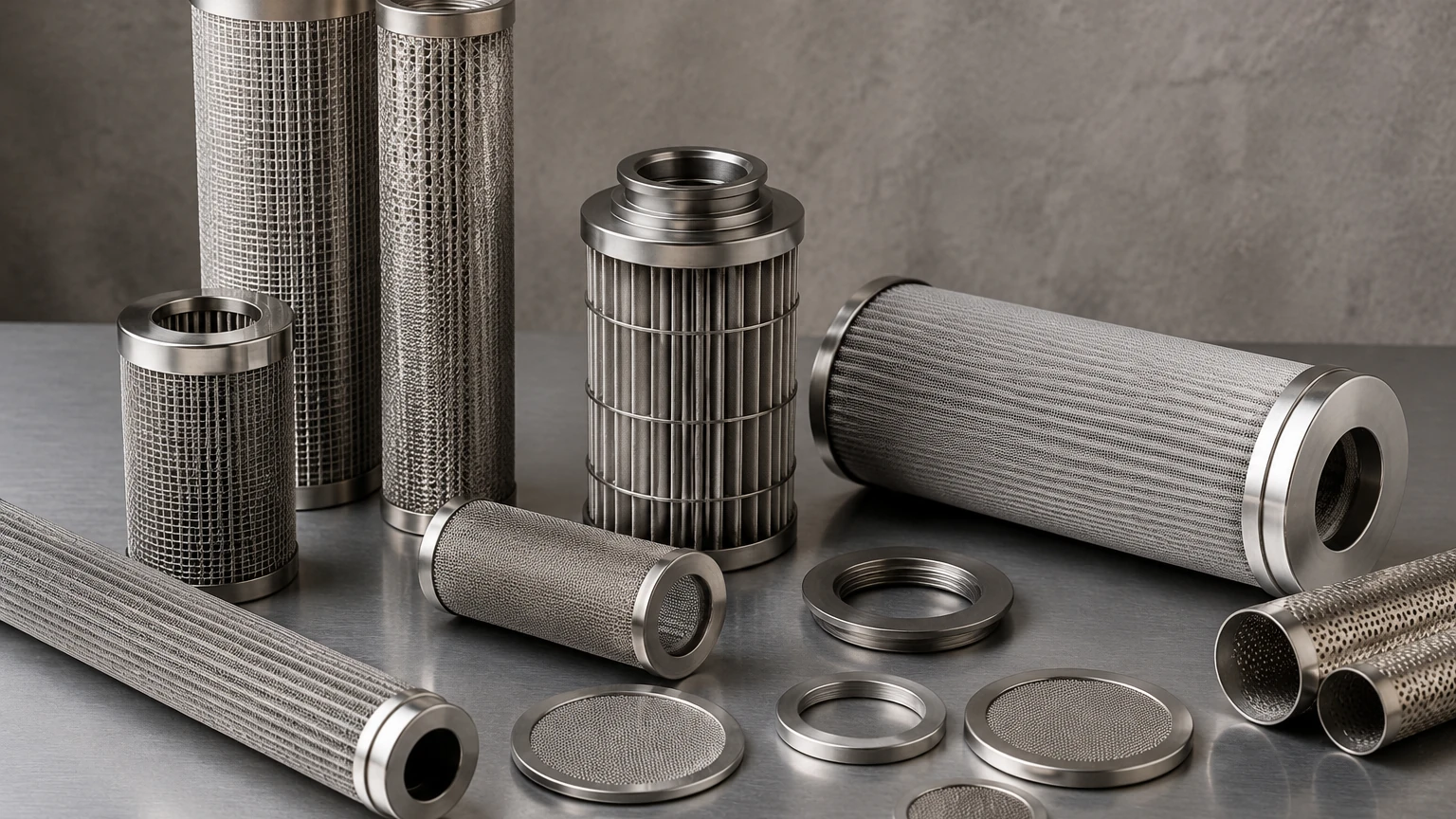
The performance of an oil purification system is largely dictated by the geometry of the filter media. For industrial oil applications, the most common configurations include:
1. Cylindrical Filter Cartridges: These provide a straightforward flow path and are easy to replace. They are often used in bypass filtration loops where a portion of the oil is continuously cleaned.
2. Pleated Metal Filters: By pleating the stainless steel wire cloth, the surface area is increased by 3 to 5 times compared to a cylindrical design. This results in a lower clean pressure drop and a higher dirt-holding capacity, which extends the service interval of the oil purification system.
3. Multi-Layer Sintered Mesh: For the most demanding applications, multiple layers of wire mesh are sintered together under vacuum. This process bonds the wires at every contact point, creating a robust, porous medium that combines the filtration accuracy of fine mesh with the structural strength of coarse support layers. Sintered mesh is ideal for systems that experience high-pressure surges or frequent backwashing.
Engineers must calculate the required flow velocity and compare it against the fluid's viscosity at operating temperature. High-viscosity oils require larger pore sizes or greater surface areas to prevent the system from entering a bypass state prematurely.
Maintenance and Cleaning of Stainless Steel Filters
One of the primary advantages of using stainless steel components in an oil purification system is their cleanability. Unlike disposable fiberglass or paper elements, which must be discarded once they reach their terminal pressure drop, stainless steel filters can be cleaned and reused multiple times. This not only reduces the environmental impact but also significantly lowers the long-term operational costs.
Cleaning Methods
* Ultrasonic Cleaning: This is the most effective method for removing fine particulates lodged deep within the mesh. High-frequency sound waves create cavitation bubbles that dislodge contaminants without damaging the delicate wire structure.
* Backwashing: In some automated oil purification systems, the flow is periodically reversed to flush out accumulated solids. Stainless steel mesh is uniquely suited for this due to its high fatigue resistance.
* Chemical Cleaning: For oils that have formed heavy sludge or varnish, compatible solvent baths can be used to dissolve the organic buildup before mechanical cleaning.
Replacement Cycles
While cleanable, metal filters are not infinite. Engineers should monitor the pressure drop across the filter. If the "clean" pressure drop after a cleaning cycle is significantly higher than the original specification, it indicates that the media is permanently fouled or that the pore structure has been compromised. Regular inspection of the mesh for signs of wire displacement or corrosion is essential to maintain the integrity of the oil purification system.
Total Cost of Ownership (TCO) Considerations
When evaluating the components for an oil purification system, the initial purchase price is only one factor. The Total Cost of Ownership (TCO) includes the cost of the filter element, the labor for replacement, the cost of disposal for contaminated elements, and the potential cost of machinery downtime.
Stainless steel filters represent a higher initial investment but offer a lower TCO over the life of the system. Their durability prevents catastrophic failures caused by media migration (a common issue with low-quality disposable filters), and their cleanability eliminates the recurring cost of purchasing new elements. Furthermore, the precise filtration offered by high-quality metal mesh ensures that the oil remains within specification for longer periods, reducing the frequency of oil changes and the volume of waste oil generated.
Integration with Modern Industrial Standards
Modern industrial operations are increasingly adopting Industry 4.0 principles, which involve real-time monitoring of fluid health. An oil purification system equipped with high-quality stainless steel filters provides a stable baseline for sensor data. Because metal filters do not shed fibers or deform under pressure variations, the particulate counts measured by online laser particle counters are more accurate, allowing for predictive maintenance strategies based on actual fluid condition rather than fixed time intervals.
Kaifil's commitment to manufacturing precision ensures that every component integrated into an oil purification system meets the rigorous demands of the chemical, pharmaceutical, and hydraulic sectors. By selecting the appropriate filtration hardware, engineers can ensure that their oil purification system provides consistent, reliable performance in even the most challenging industrial environments. For more information on custom filtration solutions and engineering support, please refer to the Main Page.
